









The best medical billing services for small practices in the USA cover insurance verification, medical coding, claim submission, denial management, accounts receivable (A/R) follow-up, credentialing, payment posting, and patient collections. These services help independent physicians and small medical groups manage reimbursement without building a large administrative department.
For most small practices, the priority is not outsourcing every billing task. It is identifying which part of the revenue cycle causes delayed payments, denied claims, or unnecessary staff work.
A solo physician may need help with medical coding and claim follow-up. A dermatology clinic may need stronger procedure coding and modifier review. A new family medicine practice may need payer enrollment before it can bill participating insurance plans.
This guide compares the ten best medical billing services for small practices, explains what they cost
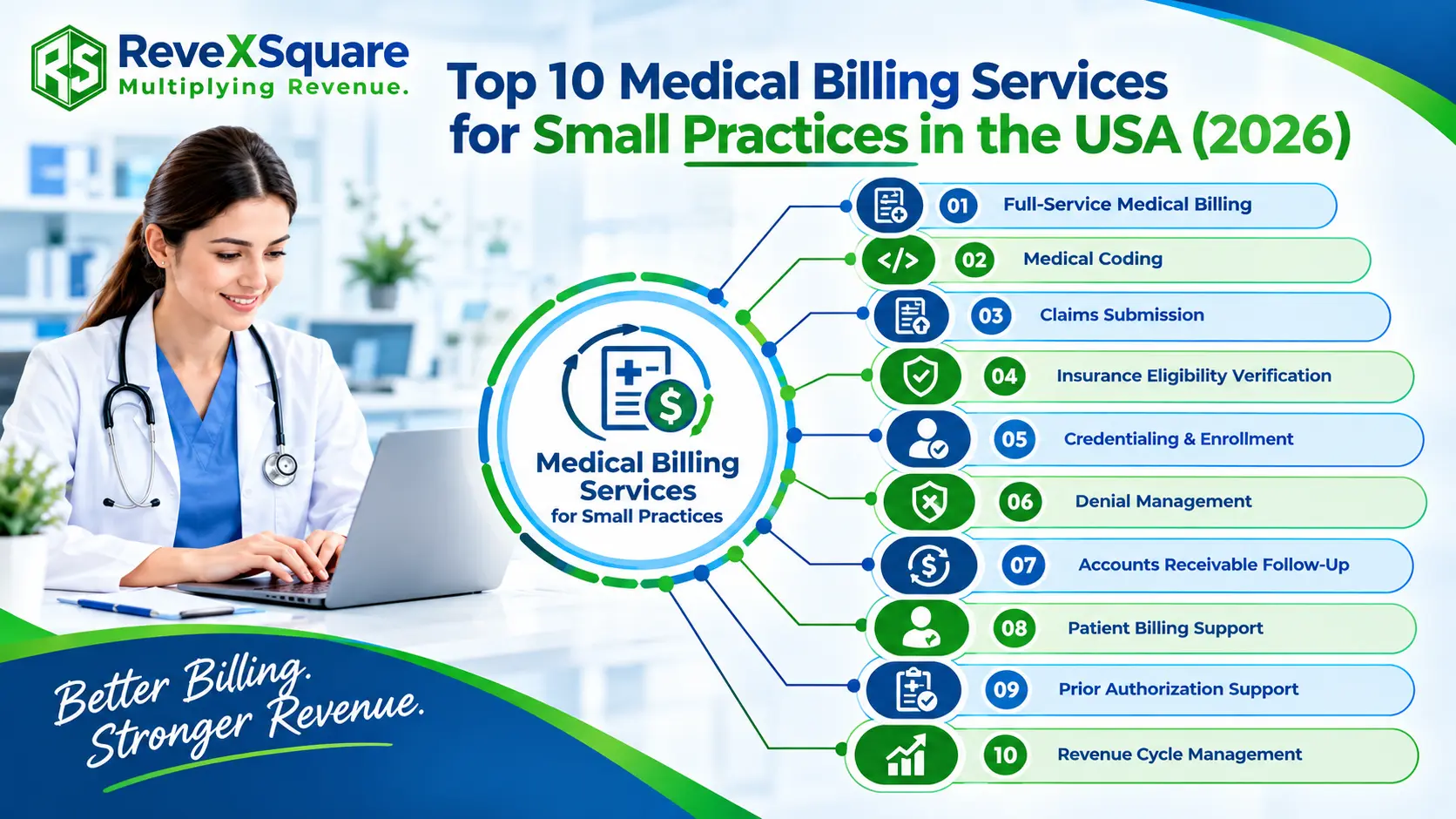
What Are the 10 Best Medical Billing Services for Small Practices?
The following comparison shows which services solve specific revenue cycle problems.
| Medical billing service | What it handles | When a small practice needs it |
| 1. Full-service medical billing | Complete billing workflow | Limited in-house billing staff |
| 2. Eligibility verification | Insurance coverage and benefits | Frequent coverage-related denials |
| 3. Medical coding | ICD-10-CM, CPT, HCPCS, and modifiers | Complex procedures or coding errors |
| 4. Claims submission | Claim preparation and clearinghouse processing | High rejection rates |
| 5. Denial management | Denial reviews, corrections, and appeals | Repeated insurance denials |
| 6. A/R management | Outstanding insurance balances | Unpaid claims and aging revenue |
| 7. Provider credentialing | Payer enrollment and participation | New physicians or practice expansion |
| 8. Patient billing | Statements and patient collections | Growing patient balances |
| 9. Payment posting | ERA/EFT reconciliation and adjustments | Payment or underpayment discrepancies |
| 10. Billing audits and analytics | Coding audits, KPIs, and reporting | Unclear financial performance |
The best medical billing services for small practices work best when these activities are connected. An error discovered during eligibility verification, for example, should reach the billing team before the claim is submitted.
Why Do Small Practices Need the Best Medical Billing Services?
Small healthcare practices face complex payer requirements without always having enough staff to manage every claim.
A billing specialist may be responsible for patient registration, claim entry, payment posting, denial appeals, and collection calls. When that employee is absent or claims become more complicated, unpaid balances can accumulate.
The financial pressure on independent physicians is well documented.
The American Medical Association’s 2024 Physician Practice Benchmark Survey found that 47.4% of physicians worked in practices with ten or fewer doctors, down from 61.4% in 2012.
Meanwhile, a January 2026 survey by the Medical Group Management Association (MGMA) asked 288 medical practice leaders to identify their biggest source of revenue cycle leakage.
| Revenue cycle problem | Share identifying it as the biggest problem |
| Denials and appeals | 48% |
| Front-end eligibility and related issues | 23% |
| Billing and collections | 14% |
| Coding | 13% |
| Charge posting | 2% |
These percentages describe respondents’ main concerns, not the proportion of claims denied nationwide.
The results highlight an important point: Submitting more claims does not necessarily solve a practice’s billing problems.
Practices need accurate patient information, correct coding, timely follow-up, and reliable financial reporting.
1. Full-Service Medical Billing and Revenue Cycle Management
Full-service medical billing covers the financial process from patient registration to final payment.
Rather than assigning different responsibilities to several employees, a practice can use a billing partner to coordinate charge entry, claim submission, payment posting, denial follow-up, and A/R management.
For example, consider a two-physician family medicine clinic.
The front desk collects patient information, physicians complete clinical documentation, and the billing team prepares and submits claims. If an insurer rejects a claim, someone must identify the error and correct it. If the payer accepts but does not pay the claim, follow-up is still necessary.
A complete revenue cycle management (RCM) service connects these steps.
What Should Be Included?
- Patient demographic and insurance validation
- Charge entry and claim preparation
- Coding review where contracted
- Electronic submission and claim tracking
- Rejection and denial follow-up
- Payment posting and reconciliation
- Outstanding accounts receivable management
- Monthly billing and collection reports
Best for: Solo physicians, small specialty practices, and growing medical groups that do not want to maintain a complete billing department.
Outsourcing should not remove a practice owner’s visibility into financial performance. The practice should still receive regular reports and retain appropriate access to billing information.
Explore Revex Square’s medical billing services.
2. Insurance Eligibility and Benefits Verification
Insurance verification confirms whether a patient has active coverage and identifies relevant benefit information before treatment.
This is particularly valuable for clinics with frequent appointments, high patient turnover, or complicated insurance requirements.
A patient can provide a valid insurance card but still have inactive coverage, an out-of-network benefit, or a service that requires prior authorization.
If the practice discovers the problem after treatment, payment may be delayed or denied.
An effective eligibility workflow should verify:
- Active coverage on the date of service
- Patient and subscriber information
- Provider network status where available
- Relevant copayments, deductibles and coinsurance
- Referral or authorization requirements
- Service-specific coverage limitations when available
Electronic eligibility transactions commonly use the HIPAA 270/271 format. These standards allow providers and insurers to exchange eligibility and benefit information.
However, eligibility verification is not a guarantee of payment. Medical necessity, correct coding, coverage conditions and other payer requirements still matter.
Best for: Primary care, behavioral health, physical therapy and other outpatient practices with recurring appointments.
Learn more about insurance eligibility verification services.
3. Medical Coding Services for Small Practices
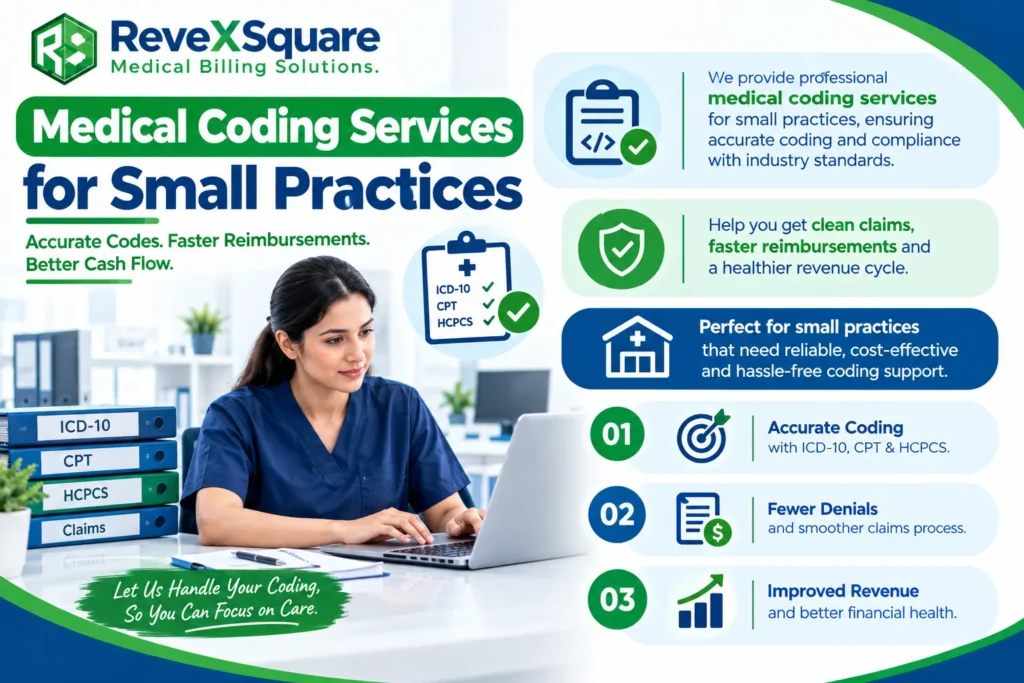
Medical coding converts documented healthcare services into standardized diagnosis and procedure codes.
Accurate coding supports proper claim submission, medical necessity reporting and appropriate reimbursement.
Small practices commonly use three coding systems:
| Code system | Purpose |
| ICD-10-CM | Reports diagnoses and medical conditions |
| CPT | Reports many professional services and procedures |
| HCPCS Level II | Reports additional services, supplies and products |
The challenge often increases with specialty-specific procedures.
A dermatology clinic may need accurate coding for biopsies, lesion removal and office visits. A cardiology practice may require more detailed reporting for diagnostic tests and procedures. Behavioral health providers must distinguish between different psychotherapy and psychiatric services.
An experienced medical coder should review the documentation and apply the correct codes and modifiers.
Example: Modifier 25
Suppose a physician performs a minor procedure and a separate evaluation during the same appointment.
Modifier 25 may be appropriate when the E/M service is significant, medically necessary and separately identifiable from the work included in the procedure.
It should not be added automatically whenever two services occur on the same date.
Why this matters: Incorrect modifiers, diagnosis mismatches and unsupported procedures can result in denials or compliance concerns.
Medical billing services for small practices should therefore include an appropriate coding review process, especially when the practice regularly performs procedures.
Explore medical coding services from Revex Square.
4. Electronic Claims Submission and Rejection Management
Electronic claim submission is the process of sending healthcare claims to insurance payers through an approved billing system or clearinghouse.
Before transmission, the billing team should verify that each claim includes the correct provider, patient, service, diagnosis and payer information.
A clearinghouse may identify missing or invalid information before the claim reaches the insurer.
This creates an important distinction:
A rejected claim generally fails a submission or validation requirement.
A denied claim has been adjudicated by a payer that determines payment is not due for some or all of the billed services.
The correction process is not always the same.
For example, an invalid subscriber identifier may cause a clearinghouse rejection. An insurer’s determination that a service is not medically necessary may result in a denial.
Good claim submission services should include claim validation, acceptance monitoring, timely correction of rejections and payer-specific filing controls.
Best for: Clinics experiencing repeated claim rejections, charge-entry errors or delayed submission.
5. Denial Management Services
Denial management involves identifying why insurance claims were denied and taking the appropriate action to resolve them.
For a small medical practice, denials can be particularly disruptive because administrative staff may have limited time to review payer policies, medical records and appeal deadlines.
A denial management specialist should examine the remittance advice, claim adjustment codes, medical documentation and applicable payer rules.
Common causes include:
- Incorrect patient or insurance information
- Missing prior authorization
- Diagnosis and procedure coding mismatches
- Unsupported medical necessity
- Duplicate submissions
- Incorrect modifier use
- Coordination of benefits issues
- Claim filing or appeal deadlines
Not every denied claim should be appealed.
Some require a corrected claim. Others may be unpayable under the applicable coverage rules.
The most useful denial management service does more than resolve individual claims. It identifies recurring problems and helps prevent them from happening again.
For example, if one insurer repeatedly denies a specific procedure because of missing authorization, the practice should review its authorization workflow before scheduling future services.
Best for: Practices with persistent denials, unresolved appeals or limited payer-follow-up capacity.
Learn about Revex Square’s denial management services.
6. Accounts Receivable Management
Accounts receivable represents payments still owed to the practice for healthcare services.
A claim may remain unpaid even when it has not been denied. The insurer may be processing it, requesting documentation or waiting for information.
A/R management helps practices identify these balances and take the correct follow-up action.
How Should a Small Practice Review Its A/R?
| Claim age | Recommended action |
| 0–30 days | Confirm acceptance and expected processing |
| 31–60 days | Investigate claims exceeding normal payer timelines |
| 61–90 days | Escalate unresolved claims and check deadlines |
| Over 90 days | Prioritize recoverable balances and investigate delays |
These aging categories are useful operational checkpoints, not universal payer processing or filing deadlines.
For medical billing services for small practices, the goal should be to identify which claims are still collectible, which have already been paid incorrectly, and which require appeals or other follow-up.
A practice should also know how much of its A/R is attributable to insurance companies versus patients.
Best for: Practices with substantial unpaid balances, irregular collections or limited follow-up staff.
Explore accounts receivable management services.
7. Provider Credentialing and Payer Enrollment
A new physician may be licensed to practice medicine but not yet enrolled with every insurance payer.
Credentialing and enrollment help establish a provider’s eligibility to participate in an insurance network and submit claims under the appropriate billing arrangements.
The process can involve verifying qualifications, submitting enrollment applications, updating provider information and monitoring effective dates.
Consider a family medicine group opening a second location.
Its existing physicians may have valid insurance contracts, but adding a new provider or location can require updates with participating payers.
If those updates are not completed properly, claims may encounter payment or participation problems.
Credentialing services are especially valuable for practices hiring physicians, nurse practitioners, physician assistants or other qualified healthcare professionals.
Best for: New clinics, expanding physician groups and practices changing ownership or locations.
Explore Revex Square’s provider credentialing services.
8. Patient Billing and Collection Services
Patient billing begins after the practice determines what portion of a medical bill the patient owes, based on the relevant services, insurer processing and applicable protections.
A patient may be responsible for a deductible, copayment, coinsurance or noncovered service.
The billing team should provide clear statements and a way to resolve questions or disputes.
Confusing bills may increase administrative work and delay payment.
Useful patient billing services include itemized statements, payment portals, support for billing questions, reasonable payment arrangements and appropriate follow-up.
For small practices, patient billing can consume significant front-desk time.
Outsourcing selected tasks may help the team remain focused on scheduling and patient-facing responsibilities.
Best for: Family medicine, urgent care, specialty clinics and practices with growing patient-responsibility balances.
Learn more about patient billing services.
9. Payment Posting and Reconciliation
Payment posting records payments received from insurers and patients.
It also identifies contractual adjustments, unpaid balances and potential reimbursement discrepancies.
Electronic remittance advice (ERA) provides information about how claims were processed, while electronic funds transfer (EFT) supports the transfer of payments.
For example, a payer may approve a procedure but pay less than the amount expected under the practice’s contract.
Without reconciliation, the billing team may not recognize the difference.
However, a lower payment does not automatically indicate an underpayment. Contractual adjustments and other legitimate payment rules must be considered.
Accurate posting helps the practice maintain reliable A/R records and investigate payments that do not match expected reimbursement.
Best for: Practices working with several insurance companies or managing large volumes of payments.
10. Billing Audits, Reporting and Automation
Medical billing audits examine whether the practice’s documentation, coding, claim submission and follow-up processes are working correctly.
A periodic audit may uncover claims submitted with missing modifiers, repeated eligibility problems or balances that no one has followed up on.
Automation can support administrative tasks such as eligibility checks, claim status inquiries and payment posting.
It cannot replace appropriate judgment in complex coding, medical necessity review or appeals.
Medical billing services for small practices should include meaningful reports that show both financial results and operational problems.
Useful measures include net collection rate, initial claim denial rate, first-pass acceptance rate, days in A/R and percentage of receivables older than 90 days.
Best for: Practices planning to expand, change billing vendors or improve revenue cycle visibility.
Real Case Studies: How Medical Billing Support Has Helped US Practices
Medical practices often want evidence before outsourcing billing.
The following examples come from published, named healthcare organizations. They demonstrate what structured revenue cycle support can achieve, although neither case represents results delivered by Revex Square.
Case Study 1: A Solo Internal Medicine Practice in South Carolina
Dr. Alyssa M. Degnan operated an independent internal medicine practice in Aiken, South Carolina.
According to an athenahealth case study, her practice struggled with coding responsibilities, billing delays and claim follow-up as patient demand increased.
She adopted expanded revenue cycle management and medical coding support.
The provider-published case study reported:
| Revenue cycle metric | Before | After |
| Days in accounts receivable | 28 | 17 |
| Denial rate | 4.4% | 1.8% |
| Overall collection yield | 87% | 95% |
What can small practices learn?
When a physician is handling complex billing tasks after clinical hours, the problem may be limited administrative capacity rather than patient demand.
Better coding and claims follow-up can make a meaningful difference, but results depend on the practice’s existing processes and circumstances.
Case Study 2: Troy Medical’s Revenue Cycle Improvements
Troy Medical, a primary care organization focused on rural communities, also worked with athenahealth to support coding and revenue cycle management.
Its published case study reports a 53% reduction in days in A/R, a 1.04% coding-related denial rate and a 93% average payer collection yield.
These are vendor-reported results from the organization’s experience, not guaranteed performance benchmarks.
What can small medical groups learn?
An expanding practice should consider whether its billing workflow can scale with provider count and claim complexity.
Technology and external support may improve capacity, but ongoing reporting remains essential.
Research Finding: Electronic Billing Can Reduce Administrative Work
The 2024 CAQH Index, summarized in Aetna’s electronic transaction savings analysis, estimated the following costs for common medical administrative transactions.
| Transaction | Manual cost | Electronic cost |
| Eligibility verification | $8.57 | $2.00 |
| Claim submission | $6.33 | $3.05 |
| Claim status inquiry | $13.80 | $3.64 |
These are industry estimates, not measured savings for a particular Revex Square client.
The figures show why practices should examine repetitive billing tasks. Even modest administrative costs can accumulate when staff repeatedly verify coverage, correct claims or contact insurers.
How Much Do Medical Billing Services Cost for Small Practices?
Medical billing pricing depends on several factors, including specialty, claim volume, payer mix, coding complexity and the scope of outsourced work.
Most contracts use one of three models.
| Pricing model | How it works | Consideration |
| Percentage of collections | A portion of defined collected revenue | Clarify which collections count |
| Per-claim pricing | A fixed charge for each claim processed | Confirm charges for corrections and resubmissions |
| Fixed monthly fee | A set recurring amount | Review volume limits and service exclusions |
Some providers combine these models or charge separate fees for credentialing, old A/R recovery, software or patient statements.
Revex Square advertises medical billing pricing starting as low as 2.75%. That is a starting offer, not a guaranteed rate for every practice.
Example: Understanding a Percentage-Based Fee
Suppose a physician practice collects $60,000 per month.
At an illustrative billing rate of 3%, its monthly billing fee would be $1,800, assuming the contract applies that percentage to all $60,000.
That amount does not include possible additional fees.
To compare in-house and outsourced billing fairly, include staff wages, benefits, software, training, clearinghouse costs, management time and any transition expenses.
Also compare performance. A cheap billing service is not good value if claims remain unresolved.
Review Revex Square’s medical billing pricing for information about obtaining a practice-specific quote.
In-House vs. Outsourced Medical Billing: Which Is Better?
The best choice depends on the practice’s existing resources and financial performance.
| Factor | In-house medical billing | Outsourced medical billing |
| Staffing | Managed by the practice | Managed by the vendor |
| Training | Practice responsibility | Vendor responsibility for its team |
| Software | Typically maintained by practice | Depends on the vendor arrangement |
| Follow-up capacity | Depends on staffing | Depends on contracted services |
| Direct supervision | Higher | Requires clear reporting and accountability |
| Costs | Salaries, benefits and infrastructure | Contracted fees and possible add-ons |
| Scaling | May require new employees | May offer flexible staffing capacity |
For a practice with one experienced biller and consistently strong collections, full outsourcing may not be necessary.
For a clinic where claim denials increase whenever billing staff are absent, external support could be worth evaluating.
A hybrid model is another option. The practice can retain front-desk and patient-facing tasks while outsourcing coding, denial management or A/R follow-up.
Which Medical Billing Services Should Your Practice Outsource First?
Different specialties have different billing problems.
| Practice type | Services to prioritize |
| Solo family physician | End-to-end billing, claims follow-up, payment posting |
| Small dermatology clinic | Procedure coding, modifier review, denial management |
| Behavioral health practice | Eligibility, authorizations, psychotherapy coding, patient billing |
| Physical therapy clinic | Visit authorization tracking, coding, A/R management |
| New multi-provider practice | Credentialing, enrollment, eligibility verification |
| Growing specialty group | Coding audits, denial analysis, reporting and scalable RCM |
This does not mean every practice in a specialty needs the same arrangement.
The correct starting point is an audit of your existing billing performance.
A physician group with accurate coding but poor A/R follow-up should not spend its entire budget replacing the coding process.
Similarly, a practice with frequent eligibility mistakes may see little benefit from adding more denial staff without first improving front-end verification.
The most effective medical billing services for small practices solve the actual cause of delayed reimbursement.
Seven Questions to Ask Before Hiring a Medical Billing Company
Before signing a contract, ask prospective billing providers:
- Do you have experience with our specialty? Request examples of relevant billing workflows and coding challenges.
- Who handles denied claims? Find out whether corrections, appeals and payer follow-up are included.
- Will we retain access to our billing data? Confirm reporting access, data ownership and transition procedures.
- Which EHR and practice management systems do you support? Ask how existing workflows will integrate.
- How do you protect patient information? Review access safeguards and the HIPAA business associate agreement.
- What does the monthly fee include? Confirm the treatment of old A/R, coding, credentialing and other services.
- How will performance be measured? Ask for sample reports and agreed service expectations.
Under HIPAA, vendors handling protected health information on behalf of a covered provider generally have business associate responsibilities. The US Department of Health and Human Services explains these requirements.
A practice should confirm the appropriate agreement and security arrangements before providing access to patient information.
Which Medical Billing KPIs Should Small Practices Track?
A reliable billing partner should provide reports that practice managers can understand.
| KPI | Why it matters |
| Net collection rate | Measures collection of eligible revenue |
| First-pass claim acceptance rate | Tracks claims accepted without initial rejection |
| Initial denial rate | Measures claims denied during payer adjudication |
| Days in A/R | Shows how long receivables remain outstanding |
| A/R older than 90 days | Identifies aging unpaid balances |
| Charge lag | Measures delay between service and charge processing |
| Appeal outcomes | Shows results of appropriate denial follow-up |
No single number tells the complete story.
For example, a high clean claim rate does not guarantee full payment. A claim may pass the clearinghouse and still receive a payer denial.
Medical billing services for small practices should produce reporting that makes these distinctions clear.
How Revex Square Supports Small Medical Practices
Independent physicians and small medical groups need billing support that fits their clinical and administrative structure.
Revex Square offers services across the revenue cycle, including medical coding, insurance verification, claim submission, denial management, provider credentialing, accounts receivable follow-up and patient billing.
These services are designed to help healthcare practices manage claims and outstanding balances while maintaining visibility into revenue cycle activity.
A practice considering outsourcing should begin by reviewing its current claims, denial reasons, collection trends and administrative costs.
From there, it can determine whether it needs complete medical billing support or assistance with specific areas.
For physicians looking for medical billing services for small practices in the United States, Revex Square provides a way to discuss these requirements and explore an appropriate service arrangement.
Need help managing unpaid claims, denials or medical billing operations?
Contact Revex Square to discuss your practice’s billing needs.
Frequently Asked Questions
What are the best medical billing services for small practices?
The most important services include coding, eligibility verification, claim submission, denial management, A/R follow-up and payment posting. Choose them based on your practice’s actual problems.
How much does medical billing cost for a small practice?
Costs vary by specialty, claim volume and service scope. Revex Square advertises pricing starting as low as 2.75%, subject to a customized quote.
Is outsourcing medical billing worth it for a solo physician?
It can be if billing staff costs, claim delays or administrative workloads are significant. Compare total outsourcing costs against your current expenses and collections.
Can Revex Square handle billing for a two-physician practice?
Revex Square offers medical billing support for physician practices and groups. Contact its team to confirm the best package for your specialty and claim volume.
Can a medical billing company reduce claim denials?
A qualified company can identify preventable billing errors, correct eligible claims and investigate recurring denials. It cannot guarantee approval of every claim.
Can I outsource medical billing without changing my EHR?
Often, yes. Confirm that the billing company supports your existing EHR or practice management system before signing.
Does Revex Square offer credentialing with medical billing?
Revex Square advertises both provider credentialing and medical billing services. Confirm whether credentialing is included in your proposed package or priced separately.
How long does it take to switch medical billing companies?
The timeline depends on EHR access, data migration, outstanding claims and the existing contract. A written transition plan helps prevent billing interruptions.
What happens to unpaid claims when changing billing companies?
Your contract should define who follows up on old A/R, handles existing denials and manages appeals. Confirm these responsibilities before the transition begins.
What information should I prepare before requesting a billing quote?
Prepare provider count, specialty, monthly collections, claim volume, payer mix, EHR details and available denial reports. This helps the billing company estimate scope and pricing.
Conclusion
Choosing the best medical billing services for small practices requires more than comparing monthly fees.
A physician practice needs accurate coding, timely claim submission, consistent denial follow-up and clear financial reporting.
Some clinics will benefit from outsourcing the entire revenue cycle. Others may need targeted support for credentialing, coding or unpaid insurance claims.
The strongest approach begins with understanding where reimbursement is delayed and selecting services that address those weaknesses.
Your practice should not have to guess what is happening to its unpaid claims.