









A new physician joins your practice on Monday. The schedule is full, and the first claims go out by Friday. Then the denials start, and the cause is rarely a coding error. More often, the payer never approved the provider.
Credentialing is the step that prevents this, and it is the step most practices start too late. This guide explains what credentialing is, how the process works, how long it takes, and how to avoid the mistakes that stall payment. If you would rather hand it off, our credentialing services team manages the full process.
Quick answer:
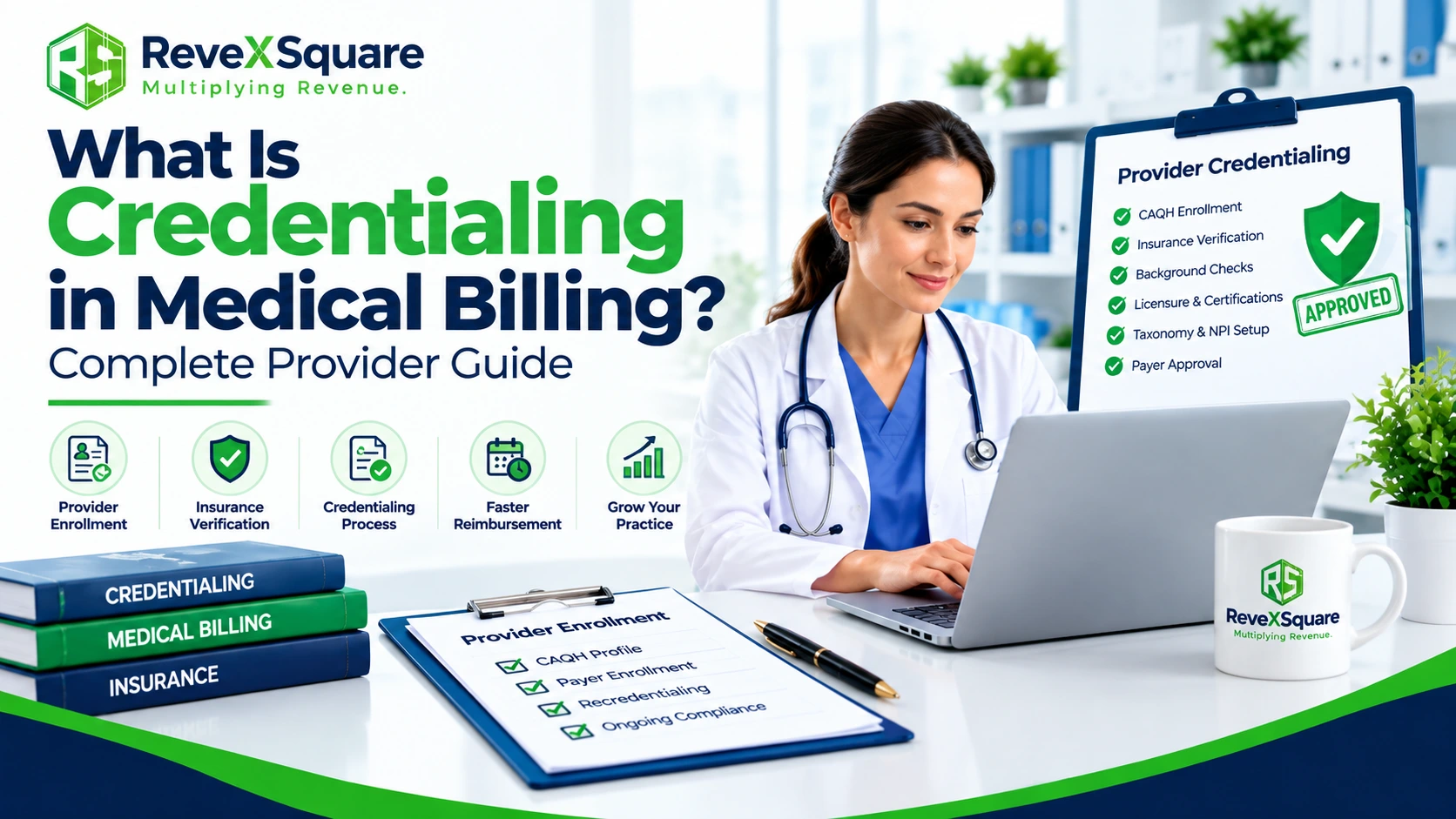
what is credentialing in medical billing? Credentialing is the process insurance payers use to verify a provider’s education, license, training, and work history. Once the payer verifies those details and approves the provider, the provider can join the payer’s network and be paid for covered services.
Key takeaways
- Credentialing verifies that a provider is qualified. Enrollment is a separate step that lets the provider bill a specific payer.
- Most commercial payers take 90 to 120 days. Medicare often takes 60 to 90 days.
- Providers must re-attest their CAQH profile every 120 days, and most payers re-credential every two to three years.
- Start 120 to 180 days before the provider’s first day, or you will pay salary with no billable visits.
What Is Credentialing in Medical Billing?
Credentialing is a formal review of a provider’s qualifications by a payer, hospital, or government program. The reviewer does not accept your word. It confirms each detail directly with the organization that issued it.
A standard review checks:
- Medical school and degree
- Residency and fellowship training
- State medical license
- Board certification
- DEA registration and state controlled substance certificates
- Work history and hospital affiliations
- Malpractice insurance and claims history
- Sanctions, exclusions, and disciplinary actions
Credentialing serves two goals. It protects patients by keeping unqualified practitioners out of networks. It also protects your cash flow, because payers will not reimburse a provider they have not approved.
Why Credentialing Affects Your Revenue
Credentialing sits at the start of the revenue cycle management process. If it fails, everything after it fails too. You can have perfect coding and clean claims and still collect nothing.
Here is how a credentialing gap hurts a practice:
- Delayed billing. You pay the provider’s salary but cannot bill the payer until approval arrives.
- Claim denials. Payers reject claims for any provider who is not active in their system on the date of service. See the common causes of claim denials for where this fits.
- Lost revenue. Many payers will not pay for visits that happened before the effective date. Medicare ties the effective date to the application filing date, with limited retroactive billing. Those dollars are often gone.
- Rework costs. Staff spend hours fixing, resubmitting, and appealing claims that should never have been denied.
Even strong denial management services cannot recover payment that was never payable. To see how denials begin and how to prevent them, read our denial management guide.
Credentialing vs. Enrollment vs. Privileging
These terms are often used as if they mean the same thing. They do not, and mixing them up causes missed steps and long delays.
| Term | Question it answers | Who handles it | Result |
|---|---|---|---|
| Credentialing | Is this provider qualified? | Payer, hospital, or credentialing verification organization | Verified provider |
| Payer enrollment | Can this provider join our network and bill us? | Payer’s contracting team | In-network status with a billing effective date |
| Privileging | What can this provider do at our facility? | Hospital medical staff committee | Approved clinical privileges |
| Certification | Has the provider passed a professional exam? | Certifying board (for example, a specialty board) | Board-certified status, which payers verify |
Credentialing comes first because it verifies the provider. Enrollment follows because it links the provider to the payer’s plans and fee schedules. Privileging applies to hospitals and facilities, not insurance billing. A surgeon can be fully credentialed and enrolled with Aetna and still need privileges before using a hospital’s operating room.
Types of Credentialing in Healthcare
Credentialing is grouped in two ways.
- By timing: initial credentialing happens when a provider first applies. Re-credentialing repeats the verification every two to three years.
- By who runs it: payer (insurance) credentialing decides network participation and payment. Hospital credentialing decides medical staff membership.
The word credentials itself usually covers three things: education (a medical degree), licensure (a state medical license), and certification (board certification or a specialty credential).
Documents You Need Before You Apply
Missing paperwork is the most common reason applications stall. Collect everything before you submit anything.
- Government-issued photo ID
- Current CV with month and year for every position (explain any gap longer than 30 days)
- Medical school diploma
- Residency and fellowship certificates
- Active state license(s)
- DEA certificate and state controlled substance registration
- Board certification
- National Provider Identifier (NPI) confirmation from NPPES
- Current malpractice insurance certificate
- Completed IRS Form W-9
- Practice details: tax ID, group NPI, service locations, and billing address
Keep digital copies in one folder and track expiration dates. Licenses, DEA registrations, and insurance policies all expire, and an expired document can freeze an application.
The Credentialing Process, Step by Step
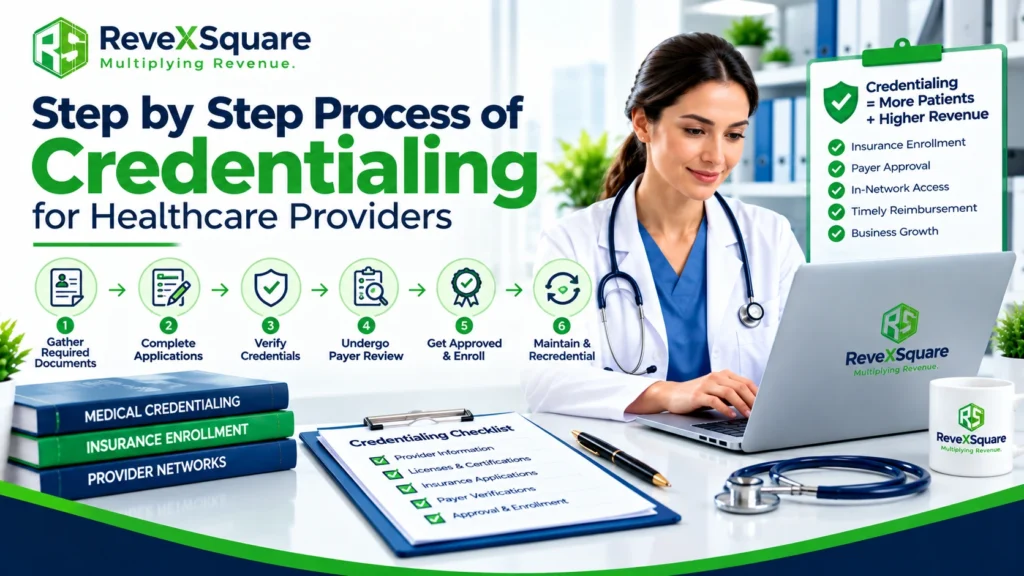
Each payer runs its own process, but the core workflow is the same everywhere. For a provider-side checklist, see our provider credentialing guide.
Step 1: Gather and check your documents
Start with the list above. Compare names, addresses, license numbers, and dates across every document. A mismatch between a license and an application is enough to trigger a rejection.
Step 2: Build and maintain your CAQH profile
The CAQH ProView database stores a provider’s credentialing data in one place. You enter your information once and authorize payers to view it, so you do not fill out a new application for each insurer. Providers must re-attest the profile every 120 days. An expired attestation can block payers from reviewing your application.
Step 3: Complete primary source verification
Payers do not accept photocopies as proof. Under primary source verification (PSV), they confirm each credential directly with the issuer: the state medical board for your license, the medical school for your degree, and the certifying board for your certification. They also search federal exclusion lists such as the OIG exclusion database. Standards from NCQA and The Joint Commission shape how thorough this step is.
Step 4: Submit payer applications
A complete CAQH profile does not enroll you anywhere. You still apply to each payer, such as Aetna, Cigna, UnitedHealthcare, and your state Medicaid program. Medicare enrollment goes through PECOS using the CMS-855 application. Rules and timelines differ by state, so check the state pages below.
Step 5: Follow up consistently
Submitting the application is not the finish line. Payers lose files, send requests to the wrong inbox, and leave questions unanswered. Call regularly, log every reference number, and answer every payer request within one to two days.
Step 6: Confirm your effective date and load the contract
When approval arrives, read the effective date carefully. It is the first date of service you can bill. Then confirm the provider is loaded in your billing system with the right NPI, tax ID, and fee schedule.
Once a provider is active, pair credentialing with eligibility verification services so every visit is checked against an active plan before the patient arrives. Our guide to insurance eligibility checks explains how.
How Long Does Credentialing Take?
Plan for months, not weeks. Credentialing typically takes 90 to 120 days with commercial payers and 60 to 90 days with Medicare. Timelines vary by payer, state, and how complete your application is.
| Payer type | Typical timeline |
|---|---|
| Commercial payers | 90 to 120 days, sometimes longer |
| Medicare | 60 to 90 days |
| Medicaid | Varies by state, often 45 to 90 days |
| Re-credentialing | 60 to 90 days |
These are general ranges, not guarantees. Start at least four to six months before a provider’s first day. If you wait until the offer letter is signed, you will pay a salary with no billable visits for a long stretch.
Common Credentialing Mistakes That Delay Approval
Most delays come from small, avoidable errors, not serious problems.
- Incomplete applications. One blank field can send the whole file back.
- Typos in key data. A wrong NPI digit or an outdated address causes mismatches.
- Expired CAQH attestation. Missing the 120-day window puts your application on hold.
- Unexplained work gaps. Payers want a reason for every gap beyond 30 days.
- Slow responses. A week of silence after a payer asks for a document can send you to the back of the queue.
- No follow-up. Applications do not move on their own.
- Ignored expiration dates. A lapsed license or malpractice policy halts everything.
Re-Credentialing: Do Not Let It Lapse
Approval does not last forever. Most payers re-credential providers every two to three years. They re-verify licenses, check sanctions, and confirm malpractice coverage.
If you miss a re-credentialing deadline, a payer can terminate your participation and deny claims. Build one calendar that tracks every payer deadline, license renewal, DEA expiration, and CAQH attestation date, and assign one person to own it.
In-House vs. Outsourced Credentialing
Many practices start in-house. That works for a solo provider with one or two payers. It breaks down fast as you add providers, locations, and plans.
| Factor | In-house | Outsourced |
|---|---|---|
| Payer knowledge | Staff learn each payer’s rules and forms | Specialists already know each payer’s quirks |
| Follow-up | Phone calls squeezed between front-desk and billing work | Dedicated follow-up on every file |
| Expiration tracking | Manual spreadsheet, easy to miss | Central tracking of licenses, DEA, CAQH, re-credentialing |
| Cost | Salary and training, plus delay cost if errors occur | Predictable fee |
Compare the fee with one month of lost billing for a single provider, and the decision gets easier. RevExSquare handles the entire process through its credentialing services, from document collection to final approval and re-credentialing. We also connect credentialing to your wider medical billing services, so claims go out under active, correctly loaded providers. Review the pricing plans before you decide, and read how to choose a medical billing company if you are comparing vendors.
Credentialing Best Practices Checklist
- Start 120 to 180 days before the provider’s start date
- Keep a master folder of current documents
- Re-attest CAQH every 120 days, and set reminders at day 100
- Use the same legal name, address, and NPI details everywhere
- Document every call with the date, representative name, and reference number
- Track effective dates for each payer separately
- Do not schedule a payer’s patients with a provider before the effective date, unless the payer’s rules clearly allow it
- Audit your credentialing files every quarter
Credentialing Support by State
Payer rules and Medicaid processing times differ by state. RevExSquare supports credentialing and enrollment in six states:
- Credentialing and enrollment services in Texas
- Credentialing and enrollment services in California
- Credentialing and enrollment services in New York
- Credentialing and enrollment services in Florida
- Credentialing and enrollment services in Illinois
- Credentialing and enrollment services in Indiana
Frequently Asked Questions About Credentialing
What are the two types of credentialing?
The two main types are initial credentialing and re-credentialing. Initial credentialing happens when a provider first applies to a payer or hospital. Re-credentialing repeats the verification every two to three years so the payer can confirm your license, certifications, and malpractice coverage are still current. Credentialing is also split by who performs it: payer (insurance) credentialing and hospital credentialing.
What is CAQH credentialing?
CAQH credentialing means storing your credentialing data in the CAQH ProView database and authorizing payers to view it. You build the profile once and re-attest every 120 days. CAQH does not approve you. Each payer reviews your profile and makes its own decision.
What is the credentialing process?
The process has six steps: gather documents, build and attest your CAQH profile, complete primary source verification, submit each payer application, follow up until a decision, and confirm your effective date. Most commercial payers need 90 to 120 days from a complete application.
What does getting credentialed mean?
Getting credentialed means a payer or organization has verified your qualifications and approved you. In billing terms, it lets you join a payer’s network, once enrollment is complete, and receive payment for covered services. Without it, claims are denied.
What does it mean to be credentialed at a hospital?
Hospital credentialing means the medical staff office verifies your license, training, and history, and a medical staff committee approves you for membership. Privileging is a separate step that decides which procedures you may perform there. Hospital approval does not enroll you with insurance payers.
What is an example of a credential?
A credential is proof of a qualification. Examples include a medical degree, a state medical license, board certification, residency completion, and a DEA registration. Outside medicine, a diploma or a professional certification such as a coding credential also counts.
What does a credentialing specialist do?
A credentialing specialist collects and verifies provider documents, maintains CAQH profiles, submits payer applications, and follows up until approval. They also track expiration dates and re-credentialing deadlines. The role depends more on detail and persistent follow-up than on clinical knowledge.
Do you need a degree to be a credentialing specialist?
Usually not. Many employers ask for a high school diploma or equivalent plus experience in medical billing, healthcare administration, or medical staff services. Some prefer an associate or bachelor’s degree. Requirements vary by employer.
How do you become certified in credentialing?
The most common U.S. certification is the Certified Provider Credentialing Specialist (CPCS) from NAMSS, the National Association Medical Staff Services. You apply, document your work experience, and pass a computer-based exam. Check the current NAMSS Candidate Handbook for eligibility rules before applying.
How long does credentialing take?
Plan for 90 to 120 days with most commercial payers and 60 to 90 days with Medicare. Medicaid varies by state, and re-credentialing usually takes 60 to 90 days. Start at least four to six months before the provider’s first day.
What are the three main types of credentials?
The three main types are education, licensure, and certification. Education covers degrees and training programs. Licensure is the legal permission to practice, such as a state medical license. Certification is proof of passing a professional or board exam. Payers verify all three during credentialing.
What do I put for credentials?
List your degree, license, and board certifications, with license numbers where a form asks for them. On a payer application, add your NPI, DEA registration, and malpractice coverage. On a CV or email signature, use the standard abbreviations, such as MD, NP, or CPCS, and only credentials you currently hold.
How do you answer “What are your credentials?”
Give your highest relevant degree, your license, and your certifications in one or two sentences, then add your years of experience. For example: “I am a licensed nurse practitioner, board-certified in family practice, with eight years in primary care.” Keep it specific and true.
Can you bill insurance before credentialing is complete?
Usually no. Most payers deny claims for dates of service before the provider’s effective date, and many will not pay retroactively. A few payers allow retroactive effective dates, but rules vary, so confirm in writing before scheduling that payer’s patients with the provider.
What is the difference between credentialing and certification?
Credentialing is a verification process run by a payer or hospital. Certification is a credential a provider earns by passing an exam from a certifying board. Board certification is one item a payer checks during credentialing. Certification can support credentialing, but it never replaces it.
How long does it take to get a CPCS certification?
There is no fixed timeline. First you need the work experience NAMSS requires, then you apply and sit for the exam during one of its scheduled testing windows. NAMSS has published application deadlines for three windows a year, so plan several months for applying, studying, and scheduling.
Conclusion:
Credentialing is the first checkpoint between your provider and every dollar they earn. Treat it as a revenue task, not a paperwork task. Start early, keep your data clean, follow up on every application, and track every renewal.
If your team is stretched thin or you are adding providers this year, let specialists take it off your plate. Contact RevExSquare or book an appointment for a free credentialing review, and get your providers approved faster so claims are paid on time.
Sources
Checked October 14, 2026:
- NAMSS exam fees (CPCS application fee, fees effective 2024)
- NAMSS certification FAQs (CPCS passing scaled score, question count, exam length)