









Medical coding errors can create problems long after a patient leaves the exam room. An incorrect diagnosis code, an unsupported procedure code, or a missing modifier can delay claim processing, lead to rework, or contribute to a claim denial. For busy healthcare providers, keeping coding accurate while managing daily operations is not always easy.
That is why many US healthcare practices consider whether to outsource medical coding services instead of handling every coding task in-house. Working with qualified coding professionals can help practices manage workloads, access specialized knowledge, and establish a more consistent review process.
But choosing a medical coding outsourcing company is not simply about finding the lowest price. Providers also need to understand coder qualifications, coding accuracy, data security, turnaround times, and how the service will fit into their existing workflow.
This guide explains how outsourced medical coding services work, why certified coders matter, what they cost, and how to choose a reliable partner for your practice.
What Are Outsourced Medical Coding Services?
Outsourced medical coding services allow healthcare providers to hire an external company or qualified coding professionals to review clinical documentation and assign the appropriate diagnosis and procedure codes.
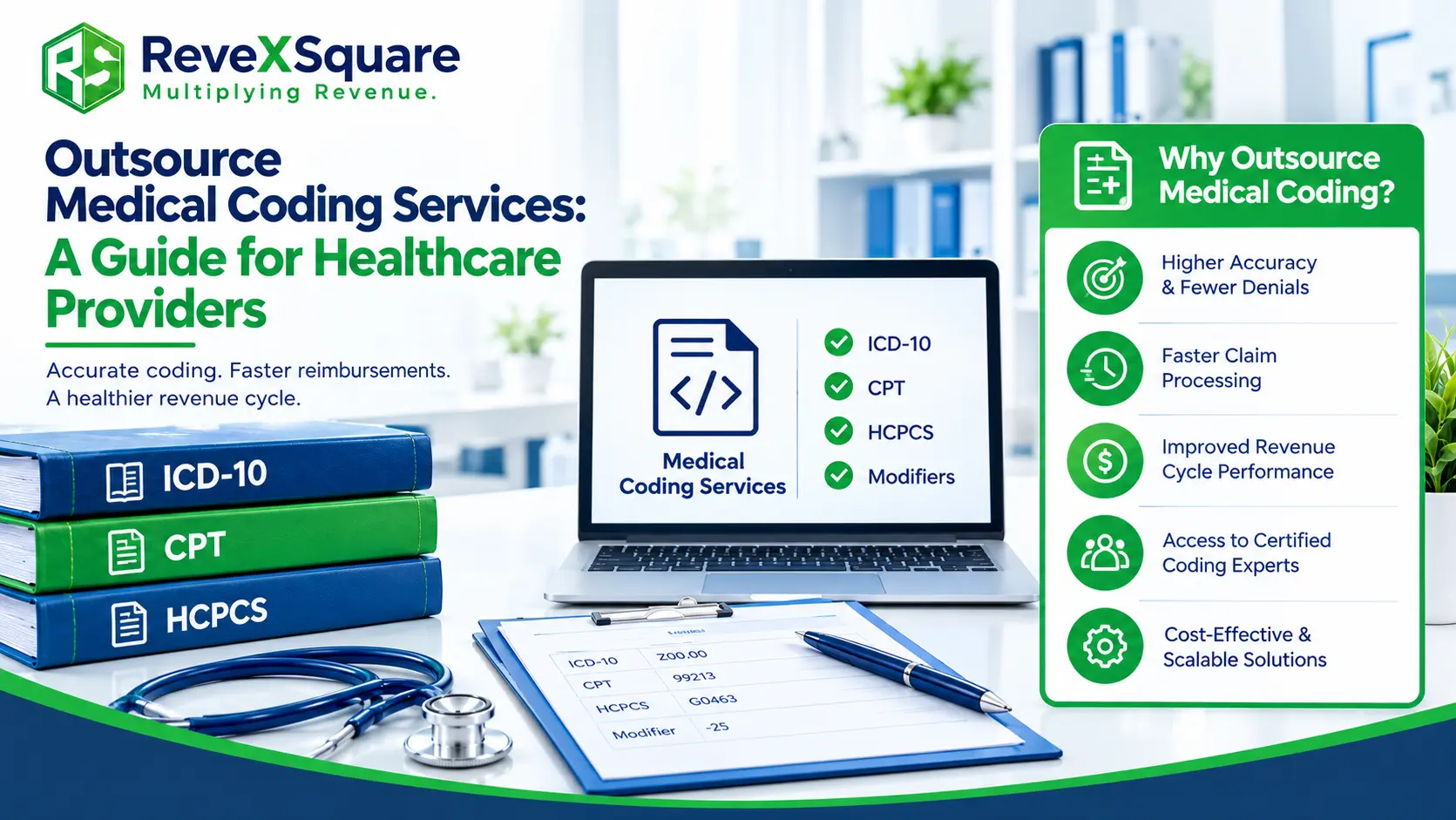
These codes communicate the conditions treated and services provided. Depending on the healthcare setting, coding may involve ICD-10-CM, ICD-10-PCS, CPT, and HCPCS code sets.
When a practice chooses to outsource medical coding, it may transfer its entire coding workload to an external team or outsource only selected tasks. Some practices need help with daily encounters, while others need support with a growing backlog, specialty-specific coding, or periodic coding audits.
A typical medical coding workflow includes:
- Reviewing physician notes and relevant clinical documentation.
- Identifying documented diagnoses, procedures, and services.
- Assigning codes that are supported by the medical record.
- Checking code specificity, sequencing, and applicable modifiers.
- Flagging incomplete documentation for clarification when necessary.
- Reviewing completed records before moving them into the billing workflow.
The goal is not simply to assign codes quickly. It is to make sure that the codes accurately represent the documented services and follow the applicable coding rules.
For official guidance, healthcare providers can consult the CMS ICD-10 coding resources.
Why Do Healthcare Providers Outsource Medical Coding?
Medical coding requires attention to detail, knowledge of coding guidelines, and an understanding of clinical documentation. When patient volume increases or an experienced employee leaves, an internal team may struggle to keep up.
Medical coding outsourcing can provide additional support without requiring a practice to recruit and train every coding professional itself.
1. Access to Certified Medical Coders
One of the main reasons providers outsource medical coding is to access professionals with relevant training, credentials, and experience.
Certifications such as the Certified Professional Coder (CPC), offered by AAPC, and the Certified Coding Specialist (CCS), offered by AHIMA, are recognized credentials in the medical coding field.
However, certification alone does not establish expertise in every specialty. A practice should also ask whether its assigned coders understand the documentation requirements, code sets, and workflows associated with its services.
For example, coding office visits for a family medicine practice differs from coding complex inpatient hospital records. The right experience depends on the work being performed.
2. Better Control Over Coding Quality
Coding problems may arise when documentation is incomplete, code selection is inconsistent, or applicable guidelines are misunderstood.
A professional outsourcing arrangement can include sample audits, peer reviews, coding guidelines, and regular feedback. These measures help identify recurring problems and give the practice a clearer picture of coding performance.
Outsourcing does not automatically guarantee higher accuracy. The outcome depends on coder qualifications, documentation quality, the vendor’s review process, and the practice’s own oversight.
3. Support During Staffing Shortages
Hiring an experienced coder can take time. Training a new employee also requires resources, particularly when the practice handles multiple specialties.
An outsourced team may help cover vacancies, manage temporary increases in volume, or clear a backlog of unprocessed records.
This flexibility can be useful for growing practices that need additional capacity but are not ready to hire permanent staff.
4. More Time for Daily Practice Operations
Practice managers already have to coordinate patient access, staff schedules, payer requirements, and administrative responsibilities.
When coding work becomes difficult to manage, other priorities can suffer. An external coding team can take responsibility for the agreed workload while the practice maintains oversight of documentation, compliance, and business decisions.
5. A More Organized Billing Workflow
Medical coding and medical billing are closely connected. Coding determines how documented diagnoses and services are represented, while billing uses coding and other claim information to prepare and submit claims.
When both functions communicate effectively, coding-related issues may be identified earlier in the claims process.
Practices that need broader operational support can also explore Revex Square’s medical billing services.
In-House vs. Outsourced Medical Coding: Which Is Better?
There is no single approach that works for every healthcare organization. The best choice depends on patient volume, coding complexity, staffing, budget, and the level of direct oversight required.
| Factor | In-house medical coding | Outsourced medical coding |
|---|---|---|
| Staffing | Requires recruitment and internal management | Provides access to an external team |
| Cost | Includes salaries, benefits, training, and management | Usually follows an agreed service or project fee |
| Flexibility | May require hiring as volume increases | Capacity may be adjusted through the contract |
| Specialty knowledge | Depends on the existing team’s experience | Can be selected according to vendor expertise |
| Oversight | Direct daily supervision | Requires clear reporting and communication |
| Security | Managed through internal systems and policies | Requires vendor due diligence and appropriate safeguards |
| Quality control | Designed and managed internally | Depends on documented vendor review procedures |
Which option should you choose?
A small practice with fluctuating coding volume may benefit from outsourcing selected tasks. A hospital with complex coding needs may prefer an experienced internal team or a hybrid arrangement.
Before deciding, compare the full cost of each option and evaluate actual coding quality. A lower service fee does not necessarily mean lower overall costs.
How Much Do Outsourced Medical Coding Services Cost?
The cost of outsourced medical coding services in the USA varies according to the specialty, number of records, complexity of encounters, turnaround requirements, and scope of work.
Some companies charge per chart, while others use hourly rates, monthly contracts, or project-based pricing. There is no universal rate that applies to every practice.
| Pricing model | How it works | Suitable for |
|---|---|---|
| Per-chart pricing | A fee is charged for each coded record | Practices with predictable chart volumes |
| Hourly pricing | The provider pays for coding time | Complex cases, audits, and variable workloads |
| Monthly agreement | A recurring fee covers agreed services or capacity | Practices needing ongoing support |
| Project-based pricing | A defined fee covers a specific assignment | Backlogs, temporary support, or coding reviews |
Before signing a contract, ask what the quoted price includes. Does it cover quality reviews, corrections, documentation queries, reporting, and onboarding?
You should also clarify minimum monthly volumes, turnaround expectations, contract length, and additional charges.
A useful comparison looks beyond the initial quote. Consider the total cost of the service alongside the quality, communication, and consistency your practice receives.
Why Certified Medical Coders Matter
Medical coding affects more than claim preparation. It also supports clinical data reporting, reimbursement processes, and compliance with applicable coding requirements.
Qualified coders understand how to interpret documentation, apply the appropriate code sets, and recognize when a record needs clarification.
Two commonly recognized credentials are:
- Certified Professional Coder (CPC): Offered by AAPC and commonly associated with professional medical coding.
- Certified Coding Specialist (CCS): Offered by AHIMA and associated with coding proficiency across applicable healthcare settings.
The appropriate credential depends on the role, care setting, and type of coding performed. Providers should verify current credentials and relevant experience instead of relying solely on a company’s marketing claims.
AHIMA provides information about the Certified Coding Specialist credential.
Questions to Ask About Your Coding Team
| Evaluation area | What to ask | Why it matters |
|---|---|---|
| Certifications | Which relevant credentials do assigned coders hold? | Helps verify professional qualifications |
| Specialty experience | Have they coded records similar to ours? | Different specialties have different documentation needs |
| Quality assurance | How are completed records audited? | Helps identify errors and recurring issues |
| Continuing education | How does the team stay current with code changes? | Supports the use of current coding guidance |
| Communication | Who handles documentation queries? | Keeps incomplete records from remaining unresolved |
A reliable outsourcing partner should be able to explain its process clearly and provide appropriate evidence of its qualifications and quality controls.
How Medical Coding Outsourcing Can Help Reduce Coding-Related Denials
A claim can be denied for many reasons, including eligibility issues, missing authorization, incomplete documentation, payer-specific requirements, and coding errors.
Outsourcing medical coding may help address the coding-related portion of this problem when the vendor follows appropriate guidelines and maintains effective quality checks.
Consider this illustrative example.
A physician documents a follow-up visit, but the record does not clearly support the service level initially being considered. A qualified coder reviews the documentation and follows the practice’s approved process to request clarification when necessary.
Rather than selecting a code that is not supported by the record, the coder helps ensure that the final coding decision reflects the documented service.
This type of workflow can help reduce avoidable corrections and improve consistency. It cannot eliminate all denials because many claim problems originate outside the coding process.
Coding Performance Metrics to Monitor
Do not evaluate an outsourced coding company only by the number of records it completes. Quality and turnaround should be measured together.
| Metric | What it tells you |
|---|---|
| Coding accuracy | How often audited coding decisions meet the agreed standards |
| Turnaround time | How long coding takes after a complete record is received |
| Rework rate | How often completed records need corrections |
| Documentation query rate | How frequently coders need clarification |
| Coding-related denial rate | How frequently claims are denied for identified coding issues |
Agree on the definitions of these metrics before the engagement begins. For example, a high query rate may reflect incomplete physician documentation rather than poor coder performance.
Likewise, a coding-related denial rate should be separated from denials caused by eligibility, authorization, or other unrelated issues.
HIPAA and Data Security: What Should You Check?
Medical records contain protected health information (PHI). Before sharing records with an external coding company, healthcare providers should understand how the vendor accesses, processes, stores, and protects that information.
Depending on the arrangement, a vendor that handles PHI on behalf of a covered entity may qualify as a business associate under HIPAA. A business associate agreement may be required.
Before onboarding a vendor, ask about:
- Role-based access and user authentication.
- Secure transmission and storage of patient information.
- Workforce confidentiality and security training.
- Incident reporting and breach-response procedures.
- Subcontractor oversight, where applicable.
- Data retention and secure disposal.
- Access monitoring and periodic security reviews.
A vendor’s statement that it is HIPAA compliant should not replace your own due diligence. Review the safeguards and contractual responsibilities that apply to your organization.
You can consult the HHS HIPAA resources for professionals for official guidance.
How to Choose the Right Medical Coding Outsourcing Company
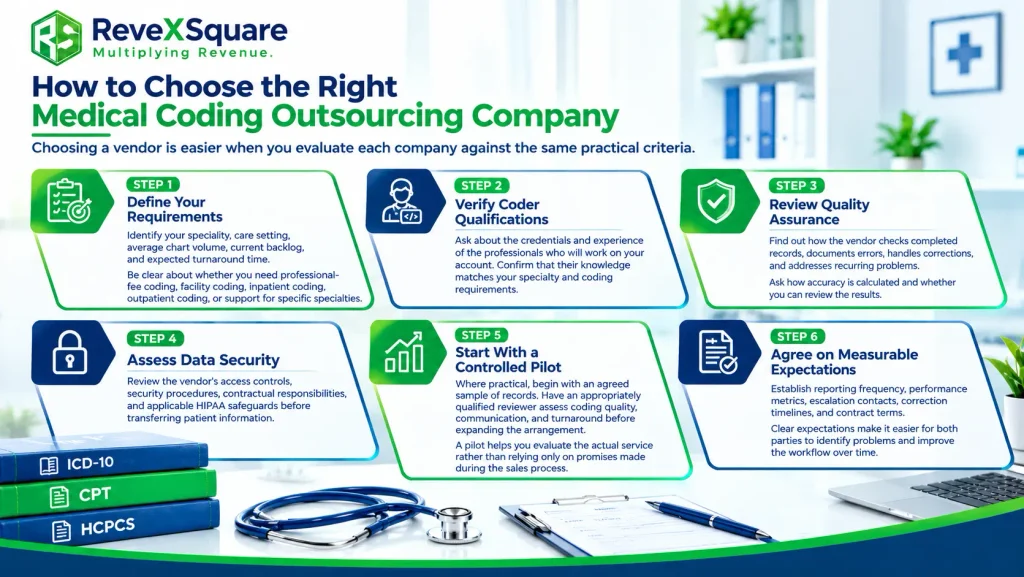
Choosing a vendor is easier when you evaluate each company against the same practical criteria.
Step 1: Define Your Requirements
Identify your specialty, care setting, average chart volume, current backlog, and expected turnaround time.
Be clear about whether you need professional-fee coding, facility coding, inpatient coding, outpatient coding, or support for specific specialties.
Step 2: Verify Coder Qualifications
Ask about the credentials and experience of the professionals who will work on your account. Confirm that their knowledge matches your specialty and coding requirements.
Step 3: Review Quality Assurance
Find out how the vendor checks completed records, documents errors, handles corrections, and addresses recurring problems.
Ask how accuracy is calculated and whether you can review the results.
Step 4: Assess Data Security
Review the vendor’s access controls, security procedures, contractual responsibilities, and applicable HIPAA safeguards before transferring patient information.
Step 5: Start With a Controlled Pilot
Where practical, begin with an agreed sample of records. Have an appropriately qualified reviewer assess coding quality, communication, and turnaround before expanding the arrangement.
A pilot helps you evaluate the actual service rather than relying only on promises made during the sales process.
Step 6: Agree on Measurable Expectations
Establish reporting frequency, performance metrics, escalation contacts, correction timelines, and contract terms.
Clear expectations make it easier for both parties to identify problems and improve the workflow over time.
Why Choose Revex Square as Your Medical Coding Partner?
Finding a medical coding partner is about more than transferring records to an external team. Healthcare providers need a service that fits their specialty, follows a structured workflow, and communicates clearly when documentation requires attention.
Revex Square offers medical coding support for healthcare providers looking to manage coding workloads and coordinate coding with their broader revenue cycle operations.
Here are several areas to discuss when evaluating Revex Square for your practice.
Medical coding support: Review the available services, code sets, and care settings on the Revex Square Medical Coding Services page. Confirm that the proposed scope matches your specialty and workflow.
Qualified coding professionals: Ask about the credentials, specialty experience, and quality review procedures of the professionals who would be assigned to your account. The right experience is especially important when your practice handles complex or specialty-specific records.
Connected billing services: Coding is one part of the claims process. Revex Square also provides medical billing services, which may be relevant if your practice is exploring support across coding and billing.
Broader revenue cycle support: Practices that need help coordinating coding, claims, and follow-up can review Revex Square’s revenue cycle management services.
A workflow suited to your practice: Discuss coding volume, turnaround expectations, reporting, documentation queries, data security, and performance measures before making a commitment.
The best way to determine whether Revex Square is the right partner is to evaluate its proposed service against your practice’s actual needs. Ask for clear information about qualifications, safeguards, quality controls, and how results will be measured.
To discuss your requirements, visit the Revex Square contact page.
Frequently Asked Questions About Outsource Medical Coding Services
1. What does it mean to outsource medical coding?
To outsource medical coding means hiring an external company or qualified coding professionals to review clinical documentation and assign appropriate diagnosis and procedure codes. The service may cover daily coding, selected specialties, coding backlogs, or periodic audits.
2. Why do healthcare providers outsource medical coding?
Healthcare providers outsource medical coding to manage workloads, access specialized expertise, support staffing needs, and establish structured quality checks. The benefits depend on coder qualifications, documentation quality, and the vendor’s performance.
3. Should an outsourced medical coding company use certified coders?
Healthcare providers should prioritize qualified coders with relevant certifications and specialty experience. CPC and CCS are examples of recognized credentials. Practices should also verify practical experience, continuing education, and the vendor’s quality assurance process.
4. How much do outsourced medical coding services cost in the USA?
Pricing depends on chart volume, specialty, complexity, turnaround requirements, and the contract structure. Common models include per-chart, hourly, monthly, and project-based pricing. Request a detailed quote that explains what is included and whether additional fees apply.
5. Can outsourced medical coding reduce claim denials?
Outsourced medical coding may help reduce denials caused by coding errors when the vendor uses appropriate guidelines and quality checks. It cannot prevent every denial because eligibility, authorization, documentation, and payer requirements also affect claim outcomes.
6. Is outsourced medical coding HIPAA compliant?
It can be structured to meet applicable HIPAA requirements when the parties implement appropriate safeguards, access controls, and contractual protections. A business associate agreement may be required, depending on the arrangement. Providers should verify the vendor’s practices before sharing protected health information.
7. What is the difference between medical coding and medical billing outsourcing?
Medical coding translates documented diagnoses and procedures into standardized codes. Medical billing uses coding and other claim information to prepare, submit, and manage claims. Some companies provide both services, while others specialize in one function.
8. How can I check the accuracy of an outsourced medical coding company?
Review audited coding accuracy, correction rates, turnaround times, and the process for resolving documentation questions. Agree on how accuracy is calculated and use regular sample audits to verify the vendor’s performance.
9. Can a small medical practice outsource only part of its coding workload?
Yes. Depending on the vendor’s service model, a practice may outsource overflow work, a specific specialty, coding backlogs, or periodic audits while keeping its existing coding team.
10. What should I look for when choosing a medical coding outsourcing company?
Look for relevant coder certifications, specialty experience, documented quality checks, appropriate data security, clear communication, transparent pricing, and measurable performance expectations. A controlled pilot can help you assess whether the service fits your workflow.
11. Why consider Revex Square for outsourced medical coding services?
Revex Square offers medical coding support alongside medical billing and revenue cycle services. Healthcare providers can review the available services, discuss their specialty and workload, and verify the proposed team’s qualifications, quality controls, and security arrangements before deciding whether the partnership is suitable.
12. How do I get started with Revex Square?
Start by identifying your specialty, monthly coding volume, current challenges, and required turnaround time. Then contact Revex Square to discuss your requirements and determine whether its available services are a suitable fit.
Conclusion: Choose Medical Coding Support That Prioritizes Accuracy
Deciding to outsource medical coding is about more than managing a busy workload. Healthcare providers need qualified coding professionals, accurate documentation review, appropriate data security, and a clear way to measure performance.
Before selecting an outsourcing company, compare its relevant credentials, specialty experience, quality assurance procedures, turnaround expectations, and total service costs. Monitor coding accuracy and coding-related denial trends over time so that decisions are based on evidence rather than marketing promises.
Revex Square offers medical coding services alongside medical billing and revenue cycle management support.
If your practice is considering outsourced medical coding, start by identifying the problems you need to solve, asking the right questions, and setting clear expectations. The right partner should help you build a more organized, transparent, and quality-focused coding workflow.