










The HO modifier is an HCPCS Level II modifier meaning “master’s degree level.” It identifies a rendering provider’s educational qualification when a health insurance payer requires that information for a covered service. It is most commonly relevant to certain Medicaid behavioral health programs, mental health services, and Applied Behavior Analysis (ABA) billing.
The HO modifier is not required for every master’s-level therapist. Its use depends on the clinician’s qualifications, the procedure code, and the insurer’s current billing policy.
For behavioral health practices, using the wrong provider-level modifier can result in denied claims, incorrect reimbursement, or additional payer review.
This guide explains the rules that matter in 2026/2027, including actual Medicaid and commercial insurance examples, code combinations, documentation requirements, and ways to correct billing errors.
What Does the HO Modifier Mean in Medical Billing?
HO means master’s degree level. It is a two-character modifier within the Healthcare Common Procedure Coding System (HCPCS) Level II code set maintained by the Centers for Medicare & Medicaid Services (CMS).
The procedure code tells the payer which service was provided. The modifier supplies additional information about the professional who performed it.
For example, a Medicaid program may require a licensed professional counselor to report a specific modifier when delivering an eligible behavioral health counseling service.
In that situation, the HO modifier helps identify the provider category used for claims processing.
It does not establish that the service is covered or that the clinician is independently eligible to bill.
HO Modifier at a Glance
| Billing question | Direct answer |
| What does HO stand for? | Master’s degree level |
| What code system includes HO? | HCPCS Level II |
| What does it identify? | Provider education level |
| Where is it commonly used? | Behavioral health, Medicaid, and certain ABA claims |
| Does every therapist need it? | No |
| Is it a professional license? | No |
| Can it affect reimbursement? | Yes, depending on the payer |
| Is it routinely required by Medicare? | No, not for standard professional psychotherapy claims |
CMS maintains the HCPCS Level II coding system, which includes modifiers used to supply additional billing information.
When Should You Use the HO Modifier?
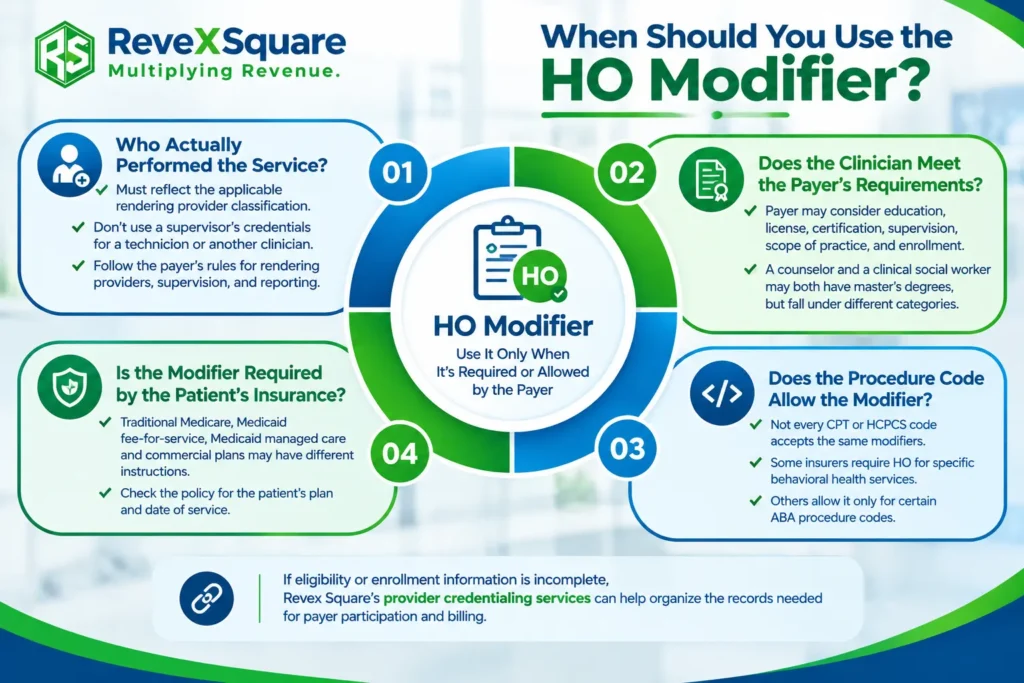
Use the HO modifier only when the payer requires or permits it for the billed procedure and the rendering clinician satisfies the applicable qualification rules.
A master’s degree does not automatically justify reporting it.
For example, a licensed marriage and family therapist may qualify for a master’s-level modifier under one state Medicaid program. Another payer may use a professional-type modifier instead or require no education-level modifier.
Before submitting a claim, the billing team should answer four questions.
1. Who Actually Performed the Service?
The modifier must reflect the applicable rendering provider classification.
A master’s-level supervisor’s credentials should not automatically be used for a service performed by a technician or another clinician.
The billing arrangement must follow the payer’s rules governing rendering providers, supervision, and reporting.
2. Does the Clinician Meet the Payer’s Requirements?
A payer may consider education, license, certification, supervision, scope of practice, and enrollment.
For example, a licensed professional counselor and a clinical social worker may both hold master’s degrees but fall under different professional categories.
3. Does the Procedure Code Allow the Modifier?
Not every CPT or HCPCS code accepts the same modifiers.
Some insurers require HO for specified behavioral health services. Others allow it only for certain ABA procedure codes.
4. Is the Modifier Required by the Patient’s Insurance?
Traditional Medicare, Medicaid fee-for-service, Medicaid managed care plans, and commercial insurers may have different instructions.
A practice should consult the policy applicable to the patient’s plan and date of service.
If eligibility or enrollment information is incomplete, Revex Square’s provider credentialing services can help practices organize the records needed for payer participation and billing.
Which Providers Can Qualify for the HO Modifier?
The HO modifier may be appropriate for certain master’s-level behavioral health professionals, provided the payer recognizes their professional category for the reported service.
Depending on the applicable program, these can include licensed professional counselors (LPCs), licensed marriage and family therapists (LMFTs), and other approved master’s-level clinicians.
In some ABA billing arrangements, the payer also identifies particular behavior analyst qualifications under HO.
A master’s degree and an approved rendering provider classification are not interchangeable.
A provider with the correct degree may still need a professional license, certification, enrollment approval, or documented supervision.
Likewise, a practice should not assume every professional with a master’s degree must use the same modifier.
The final determination comes from the relevant payer manual, provider agreement, and service requirements.
What Is the Difference Between HO, HN, HP, and HM Modifiers?
These HCPCS modifiers describe different educational levels.
| Modifier | Meaning | Typical purpose |
| HM | Less than bachelor’s degree level | Identifies certain lower educational classifications |
| HN | Bachelor’s degree level | Identifies eligible bachelor’s-level providers |
| HO | Master’s degree level | Identifies eligible master’s-level providers |
| HP | Doctoral degree level | Identifies eligible doctoral-level providers |
| HL | Intern | Identifies eligible intern-level services |
These are general modifier descriptions, not universal authorizations to perform or bill healthcare services.
For instance, a payer may classify a Registered Behavior Technician (RBT) under HN for a particular ABA procedure, even though the modifier’s general description refers to bachelor’s degree level.
That is why payer-specific instructions take precedence over a simple academic-degree comparison.
How Is HO Different From AJ, AH, and AF?
Some modifiers describe a professional category rather than education alone.
| Modifier | Description |
| HO | Master’s degree level |
| AJ | Clinical social worker |
| AH | Clinical psychologist |
| AF | Specialty physician |
A clinical social worker may have a master’s degree, but a payer may require AJ instead of HO.
Do not attach both merely because the provider appears to satisfy both descriptions. Use the combination required by the payer.
Which CPT and HCPCS Codes Can Be Billed With the HO Modifier?
There is no universal CPT code list requiring HO. Valid combinations depend on the payer, provider type, program, and date of service.
The following examples are supported by specific published payer policies.
| Procedure code | Service | Documented policy example |
| H0004 | Behavioral health counseling and treatment, per 15 minutes | Louisiana School-Based Medicaid Program |
| H0005 | Alcohol and/or drug services, group | Louisiana School-Based Medicaid Program |
| 90846 | Family psychotherapy without the patient present | Louisiana School-Based Medicaid Program |
| 90847 | Family psychotherapy with the patient present | Louisiana School-Based Medicaid Program |
| 90853 | Group psychotherapy | Louisiana SBMP and New York OASAS |
| 90849 | Multiple-family group psychotherapy | New York OASAS APG rules |
| 97153 | Adaptive behavior treatment by protocol | BCBS Texas modifier policy |
The table does not mean HO is required with every claim containing one of these codes.
Can You Bill H0004-HO for Behavioral Health Counseling?
Yes, when the applicable Medicaid program recognizes the clinician and requires that combination.
For example, Louisiana’s School-Based Medicaid Program lists HO as one of the applicable modifiers for H0004 when provided by the appropriate professional category.
The practice must also meet the program’s provider, documentation, and service-unit requirements.
Can You Use HO With CPT 90853?
Yes, under certain payer rules. Both Louisiana’s school-based program and New York’s OASAS APG framework identify circumstances involving HO and group psychotherapy.
However, the two programs apply different billing and reimbursement rules.
Do not transfer one state’s modifier requirements to another state’s claims.
Can HO Be Used With CPT 90834 or 90837?
Potentially, but only when the relevant payer recognizes the combination.
CPT 90834 and 90837 describe psychotherapy services; they do not independently establish a requirement to report the rendering clinician’s degree.
A master’s-level therapist should not automatically append HO to these codes on every claim.
Is the HO Modifier Required for Medicaid Billing in 2026?
Some Medicaid programs require it, but there is no nationwide rule requiring HO on all behavioral health claims.
Three published payer examples demonstrate how differently the requirement can operate.
Louisiana Medicaid: Which Behavioral Health Codes Require HO?
Louisiana’s Department of Health issued Informational Bulletin 26-01 for School-Based Medicaid Program services, effective February 2, 2026.
The bulletin requires an applicable professional modifier when certain psychotherapy and behavioral health procedure codes are reported by local educational agency providers.
For the specified program, HO identifies a licensed professional counselor or licensed marriage and family therapist in the applicable master’s-degree category.
The affected services include H0004, H0005, 90846, 90847, and 90853.
The department explicitly states that claims submitted without a required modifier will be denied.
For a school-based behavioral health organization, this means provider classification must be verified before claim submission.
Read the Louisiana School-Based Medicaid Program update.
This requirement applies to the identified School-Based Medicaid Program, not every Louisiana Medicaid behavioral health service.
Texas: How Does HO Affect ABA Billing Under BCBS Texas?
Blue Cross and Blue Shield of Texas updated its Modifier Reference Policy, RP023, effective October 19, 2026.
The policy identifies HO for certain ABA services billed with CPT 97153 when the rendering provider is a Board Certified Behavior Analyst (BCBA), BCBA-D, or an otherwise qualifying master’s-or-higher-level clinician.
It also states that when HO is not appended in the relevant circumstances, reimbursement defaults to the HM classification.
That means an omitted modifier may affect payment classification rather than automatically producing a denial.
A BCBA-led ABA clinic should verify the actual individual delivering CPT 97153, the applicable provider category, and the patient’s plan before submitting the claim.
The rule cannot be applied to every ABA code or every insurer in Texas.
See BCBS Texas Modifier Reference Policy RP023, effective October 19, 2026.
For clinics handling adaptive behavior treatment, Revex Square’s ABA therapy billing services address the relationship between rendering providers, service codes, authorizations, and payer requirements.
New York Medicaid: When Does HO Affect APG Reimbursement?
New York State’s Ambulatory Patient Groups (APG) modifier schedule identifies HO within certain mental hygiene reimbursement rules.
Under the Office for People With Developmental Disabilities (OPWDD), the state identifies HO as a master’s-degree modifier for applicable Article 16 rehabilitation counseling reporting.
For specified Office of Addiction Services and Supports (OASAS) group services, including CPT 90853 and 90849, the applicable licensed-practitioner modifier can influence payment.
New York’s published APG instructions explain that omitting an appropriate licensed-practitioner modifier in those circumstances results in payment without the specified enhancement.
This is a reimbursement rule associated with particular agencies and services—not a blanket requirement for every New York therapy claim.
Check the New York State Medicaid APG Modifier Schedule, revised July 1, 2026.
What Should a Multi-State Practice Track?
A behavioral health practice billing several Medicaid programs should maintain a payer-specific modifier reference.
| Information to record | Why it matters |
| State and Medicaid program | Rules differ across programs |
| Payer or managed care plan | Contract provisions may vary |
| CPT/HCPCS procedure | Not all codes accept the same modifiers |
| Rendering provider category | Determines qualification requirements |
| Required modifier | Prevents missing or incompatible modifiers |
| Effective date | Ensures the right policy is used |
| Policy source | Supports audits and billing decisions |
A single modifier template for all states can create avoidable errors.
Does Medicare Require the HO Modifier?
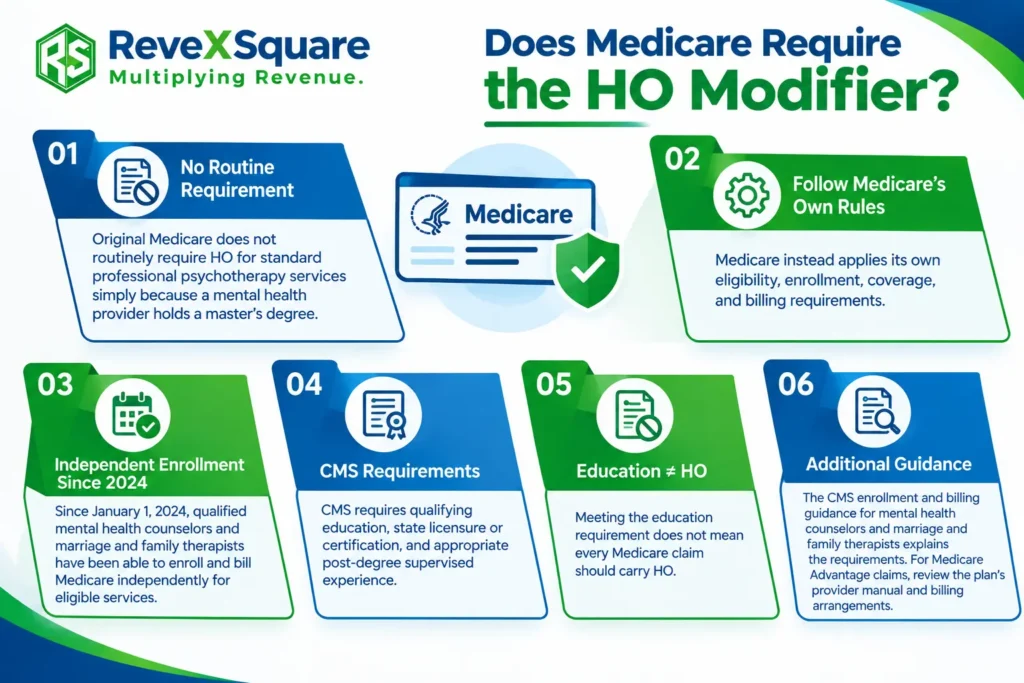
Original Medicare does not routinely require HO for standard professional psychotherapy services simply because a mental health provider holds a master’s degree.
Medicare instead applies its own eligibility, enrollment, coverage, and billing requirements.
Since January 1, 2024, qualified mental health counselors and marriage and family therapists have been able to enroll and bill Medicare independently for eligible services.
CMS requires qualifying education, state licensure or certification, and appropriate post-degree supervised experience.
Meeting the education requirement does not mean every Medicare claim should carry HO.
The CMS enrollment and billing guidance for mental health counselors and marriage and family therapists explains the requirements.
For Medicare Advantage claims, review the plan’s own provider manual and applicable billing arrangements.
Where Should the HO Modifier Be Entered on a CMS-1500 Claim?
On a paper CMS-1500 professional claim, HO appears with the procedure code in Box 24D. On electronic 837P claims, it is transmitted in the appropriate service-line procedure modifier fields.
Consider a qualifying H0004 claim under a Medicaid program that requires HO.
| Claim element | Example |
| Procedure code | H0004 |
| Modifier | HO |
| Service description | Behavioral health counseling |
| Rendering provider | Actual qualified clinician |
| Units | Based on documented service and program rules |
| Diagnosis | Supported ICD-10-CM diagnosis |
| Place of service | Actual eligible setting |
This is an illustrative claim structure, not a complete claim or a payer-independent billing instruction.
The billing team must also verify authorization, enrollment, unit calculations, and any additional modifiers.
CMS explains modifier reporting in its Medicare CMS-1500 and 837P claim field instructions.
Can HO Be Reported With a Telehealth Modifier?
Potentially. If the payer requires an education-level modifier and an applicable telehealth modifier, both may be necessary.
For example, the payer may require modifier 95 for an eligible real-time audio-video service and HO for the rendering clinician’s classification.
The practice must verify whether both are permitted, their sequencing, and the correct place-of-service reporting.
HO does not independently establish telehealth eligibility.
Can the HO Modifier Change Reimbursement?
Yes. Under certain payer policies, the HO modifier can affect the applicable provider-level reimbursement classification.
But there is no universal payment increase associated with it.
One insurer may use education-level modifiers to distinguish payment tiers. Another may use them mainly for administrative identification.
The October 2026 BCBS Texas policy provides a concrete example.
For the specified CPT 97153 circumstances, the policy explains that reimbursement defaults to the HM category when the appropriate HO modifier is omitted.
A practice should not assume that submitting HO always produces the same result under Medicaid or another commercial insurer.
The correct payment depends on the patient’s benefits, applicable payer policy, provider agreement, and claim details.
Why Do HO Modifier Claims Get Denied?
An HO-related claim may be rejected, denied, or paid under an unexpected classification when the modifier is missing, incorrectly applied, or inconsistent with payer records.
The most common areas to investigate include:
| Billing issue | What to verify | Next action |
| Required modifier missing | Procedure-specific payer rule | Correct an eligible claim |
| Invalid modifier combination | CPT/HCPCS and modifier compatibility | Review payer edits |
| Incorrect provider category | Degree, license, certification | Confirm rendering provider eligibility |
| Provider enrollment mismatch | Payer enrollment and billing identifiers | Correct verified information |
| Unsupported service units | Clinical notes and billing requirements | Reconcile documentation |
| Incorrect modifier order | Payer sequencing instructions | Submit correctly when permitted |
| Policy changed | Effective date and payer manual | Apply the rule for the service date |
How Should a Billing Team Fix an HO Modifier Denial?
The first step is to identify whether the problem involves the modifier, provider eligibility, documentation, or another billing requirement.
Review the electronic remittance advice (ERA) and relevant Claim Adjustment Reason Codes (CARCs) and remark codes.
Next, compare the claim with the rendering clinician’s qualifications, the documented service, and the payer’s current modifier policy.
If the original claim contains a correctable billing error, submit a corrected claim according to the payer’s rules.
If the claim was correctly submitted but incorrectly denied, evaluate whether a reconsideration or formal appeal is appropriate.
Do not add HO simply to get a denied claim through an edit. An unsupported modifier can create further compliance problems.
Practices with recurring modifier denials may benefit from a structured denial management process that tracks root causes, corrections, and payer follow-up.
What Does Published Research Tell Us About Behavioral Health Claim Denials?
Published research does not establish what percentage of US behavioral health claims are denied specifically because of the HO modifier.
However, research on behavioral health claims illustrates why administrative accuracy matters.
Research Example: Massachusetts Health Policy Commission, 2026
In February 2026, the Massachusetts Health Policy Commission published an analysis of commercial health insurance claim denials using 2024 data.
Approximately 3.8 million professional mental health claim lines were reported in the analyzed data, with an overall denial rate of about 10% for that category.
The commission also found that 67% of denied professional mental health claim lines fell into administrative denial categories, including incomplete claims, coding errors, duplicate claims or coverage, and other administrative reasons.
| Study finding | Reported result |
| Professional mental health claim lines | Approximately 3.8 million |
| Professional mental health denial rate | Approximately 10% |
| Share of denied mental health claims attributed to administrative reasons | 67% |
The findings are specific to Massachusetts fully insured commercial claims in 2024. They should not be interpreted as a nationwide Medicaid denial rate or evidence of HO-specific denials.
What does this mean for behavioral health practices?
Claim accuracy depends on more than one modifier. Provider details, documentation, coding, eligibility, and payer rules must work together.
Read the Massachusetts Health Policy Commission’s February 2026 analysis of insurance claim denials.
What Documentation Supports Correct HO Modifier Billing?
The claim should be supported by both the clinical service record and evidence that the rendering clinician meets the payer’s qualification requirements.
The medical record should establish which service was performed, the clinical reason, the date, the provider, and the time or units when applicable.
Provider records should confirm relevant education, licensure, certification, enrollment, and supervision arrangements.
This distinction is important because a clinical note can be complete while the provider classification on the claim is wrong.
For instance, an ABA practice might have a properly documented treatment session but assign a modifier based on the supervising BCBA rather than the professional who actually provided the service.
The claim must reflect the applicable rendering and supervision rules.
What Should Be Checked Before Submission?
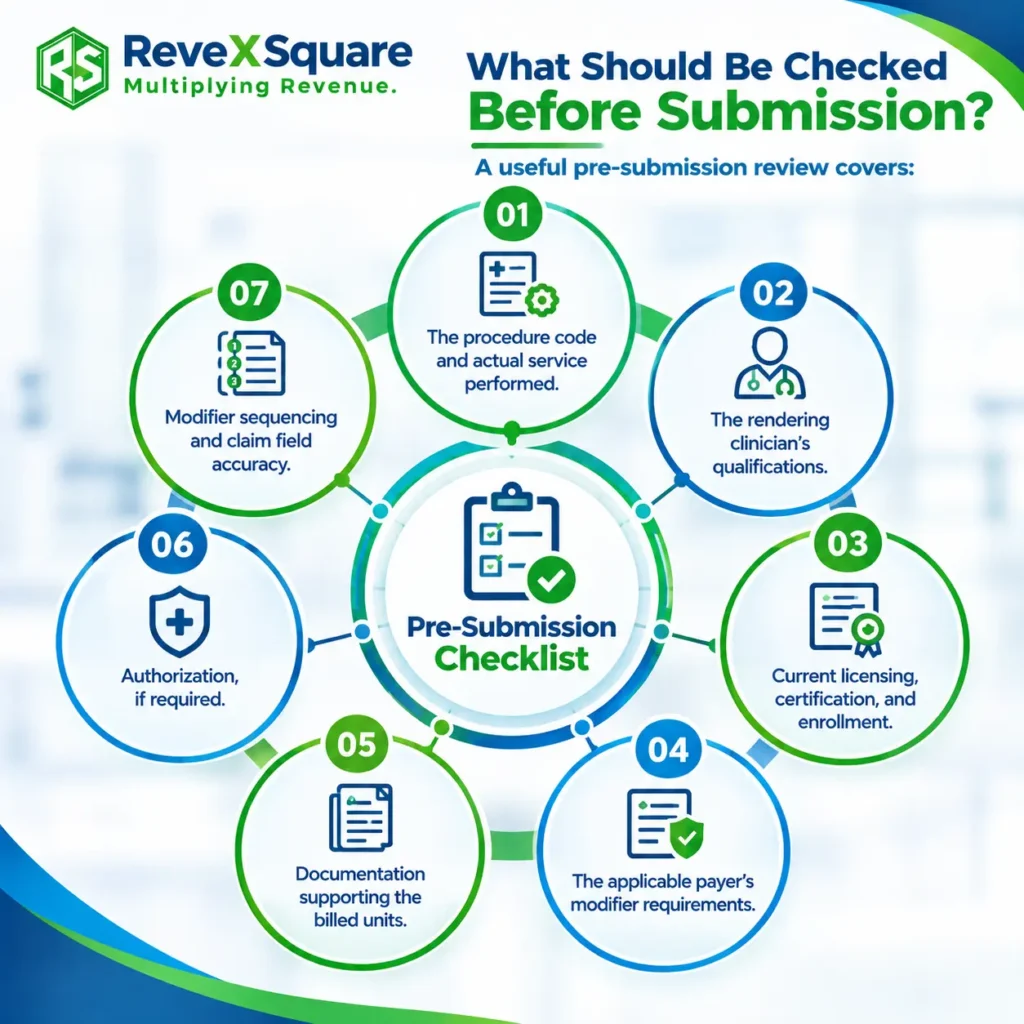
A useful pre-submission review covers:
- The procedure code and actual service performed.
- The rendering clinician’s qualifications.
- Current licensing, certification, and enrollment.
- The applicable payer’s modifier requirements.
- Documentation supporting the billed units.
- Authorization, if required.
- Modifier sequencing and claim field accuracy.
The billing team should update these checks when a payer changes its policy or a clinician’s role changes.
How Can Behavioral Health Practices Prevent Repeated Modifier Errors?
A reliable prevention process begins with correct provider records and an up-to-date payer policy matrix.
Practices should avoid building claim templates that automatically append HO to every session performed within a behavioral health department.
Instead, configure the billing workflow around the actual clinician, the service code, and the payer’s applicable instructions.
When a claim is denied, track the cause by procedure, provider category, insurer, and location.
A pattern of missing modifiers may require an updated billing rule. Repeated provider-classification errors may indicate that credentialing records are out of date.
For clinics handling several therapist types or ABA staff classifications, the combination of medical coding review and provider data validation can help identify problems before claims reach the payer.
How Can Revex Square Help With HO Modifier Billing and Denials?
Behavioral health practices often work with multiple provider classifications, complex authorizations, and insurers that apply different billing rules.
Revex Square offers medical billing and coding services, ABA therapy billing, credentialing, denial management, and accounts receivable follow-up.
For a practice experiencing modifier-related problems, a useful review begins with actual denied claim examples and the relevant payer instructions.
The billing team can examine whether the correct clinician, service code, modifier, units, and enrollment information were reported.
It can also identify recurring claim-processing issues that need to be addressed before future submissions.
For practices considering outside billing support, the goal should be accurate claims and appropriate reimbursement—not simply adding more modifiers.
Need help with behavioral health billing errors or unpaid claims?
Contact Revex Square to discuss your practice’s coding and revenue cycle requirements.
Frequently Asked Questions About the HO Modifier
1. What does HO mean on a medical claim?
HO means master’s degree level. It identifies the rendering provider’s educational classification when required by the payer.
2. Is the HO modifier mandatory for every therapist?
No. Only use it when the payer’s rules require or permit it for the clinician and service.
3. Is HO a CPT modifier or HCPCS modifier?
HO is a HCPCS Level II modifier, not a CPT procedure code.
4. What is the difference between HO and HN?
HO identifies master’s degree level; HN identifies bachelor’s degree level. Payer rules determine their use.
5. What is the difference between HO and HP?
HO represents master’s degree level, while HP represents doctoral degree level.
6. Is HO the same as AJ?
No. AJ identifies a clinical social worker, while HO identifies an educational level.
7. Does Medicaid require HO for psychotherapy?
Some Medicaid programs require it for specific services and provider categories. Requirements vary by state and payer.
8. Does Medicare require HO for 90837?
Original Medicare does not routinely require it for CPT 90837 solely because the clinician has a master’s degree.
9. Can HO be billed with CPT 90834?
Only when the applicable insurer permits or requires that combination.
10. Can HO be used with CPT 90853?
Yes, in certain programs. Louisiana’s school-based program and New York OASAS provide specific examples.
11. Can HO be used with CPT 97153?
Yes, under specified payer rules. BCBS Texas identifies qualifying ABA rendering providers for this combination.
12. Can a BCBA use HO?
Yes, when the payer recognizes the BCBA qualification for the relevant service. BCBS Texas provides one documented example.
13. Can an RBT use HO?
Not automatically. The modifier must match the payer’s classification of the actual rendering provider.
14. Does the HO modifier increase reimbursement?
It may affect payment classification under some payer policies, but there is no universal higher rate.
15. Can HO and modifier 95 be billed together?
Potentially, when both are supported by the service and permitted by the payer’s telehealth rules.
16. Where is HO entered on CMS-1500?
Enter it with the procedure code in Box 24D. Electronic professional claims use the corresponding modifier fields.
17. Why would an insurer reject the HO modifier?
The procedure combination, provider classification, modifier order, or payer requirements may be incorrect.
18. Can a billing company help resolve HO-related denials?
Yes. A medical billing company can review applicable payer rules, provider records, coding, and eligible claim corrections or appeals.
Final Takeaway
The HO modifier identifies a master’s-degree-level provider classification, but correct reporting requires more than knowing its definition.
A practice must verify the clinician, procedure code, payer policy, and documentation before submitting the claim.
Louisiana, Texas, and New York provide clear examples of why a single national modifier rule is not sufficient for every behavioral health organization.
For practices handling multiple provider types or Medicaid programs, maintaining accurate provider records and payer-specific billing instructions can reduce avoidable errors.