









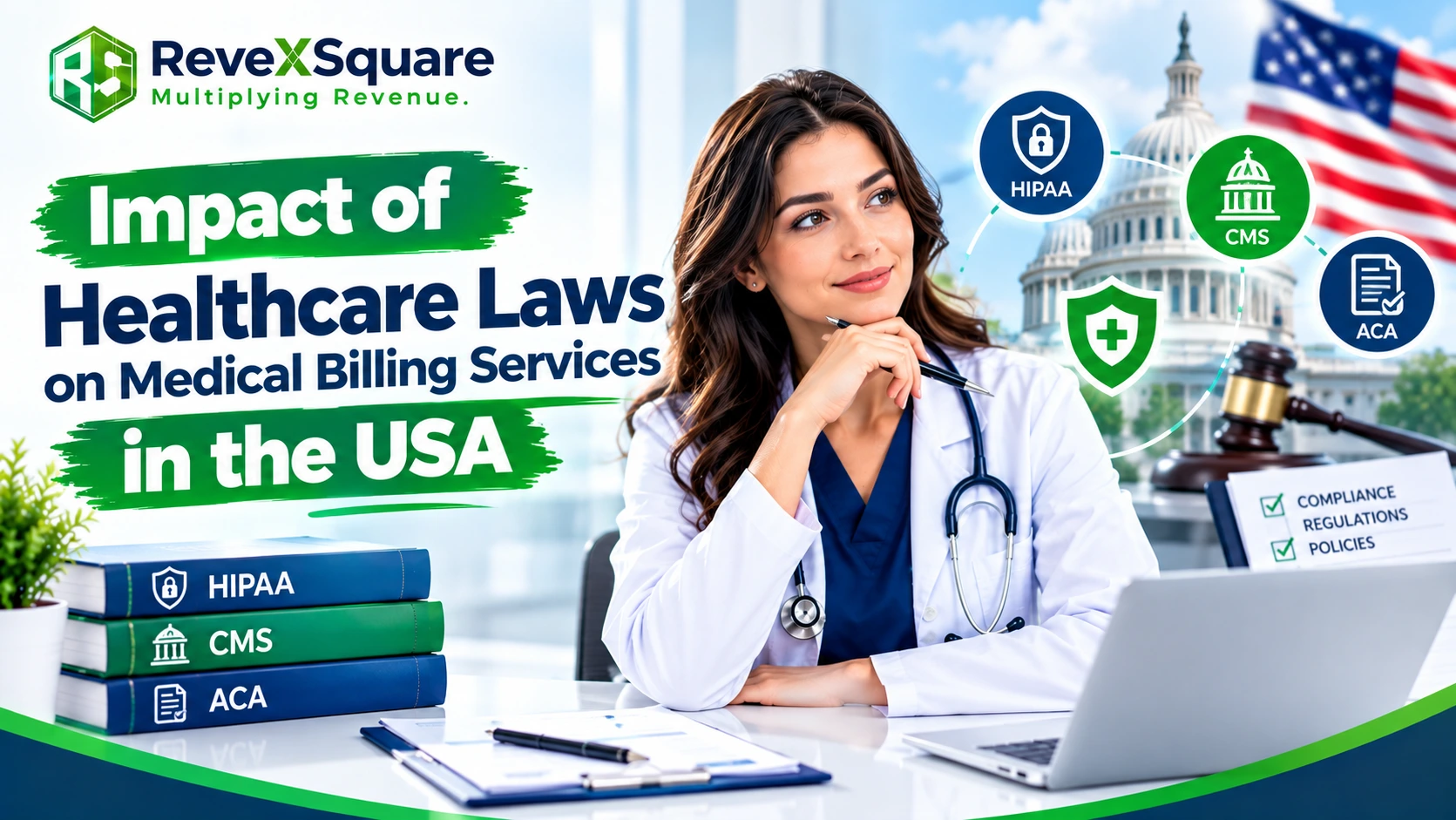
Healthcare laws on medical billing services The USA 2026 has significantly transformed the healthcare revenue cycle. Medical billing is no longer limited to submitting claims and collecting payments. Healthcare organizations must now follow strict regulations related to patient privacy, billing transparency, accurate coding, reimbursement policies, and regulatory compliance.
Federal healthcare laws, including the Affordable Care Act (ACA), the Health Insurance Portability and Accountability Act (HIPAA), the No Surprises Act, and Medicare and Medicaid regulations, directly influence how healthcare providers manage their billing operations.
Recent policy updates have also increased the importance of accurate documentation, digital health services, and value-based reimbursement models. For healthcare practices, understanding these changes is essential to reduce claim denials, prevent compliance risks, and maintain consistent revenue.
Professional medical billing services help healthcare providers manage these regulatory requirements while improving billing accuracy and administrative efficiency.
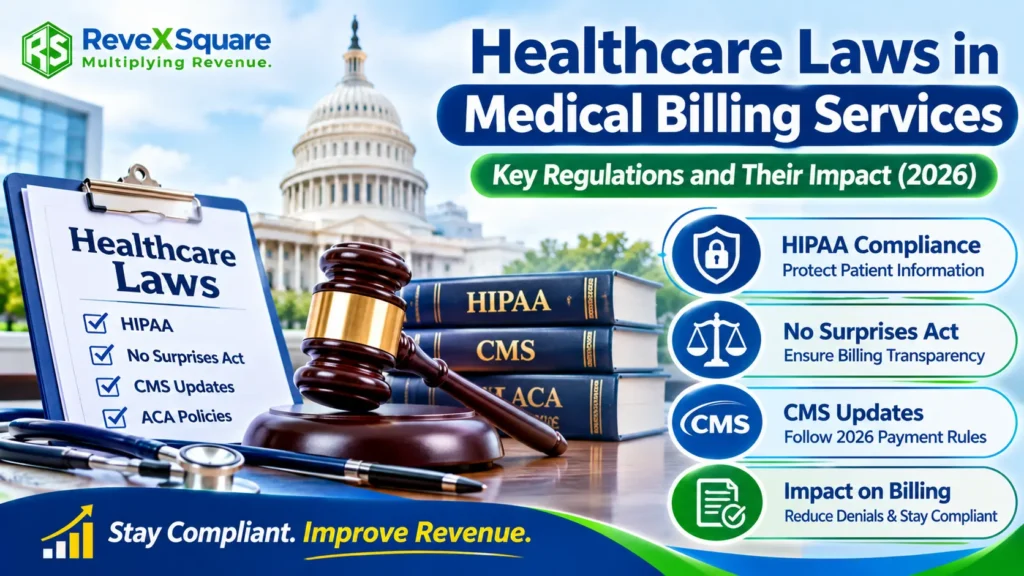
Healthcare Laws on Medical Billing Services USA 2026
Healthcare laws establish the rules that providers, insurance companies, and medical billing professionals must follow. These regulations influence everything from patient registration and insurance verification to claim submission and final reimbursement.
1. Ongoing Review of Major Healthcare Laws
Healthcare regulations continue to evolve as technology, patient needs, and insurance policies change. Healthcare organizations must regularly review major federal laws and understand how they affect daily billing operations.
Important regulations include:
- Social Security Act: Establishes the foundation for Medicare and Medicaid programs and influences healthcare reimbursement policies.
- Medicare Regulations: Define coverage requirements, payment policies, documentation standards, and billing procedures for eligible beneficiaries.
- Medicaid Regulations: Establish federal and state program requirements affecting patient eligibility, covered services, and reimbursement.
- Affordable Care Act (ACA): Expanded access to health insurance and introduced provisions that influence coverage and healthcare administration.
- HIPAA: Establishes requirements for protecting patient health information and maintaining privacy and security.
Regularly reviewing these regulations helps healthcare organizations maintain accurate billing practices and respond to changes in payer requirements.
2. Importance for Healthcare Professionals and Administrators
Healthcare laws affect the responsibilities of physicians, billing specialists, practice managers, and administrative teams. Even a small misunderstanding of a regulatory requirement can result in incorrect claims, reimbursement delays, or compliance problems.
Healthcare professionals should stay informed about legislative and policy changes to:
- Maintain compliance with federal and state regulations.
- Improve coding and billing accuracy.
- Reduce claim denials caused by incorrect information.
- Protect confidential patient information.
- Ensure appropriate reimbursement.
- Minimize financial penalties and legal risks.
Training employees regularly and reviewing internal billing procedures can help practices manage these responsibilities more effectively.
3. Notable Healthcare Reforms Affecting Medical Billing
Several important healthcare reforms influence medical billing operations in the United States.
No Surprises Act: Protects patients from certain unexpected out-of-network medical bills, particularly in emergency situations and specific non-emergency circumstances.
Medicare and Medicaid Policy Updates: Changes to coverage, reimbursement rates, eligibility requirements, and documentation standards can affect how healthcare providers submit claims.
Health Insurance Portability and Accountability Act (HIPAA): Establishes privacy and security requirements for handling protected health information (PHI), including information used during claim processing.
Affordable Care Act (ACA): Continues to influence insurance coverage, patient access, and healthcare administration.
Understanding these reforms allows medical practices to update their billing procedures, maintain transparency, and avoid preventable compliance issues.
Impact on Medical Billing After These Changes
Healthcare legislation has changed how providers manage patient financial responsibility, insurance claims, and reimbursement procedures. Practices must now pay greater attention to accurate documentation, transparent pricing, and payer-specific requirements.
The No Surprises Act is an important example of how legislation affects medical billing. It protects patients from certain unexpected out-of-network charges and establishes additional requirements for healthcare providers.
Under applicable provisions, providers may need to supply patients with a Good Faith Estimate (GFE) outlining expected charges for scheduled services or upon request.
These requirements make accurate cost calculations and clear patient communication increasingly important.
Effective medical billing practices should include:
- Providing clear information about expected healthcare costs.
- Verifying insurance coverage before scheduled services.
- Reviewing patient financial responsibility.
- Maintaining accurate billing documentation.
- Following applicable out-of-network billing restrictions.
- Addressing patient billing questions promptly.
Failure to follow applicable requirements can create disputes, administrative complications, and potential compliance risks.
Read More: Complete Medical Billing and Coding Guide 2026
Challenges for Healthcare Providers
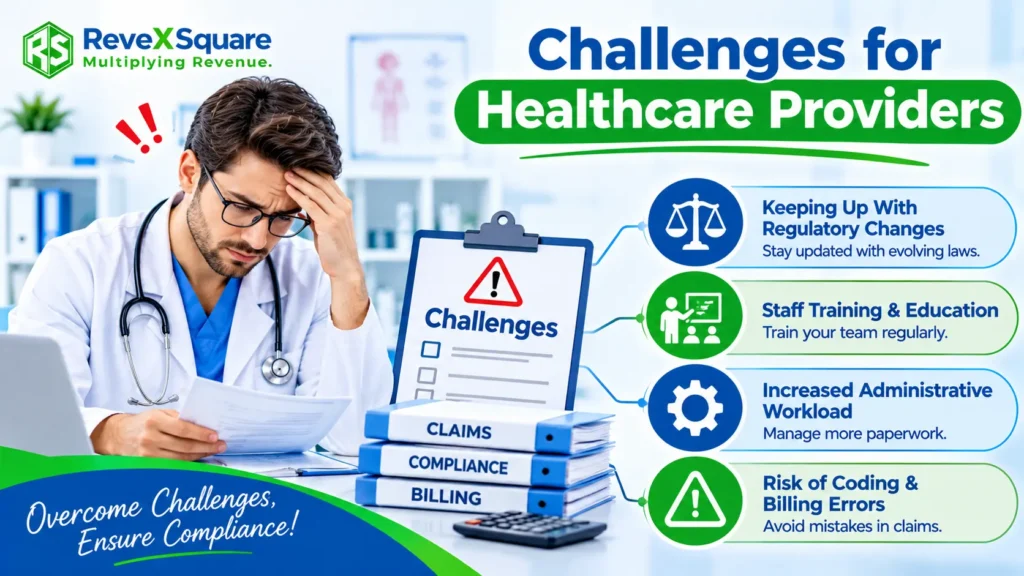
Changes in healthcare laws create several operational challenges for medical practices. Providers must balance patient care responsibilities with increasing administrative and regulatory requirements.
Some common challenges include:
1. Keeping Up With Regulatory Changes
Healthcare laws and payer policies frequently change. Billing teams must understand updated coding guidelines, coverage requirements, reimbursement policies, and claim submission procedures.
Without regular updates, practices may submit claims using outdated information, increasing the likelihood of rejections and payment delays.
2. Staff Training and Education
Medical billing professionals need continuous education to understand new regulatory requirements. Physicians, coders, and administrative employees should receive appropriate training on documentation, coding, and compliance procedures.
Regular training helps employees identify billing errors before claims are submitted.
3. Increased Administrative Workload
Healthcare organizations must maintain detailed documentation, review claims, verify insurance information, and monitor compliance requirements.
These additional responsibilities can consume valuable staff time, particularly in independent practices with limited administrative resources.
4. Risk of Coding and Billing Errors
Incorrect CPT, ICD-10, or HCPCS codes can result in claim rejections, denials, and inaccurate reimbursement.
Practices must review coding guidelines and ensure that submitted claims accurately represent the services provided.
Introducing updated billing codes and regulatory requirements, including those issued by the Centers for Medicare & Medicaid Services (CMS), requires careful implementation.
Healthcare organizations should organize training sessions and provide employees with the necessary tools and resources. Proactive leadership from practice administrators and medical directors also helps ensure a smoother transition.
The Impact of the 2026 CMS Rules on Medical Billing Services
The Centers for Medicare & Medicaid Services (CMS) plays a major role in determining Medicare reimbursement policies, coverage requirements, and billing guidelines.
The 2026 Medicare Physician Fee Schedule (PFS) includes policy and payment updates that healthcare providers must understand before submitting Medicare claims.
These updates can influence reimbursement calculations, documentation requirements, coding procedures, and the financial performance of independent medical practices.
Some important areas affecting medical billing include:
- Changes to Medicare payment policies and reimbursement calculations.
- Updates to physician services and applicable billing codes.
- Expanded or revised policies for eligible telehealth services.
- Greater attention to documentation and medical necessity.
- Changes affecting behavioral health and primary care services.
- Additional requirements for participating in alternative payment models.
For billing teams, understanding these updates is essential to prevent incorrect claim submissions and maintain accurate reimbursement.
CMS CY 2026 Medicare Physician Fee Schedule
The 2026 Medicare Physician Fee Schedule includes updates to Medicare payment policies, reimbursement rates, and eligible healthcare services. Providers can review the official 2026 Medicare Physician Fee Schedule Final Rule to understand the changes affecting their billing operations.
1. Shift Toward Value-Based Care
Healthcare reimbursement increasingly includes payment models that consider care quality, service complexity, and patient outcomes.
Providers participating in applicable value-based programs must maintain accurate documentation and follow program-specific reporting requirements.
2. Medicare Payment Adjustments
Changes to the conversion factor and practice expense calculations can influence Medicare reimbursement.
Practices should review updated payment policies to understand how they affect frequently billed services and overall revenue.
3. New Revenue Opportunities
Applicable billing codes, including G2211 and Advanced Primary Care Management (APCM) G-codes, may create additional reimbursement opportunities for eligible practices.
However, providers must meet the relevant coverage, documentation, and billing requirements before reporting these services.
4. Documentation and Compliance Requirements
Accurate clinical documentation is essential for supporting medical necessity and appropriate reimbursement.
Incomplete records, incorrect coding, and insufficient supporting information can increase the risk of claim denials and payment reviews.
5. Alternative Payment Models
Advanced Alternative Payment Models (APMs) and other value-based care arrangements provide different reimbursement opportunities for participating healthcare organizations.
Practices should understand applicable participation requirements, reporting obligations, and payment structures.
6. Important Coding and Payment Updates
Changes affecting global surgery packages, skin substitutes, vascular procedures, and drug or biological product payments may influence Medicare Part B billing.
Medical billing teams should review the applicable CMS guidance before updating their claim submission workflows.
Action Plan for Independent Practices: Get Ready for 2026
Independent healthcare practices often have limited administrative resources, making regulatory compliance particularly challenging.
A structured action plan can help practices prepare for changing healthcare requirements.
1. Analyze Frequently Used Billing Codes
Review the top 20–30 CPT and HCPCS codes based on claim frequency and revenue. Identify relevant updates and determine whether existing coding procedures need adjustments.
2. Provide Regular Staff Education
Ensure that physicians, medical coders, and billing specialists understand applicable changes involving G2211, APCM codes, telehealth services, and documentation requirements.
3. Update Billing Systems
Refresh applicable ICD-10, CPT, and HCPCS code sets in electronic health records (EHR), practice management systems, and clearinghouse platforms.
Updated systems help reduce errors caused by outdated code information.
4. Conduct Internal Billing Audits
Review recently submitted claims to identify recurring coding mistakes, missing documentation, and reimbursement discrepancies.
Regular audits help practices identify problems before they become larger financial or compliance issues.
5. Monitor Claim Denials
Track denial reasons and identify patterns related to coding, eligibility, authorization, and documentation.
A structured denial management process can help practices correct errors and improve future claim submissions.
6. Consider Professional Billing Support
Practices experiencing increasing administrative workloads may benefit from professional medical billing and revenue cycle management support.
An experienced billing partner can assist with coding reviews, claim submission, payment posting, denial management, and accounts receivable follow-ups.
What Is HIPAA in Medical Billing?
Healthcare organizations should follow the official HIPAA Security Rule guidelines to understand the administrative, physical, and technical safeguards required to protect electronic patient health information.
In medical billing services, HIPAA determines how healthcare practices and their business associates must handle, store, transmit, and protect protected health information (PHI).
Patient information includes names, medical records, diagnoses, insurance details, and payment information.
Every stage of the revenue cycle involves handling information that must be protected appropriately. This includes patient registration, insurance verification, claim submission, payment processing, and follow-up activities.
With the growing use of electronic health records, cloud-based billing platforms, and remote billing teams, maintaining HIPAA compliance has become an important responsibility for healthcare organizations.
Non-compliance can result in investigations, corrective action, and financial penalties depending on the nature and severity of the violation.
HIPAA Compliance in Medical Billing
HIPAA compliance is a legal requirement for covered healthcare entities and their business associates.
Medical billing teams must follow applicable privacy and security standards whenever they access or process patient information.
Effective HIPAA compliance helps healthcare organizations:
- Protect confidential patient information.
- Prevent unauthorized access to medical records.
- Maintain secure electronic claim processing.
- Establish appropriate employee access controls.
- Reduce the risk of data breaches.
- Build patient trust and confidence.
Healthcare practices should regularly review their security procedures and ensure that employees understand their responsibilities when handling PHI.
Key HIPAA Regulatory Rules
Medical billing operations must follow several important HIPAA rules.
1. Privacy Rule
The HIPAA Privacy Rule establishes standards for using and disclosing protected health information.
In medical billing, employees should access only the patient information necessary to perform their assigned responsibilities.
For example, billing specialists may need insurance information, diagnosis details, and service records to process claims. Access should be limited according to applicable requirements and organizational policies.
2. Security Rule
The HIPAA Security Rule establishes safeguards for protecting electronic protected health information (ePHI).
Healthcare organizations should implement appropriate administrative, physical, and technical security measures.
Examples include:
- Strong passwords and access controls.
- Multi-factor authentication where appropriate.
- Data encryption based on applicable security requirements.
- Regular security risk assessments.
- Secure electronic communication.
- Monitoring and reviewing system access.
These safeguards help protect patient information from unauthorized access, loss, and cyber threats.
3. Transactions and Code Sets Rule
This rule establishes standards for certain electronic healthcare transactions and medical code sets.
Standardized formats and code sets improve consistency when healthcare providers exchange information with insurance companies.
Medical billing professionals must use applicable coding systems, including CPT, ICD-10, and HCPCS, when reporting services.
4. Breach Notification Rule
The HIPAA Breach Notification Rule establishes requirements for reporting breaches involving unsecured protected health information.
Depending on the circumstances, healthcare organizations may need to notify affected individuals, the Department of Health and Human Services (HHS), and other appropriate parties.
Breaches affecting 500 or more individuals generally have a 60-day notification deadline.
Following established incident response procedures helps organizations address security incidents and meet applicable reporting obligations.
Essential Safeguards for Medical Billing Teams
Healthcare organizations should implement multiple layers of protection to maintain patient privacy and security.
Administrative Safeguards
Administrative safeguards focus on organizational policies and employee responsibilities.
Important measures include:
- Assigning appropriate HIPAA compliance responsibilities.
- Conducting regular security risk assessments.
- Providing employee privacy and security training.
- Establishing procedures for handling security incidents.
- Reviewing employee access permissions.
Technical Safeguards
Technical safeguards protect electronic patient information through secure systems and access controls.
Examples include:
- Unique employee login credentials.
- Multi-factor authentication.
- Encryption where appropriate.
- Automatic session timeouts.
- Access monitoring and audit logs.
- Secure data transmission systems.
Physical Safeguards
Physical safeguards protect equipment, workstations, and paper records from unauthorized access.
Healthcare practices should:
- Secure offices where patient information is stored.
- Lock filing cabinets containing medical records.
- Restrict access to sensitive work areas.
- Protect computers and mobile devices.
- Position monitors to prevent unauthorized viewing.
Combining these safeguards creates a stronger security environment for medical billing operations.
Working With Third-Party Vendors (Business Associates)
Many healthcare organizations outsource medical billing to specialized companies to reduce administrative responsibilities and improve revenue cycle efficiency.
When a billing company handles PHI on behalf of a covered healthcare provider, it generally qualifies as a HIPAA business associate.
Healthcare providers must take appropriate steps to ensure that these vendors follow applicable HIPAA requirements.
Business Associate Agreement (BAA)
A Business Associate Agreement is an important legal document between a covered entity and its business associate.
The agreement establishes responsibilities related to protecting patient information, permitted data use, security requirements, and breach reporting.
Before outsourcing billing operations, healthcare practices should:
- Confirm the vendor’s HIPAA compliance procedures.
- Review its data security practices.
- Establish a Business Associate Agreement.
- Understand how patient information is accessed and stored.
- Review procedures for reporting security incidents.
- Monitor vendor compliance regularly.
Choosing a qualified billing partner helps healthcare organizations manage administrative work while protecting sensitive patient information.
Consequences of HIPAA Non-Compliance
Failure to follow HIPAA requirements can create serious financial, legal, and operational consequences.
The HHS Office for Civil Rights (OCR) investigates potential HIPAA violations and may impose corrective actions and civil monetary penalties depending on the circumstances.
Potential consequences include:
1. Financial Penalties
HIPAA violations can result in significant financial penalties. The amount depends on factors such as the nature of the violation, the level of negligence, and whether the organization took corrective action.
2. Legal Consequences
Certain wrongful disclosures or uses of protected health information may also involve criminal liability under applicable federal law.
3. Reputational Damage
A patient data breach can reduce public confidence and damage the reputation of a healthcare organization.
4. Operational Disruptions
Security incidents may interrupt billing operations, delay claim processing, and require additional resources for investigation and recovery.
Healthcare organizations should prioritize compliance training, security assessments, and proper data management to reduce these risks.
The Future of HIPAA Compliance in 2026 and Beyond
Healthcare technology continues to change how patient information is collected, processed, and stored. Medical billing organizations increasingly rely on electronic records, cloud-based systems, automation, and artificial intelligence.
These developments create new opportunities but also introduce additional privacy and security considerations.
Some important areas healthcare organizations should monitor include:
1. Artificial Intelligence in Medical Billing
AI-powered tools can help identify billing patterns, detect unusual claim activity, and support administrative workflows.
However, organizations must ensure that these tools are used appropriately and that patient information remains protected.
2. Remote Medical Billing Operations
Remote billing teams need secure access to patient information. Organizations should establish appropriate authentication, device security, and access control procedures.
3. Cloud-Based Billing Systems
Cloud platforms can improve accessibility and operational efficiency, but organizations must evaluate vendor security practices and applicable HIPAA responsibilities.
4. Stronger Data Protection Measures
Healthcare organizations should continuously review their cybersecurity policies, employee training, and incident response procedures to address emerging threats.
5. Regular Compliance Audits
Periodic internal reviews can help identify weaknesses in billing workflows, PHI access controls, and vendor management procedures.
Practices that proactively invest in technology, training, and compliance management will be better prepared to handle future regulatory changes.
Conclusion
Healthcare laws have significantly changed medical billing services in the USA in 2026. Regulations such as HIPAA, the No Surprises Act, the Affordable Care Act, and updated Medicare and Medicaid policies influence how healthcare organizations manage patient information, submit insurance claims, and receive reimbursements.
For independent practices, hospitals, and healthcare providers, staying compliant requires continuous attention to coding updates, documentation standards, insurance requirements, and data security. Even small billing mistakes can result in claim denials, delayed payments, administrative complications, and potential compliance risks.
Implementing regular staff training, conducting internal audits, updating billing systems, and monitoring regulatory changes can help healthcare organizations maintain accurate and efficient revenue cycle operations.
Partnering with an experienced medical billing company like Revex Square can further simplify these responsibilities. Professional billing support helps practices manage claim submissions, coding accuracy, denial follow-ups, and reimbursement workflows while reducing administrative pressure.
Ultimately, healthcare organizations that prioritize regulatory compliance, accurate billing, and secure patient information management will be better positioned to improve financial performance and deliver quality patient care in the evolving healthcare environment.
FAQs
1. How do healthcare laws affect medical billing services in the USA?
Healthcare laws affect medical billing by establishing requirements for coding, reimbursement, patient privacy, documentation, and billing transparency. Regulations such as HIPAA and the No Surprises Act require healthcare providers to follow specific procedures when processing claims and handling patient information.
2. What is the impact of the 2026 CMS rules on medical billing?
The 2026 CMS updates affect Medicare payment policies, applicable billing codes, documentation requirements, and eligible healthcare services. Billing teams should review the latest official CMS guidance to ensure accurate claim submissions.
3. How does the No Surprises Act affect medical billing?
The No Surprises Act protects patients from certain unexpected out-of-network medical bills. It also establishes requirements for Good Faith Estimates in applicable situations and affects how providers communicate expected healthcare costs.
4. Why is HIPAA compliance important in medical billing?
HIPAA compliance protects sensitive patient information during registration, insurance verification, claim processing, and payment collection. It helps prevent unauthorized access and reduces the risk of legal and financial consequences.
5. What challenges do independent practices face under new healthcare laws?
Independent practices may struggle with changing coding guidelines, increased documentation requirements, staff training, regulatory compliance, and administrative workloads. These challenges can affect billing accuracy and reimbursement timelines.
6. How can outsourcing medical billing help with compliance?
Outsourcing medical billing to a qualified billing company can help healthcare practices manage coding, claim submissions, denial follow-ups, and reimbursement workflows. Providers should also ensure that vendors follow applicable HIPAA requirements and have an appropriate Business Associate Agreement.
7. How can healthcare providers stay updated on medical billing regulations?
Providers can monitor official CMS and HHS announcements, review payer policy updates, attend professional training sessions, and conduct regular internal billing audits. Working with experienced billing professionals can also help practices manage regulatory changes.