





Health care providers lose thousands of dollars each month because of denied claims, coding mistakes and slow reimbursements. That is why AI medical billing software has shifted from a luxury to a competitive edge for practices of all sizes. If you have been looking for a method to accelerate your revenue cycle without employing a team of billers this guide explains all you need to know about AI medical billing software in 2026: what it is, how it works, what to look for and how to pick the right partner.
At Revex Square we work with practices in medicine behavioral health, cardiology and durable medical equipment (DME). We see directly where automated billing tools give results and where human expertise remains essential.
What Is AI Medical Billing Software?
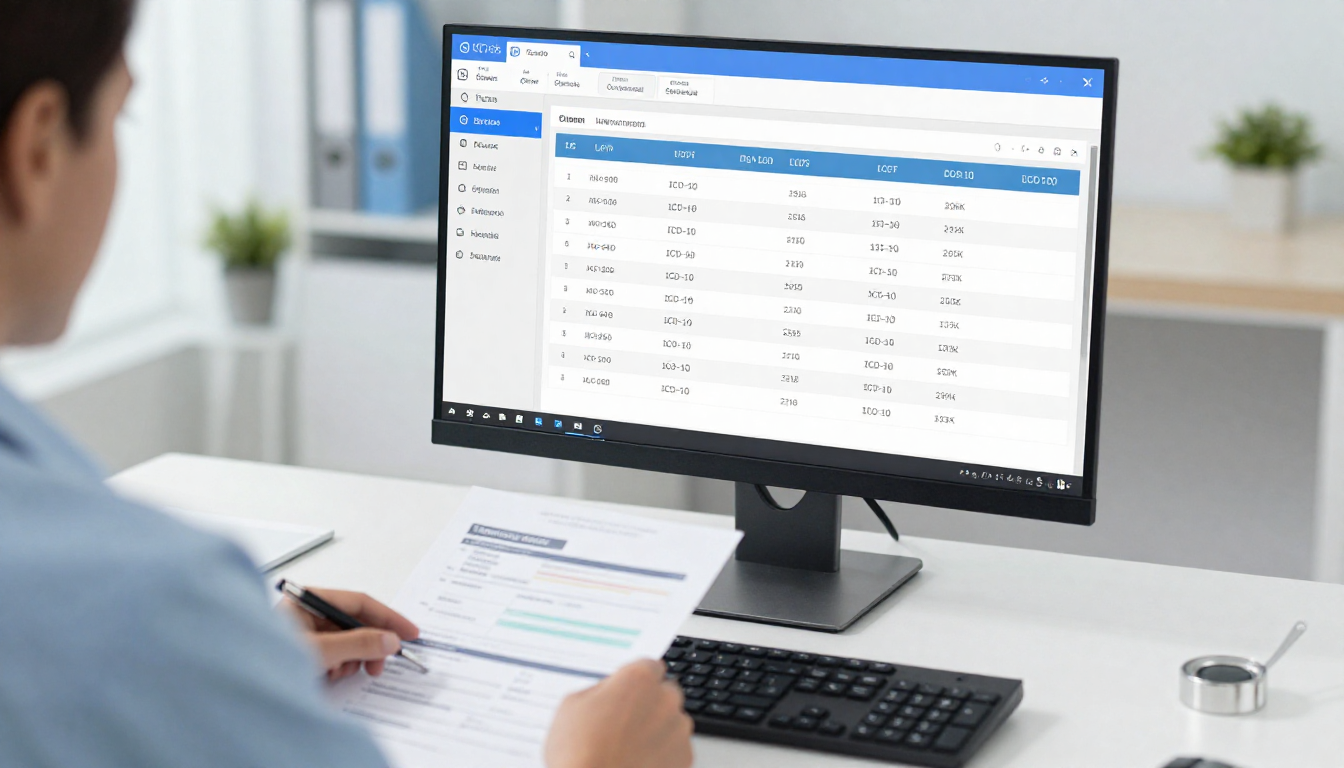
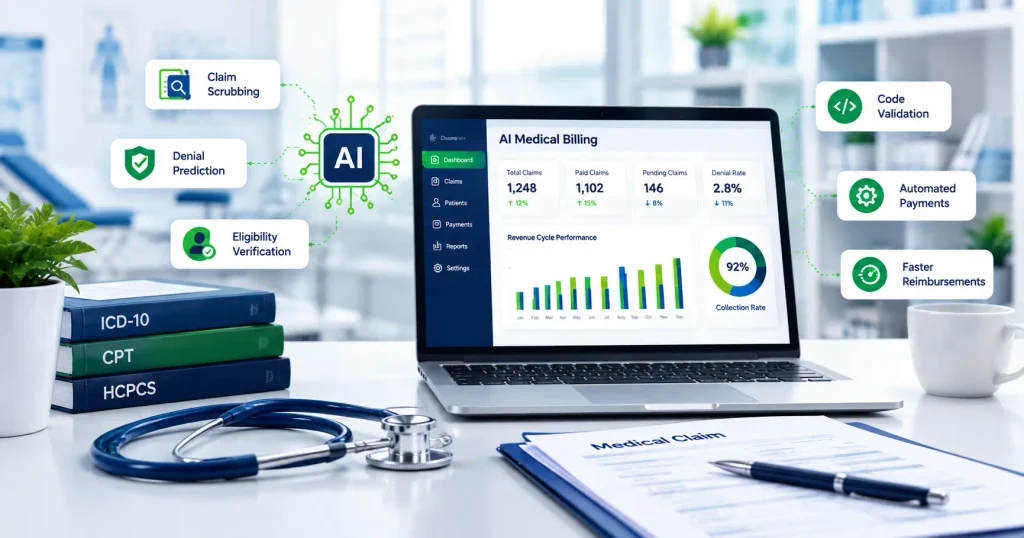
AI medical billing software uses machine learning and natural language processing to automate the error‑prone parts of the revenue cycle such as claim scrubbing, code validation, eligibility checks and denial prediction. Instead of a biller manually checking every CPT and ICD‑10 code, an automated billing system flags mismatches, missing modifiers and payer‑specific rule violations before a claim leaves the office.
In terms AI medical billing software acts like a second set of very fast very consistent eyes on every claim you submit. It reviews documentation matches codes and catches errors that can grow into denials.
Why Healthcare Practices Are Adopting AI-Powered Billing in 2026
Three pressures are driving practices toward smarter automated revenue cycle tools this year:
- Rising claim denial rates: Payers are tightening documentation requirements and manual teams simply cannot keep pace with the volume of rule changes.
- Staffing shortages: Certified billers and coders are hard to hire and expensive to retain. Automation fills the gap without adding headcount.
- Patient expectations: Patients want accurate bills the first time, not three statements and a phone call to sort out an error.
AI medical billing software addresses all three by reducing the workload and improving first‑pass claim accuracy.
The Cost of Claim Denials in 2026
Industry benchmark surveys from groups such as HFMA and MGMA show that average initial claim denial rates are above 10% in 2026 with many practices reporting rates between 10% and 15%. Re‑working each denied claim costs time and denials that are never resubmitted become revenue loss. AI medical billing software is designed to close that gap by catching the errors that cause denials before a claim reaches the payer of fighting appeals afterward. New CPT and ICD‑10 code updates each year add risk because every coding change is another opportunity for a claim to be mismatched. You can track the annual code set updates directly through CMS.gov.
How AI Medical Billing Software Works
Most AI‑driven billing platforms follow a similar workflow:
- Data capture: Clinical notes, superbills or EHR data are pulled in automatically.
- Code suggestion: Natural language processing suggests CPT, ICD‑10 and HCPCS codes based on documentation a process closely tied to AI coding.
- Claim scrubbing: The system checks the claim against rules before submission.
- Denial prediction: Machine learning models flag claims likely to be denied so staff can fix them proactively.
- Payment posting: ERA/EFT data is. Posted automatically reducing manual reconciliation.
Together these steps make the workflow called automated billing, where software handles repetitive checks and people handle judgment calls.
Traditional Billing vs. AI-Powered Billing
| Task | Traditional Medical Billing | AI Medical Billing Software |
|---|---|---|
| Code selection | Manual, biller-dependent | AI-suggested, documentation-driven |
| Claim scrubbing | Rule checklists, human review | Automated, real-time rule matching |
| Denial management | Reactive, after payer rejection | Predictive, flagged before submission |
| Eligibility verification | Phone calls or manual portal checks | Automated, real-time verification |
| Turnaround time | Days | Hours (in many cases) |
Key Features to Look for in AI Medical Billing Software
Not every platform marketed as ‘AI‑powered’ delivers the same value. When evaluating options prioritize:
- Real‑time eligibility verification to catch coverage issues before the visit
- Automated coding suggestions with an audit trail for compliance
- Denial prediction and root‑cause analytics, not just denial tracking
- EHR and practice management integration
- HIPAA‑compliant data handling with encryption at rest and in transit
- Transparent reporting dashboards so you can see the impact not just trust it
These features separate an AI‑driven billing platform from a basic rules‑based scrubber that only has an ‘AI’ label.
Benefits of AI-Powered Billing for Providers
| Benefit | Real-World Impact |
|---|---|
| Fewer claim denials | Higher first‑pass acceptance rates and steadier cash flow |
| Faster reimbursements | Claims move from submission to payment in less time |
| Reduced administrative burden | Staff spend less time on repetitive data entry |
| Improved coding accuracy | Fewer compliance risks tied to upcoding or undercoding |
| Better patient experience | Clearer, more accurate statements reduce billing disputes |
These gains compound over time a practice that reduces denials by even a few percentage points can recover a meaningful amount of previously lost revenue each year. That’s the core business case behind adopting this kind of automation rather than treating it as a technology upgrade for its own sake.
AI Medical Billing vs. AI Medical Coding: What’s the Difference?
These terms are often used interchangeably but they are not identical. AI medical coding specifically means the automated assignment of diagnosis and procedure codes from documentation. The broader category covers coding well as claim submission, eligibility checks, denial management and payment posting. A strong platform usually includes AI‑assisted coding as one part of an automated revenue cycle, which is why practices looking for ‘medical coding AI tools often end up evaluating full billing platforms instead.
Common Billing Challenges Automation Solves
Automated, AI‑supported billing is especially effective at solving problems that are repetitive, rule‑based and high‑volume:
- Claim denials caused by missing modifiers, invalid codes or eligibility mismatches
- Slow patient eligibility verification, which delays scheduling and billing
- Confusing patient statements, which drive up support calls and unpaid balances (something our patient billing services team handles daily)
- Inconsistent coding accuracy across a growing patient volume
- Backlogged accounts receivable because predictive flags let staff prioritize the claims most likely to stall
Specialty‑Specific Considerations for AI Medical Billing
This is not one‑size‑fits‑all. Different specialties have coding complexity and payer rules:
- Behavioral health billing involves session‑based codes, prior authorizations and IOP‑specific documentation. See our health billing services for how this plays out in practice.
- Cardiology billing requires coding for EKGs, echocardiograms and cardiac catheterizations, where a single missed modifier can trigger a denial. Our cardiology medical billing team handles this daily.
- Durable medical equipment (DME) billing is one of the regulation‑heavy areas with strict medical necessity documentation. Our DME billing services page covers the compliance requirements.
Automated tools can flag errors but the rules engines behind them must be tuned for each specialty to be genuinely useful. A generic scrubber built for care will not catch the nuances that matter in behavioral health or DME billing.
How to Choose the AI Medical Billing Partner
Software alone does not run your revenue cycle; people do. When evaluating a partner look for:
- A certified coding team that reviews AI‑flagged claims, not just automation running unsupervised
- A track record of first‑pass claim acceptance rates you can verify
- Transparent real‑time reporting instead of a monthly PDF
- Experience with your specific specialtys billing rules
- Clear HIPAA compliance practices and data security policies that follow standards outlined by AAPC
At Revex Square we combine AI‑assisted claim scrubbing and coding checks with certified billing specialists so every flagged claim receives a review before it becomes a denial. Our billing and coding services are built around this hybrid model. Technology for speed and consistency people for judgment and compliance.
Implementation Checklist: Rolling Out AI‑Powered Billing
Moving to an AI‑supported billing workflow does not happen overnight. A realistic rollout usually looks like this:
- Audit your denial patterns so you know which errors the software needs to catch first.
- Confirm EHR and practice management compatibility before selecting a platform.
- Pilot on a single specialty or provider instead of switching your entire practice at once.
- Train staff on reviewing AI‑flagged claims because human sign‑off still matters for compliance.
- Track first‑pass acceptance rate and days‑in‑AR monthly to measure impact.
Practices that treat this as a phased rollout. Than a one‑time software swap. Tend to see steadier gains from this kind of automation over the first six to twelve months. Rushing a full‑scale switch without a pilot phase is one of the common reasons automation projects stall.
The Future of AI in Medical Billing
Looking ahead expect this technology to move upstream. Assisting with documentation at the point of care predicting payer behavior based on historical patterns and tightening the loop between clinical notes and clean claims. Cms prior authorization requirements that begin in 2026 also push payers and providers toward more automated, real‑time verification processes. Practices that adopt this technology now build the habits and clean data pipelines that will make next‑generation tools even more effective later.
Conclusion
AI medical billing software is not about replacing your billing team. It is about giving them tools to catch errors before they cost you money. Whether you are a solo practice or a multi‑specialty group the combination of automation and experienced human oversight is what actually moves the needle on denials, reimbursement speed and patient satisfaction.
If you are ready to see what AI‑assisted billing looks like for your specialty talk to the Revex Square team about a revenue cycle review.
Frequently Asked Questions
1. What is AI medical billing software?
A: It is software that uses machine learning to automate coding suggestions claim scrubbing and denial prediction, in the medical billing process.
2. How is AI medical billing different from traditional medical billing?
A: Traditional billing depends on people checking every step by hand. AI medical billing uses automated rule checking and spots mistakes before the claim goes out.
3. Can AI medical billing software reduce claim denials?
A: Yes. AI medical billing software can guess which claims might be denied and check the codes away so it catches problems before the claim gets to the payer.
4. Is AI medical billing software HIPAA compliant?
A: Ai medical billing software is built with encryption and access controls that follow HIPAA rules. Still whether it is fully compliant depends on how the vendor runs its system.
5. Does AI replace human medical billers and coders?
A: No. AI does the checks but certified billers still look at the flagged claims deal with appeals and take care of the hard cases.
6. How much does AI medical billing software cost?
A: The price changes a lot depending on the vendor. How big the practice is. It usually depends on how claims you send what features you need and if you want the whole billing service together.
7. What specialties benefit most from AI medical billing?
A: High‑volume and hard‑to‑code specialties such as health, cardiology and durable medical equipment get the biggest gains because the coding rules in those areas are very strict.
8. How long does it take to implement AI medical billing software?
A: Usually it takes a weeks to a couple of months. The exact time depends on how the electronic health record connects and how the data moves over.
9. Can small practices use AI medical billing software?
A: Yes. Many AI platforms and billing partners make their tools small enough, for low claim volumes and tighter budgets.
10. What should I look for when choosing an AI medical billing partner?
A: I look for partners that show first‑pass acceptance rates know the specialty well give clear reports and keep human oversight together with the automation.
Contact us for furthur Details