










Cardiology revenue cycle management is one of the most complex and high-value specialties in healthcare. From diagnostic testing and advanced imaging to catheterization and interventional procedures, cardiology practices handle a wide range of services that require accurate documentation, specialized medical coding, and careful reimbursement management.
Unlike general medical practices, cardiology providers must navigate complex CPT and ICD-10 coding requirements, medical necessity guidelines, prior authorization rules, and payer-specific reimbursement policies. Even a minor billing error, such as an incorrect modifier or missing clinical documentation, can result in claim denials, delayed payments, or lost revenue.
Industry data and specialty billing experience indicate that cardiology practices face significant reimbursement challenges because of complex procedures, documentation requirements, and changing insurance policies. However, denial rates and reimbursement performance vary by practice, payer, and service type. Identifying the reasons behind rejected claims is essential for improving financial performance.
For small and mid-sized cardiology clinics, effective Revenue Cycle Management (RCM) is not optional. It is essential for maintaining consistent cash flow, reducing administrative costs, and maximizing reimbursements.
In this guide, we will explore the major cardiology RCM challenges, explain how they affect practice revenue, and discuss practical strategies to improve billing accuracy, reduce claim denials, and maximize reimbursements in 2026.
What Is Cardiology Revenue Cycle Management?
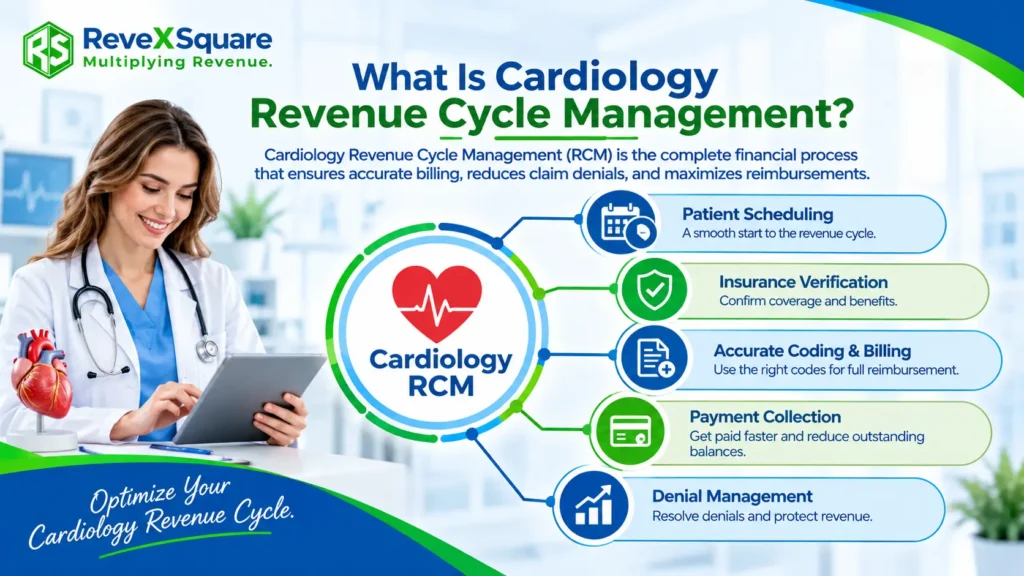
Cardiology Revenue Cycle Management (RCM) is the complete financial process of managing healthcare services, from the initial patient appointment and insurance verification to claim submission, payment posting, and final balance collection.
It ensures that cardiology practices receive appropriate reimbursement for the services they provide while maintaining compliance with insurance requirements and healthcare regulations.
Unlike general medical billing, cardiology RCM requires specialized knowledge of cardiovascular procedures, diagnostic services, coding guidelines, and payer reimbursement policies.
Cardiology practices commonly manage billing for services such as:
- Diagnostic testing: Electrocardiograms (EKGs or ECGs), echocardiograms, Holter monitoring, and cardiac stress testing.
- Interventional cardiology: Cardiac catheterization, angioplasty, and stent placement.
- Electrophysiology services: Pacemaker implantation, cardiac ablation, and device monitoring.
- Cardiac imaging: Nuclear cardiology, vascular imaging, and other diagnostic imaging services.
- Preventive cardiology: Cardiovascular risk assessments, consultations, and follow-up appointments.
- Remote patient monitoring: Eligible cardiac monitoring services and related reporting.
Each service has specific documentation, coding, and reimbursement requirements. For example, an echocardiogram claim must contain appropriate supporting documentation to establish medical necessity and justify the procedure performed.
An effective cardiology RCM process typically includes the following stages:
1. Patient Registration and Scheduling
The revenue cycle begins when a patient schedules an appointment. Staff members collect accurate demographic information, insurance details, and relevant medical information.
Incorrect patient information can create eligibility problems and claim rejections later in the billing process.
2. Insurance Eligibility and Benefits Verification
Before providing services, the billing team verifies the patient’s insurance coverage, deductible, copayment, coinsurance, and applicable service limitations.
This step helps practices identify potential coverage issues before treatment.
3. Prior Authorization
Certain cardiology procedures, diagnostic tests, and imaging services may require prior authorization depending on the insurance payer and individual policy.
The billing team must confirm authorization requirements and obtain approval when necessary.
4. Medical Coding and Charge Entry
After the service is performed, certified coders review the clinical documentation and assign appropriate CPT, ICD-10-CM, and HCPCS codes when applicable.
Accurate coding ensures that the submitted claim correctly represents the services provided.
5. Claims Submission
The billing team prepares and submits claims electronically to insurance companies. Claims should be reviewed for missing information, coding errors, incorrect modifiers, and payer-specific requirements before submission.
6. Payment Posting and Reconciliation
Once the payer processes a claim, payments and adjustments are recorded in the practice management system.
The team compares expected reimbursement with actual payments to identify underpayments, contractual discrepancies, and outstanding balances.
7. Denial Management and AR Follow-Up
Unpaid, rejected, and denied claims require timely investigation. Billing specialists identify the reason for the denial, correct errors, submit appeals when appropriate, and follow up with insurance companies.
Managing these stages effectively helps cardiology practices maintain a healthier revenue cycle.
Key Revenue Challenges in Cardiology RCM
Cardiology practices face several financial and operational challenges that can negatively affect reimbursement. Understanding these issues is the first step toward improving revenue cycle performance.
1. Complex Coding and Documentation Requirements
Cardiology involves a wide range of diagnostic and procedural services, each with specific coding requirements.
Billing professionals should follow the Medicare NCCI coding guidelines to understand applicable coding edits and procedure bundling requirements.
For example, billing for an electrocardiogram, echocardiogram, cardiac catheterization, or pacemaker procedure requires accurate code selection and supporting clinical documentation.
Common coding problems include:
- Incorrect CPT or ICD-10-CM code selection.
- Missing or inappropriate modifiers.
- Incomplete procedure descriptions.
- Insufficient medical necessity documentation.
- Incorrect coding of professional and technical components.
- Unintentional duplicate billing.
- Errors involving bundled services.
Consider a cardiology practice performing an echocardiogram. If the documentation does not sufficiently support the medical necessity of the test, the payer may reject or deny the claim.
Similarly, incorrect modifier usage can cause payment delays or reimbursement discrepancies.
How it affects revenue: Coding and documentation errors increase claim rework, delay payments, and create additional administrative expenses.
2. Elevated Claim Denial Rates
Claim denials are among the most significant revenue challenges for cardiology practices.
Unlike straightforward office visits, cardiology services often involve multiple procedures, specialized diagnostic tests, and complex reimbursement rules. These factors increase the possibility of billing mistakes and payer disputes.
Common reasons for cardiology claim denials include:
- Missing or invalid prior authorization.
- Incorrect CPT and ICD-10-CM codes.
- Lack of medical necessity.
- Incomplete clinical documentation.
- Incorrect modifier application.
- Duplicate claims.
- Timely filing violations.
- Coverage limitations and payer policy mismatches.
For example, a cardiac imaging claim may be denied because the submitted diagnosis does not satisfy the payer’s medical necessity policy.
If the billing team does not identify and address the underlying issue, the practice may experience repeated denials for similar services.
How it affects revenue: High denial volumes increase administrative workloads, delay reimbursements, and can result in unrecoverable revenue when filing or appeal deadlines are missed.
3. Prior Authorization Delays
Prior authorization is another major challenge in cardiology revenue cycle management.
Insurance companies may require authorization before approving certain diagnostic tests, advanced imaging services, and invasive cardiac procedures.
Examples may include:
- Certain echocardiography services.
- Nuclear cardiology studies.
- Cardiac CT and MRI.
- Cardiac catheterization.
- Selected electrophysiology procedures.
- Certain implanted cardiac devices.
Requirements vary by payer, plan, procedure, and clinical circumstances.
When authorization requests are submitted late or contain incomplete medical information, treatment scheduling and claim processing can be delayed.
For example, a patient scheduled for an advanced cardiac imaging procedure may need additional clinical documentation before the insurance company approves the service.
If the procedure is performed without required authorization, the resulting claim may be denied.
How it affects revenue: Authorization-related denials create payment delays, additional administrative work, and potential revenue losses.
4. Rising Patient Financial Responsibility
Increasing deductibles, copayments, and coinsurance have made patient collections an important part of cardiology RCM.
Many cardiology services involve expensive diagnostic procedures and ongoing treatment. Patients may therefore have substantial out-of-pocket responsibilities depending on their insurance coverage.
Practices that do not communicate estimated costs clearly may experience:
- Delayed patient payments.
- Increased outstanding balances.
- More billing disputes.
- Higher patient collection costs.
- Reduced patient satisfaction.
For example, a patient undergoing cardiac diagnostic testing may not understand the difference between a copayment and coinsurance.
Without clear communication, the patient may be surprised by the final bill and delay payment.
How it affects revenue: Poor patient financial communication can increase accounts receivable and make it more difficult to collect outstanding balances.
5. Payer-Specific Rules and Frequent Policy Changes
Different insurance companies maintain different coverage policies, coding edits, authorization requirements, and reimbursement methodologies.
A cardiology procedure covered by one insurance plan may require additional documentation or authorization under another.
Payers may also update their policies, reimbursement rates, and medical necessity requirements.
Without regularly reviewing these changes, billing teams may continue submitting claims based on outdated information.
Common payer-related challenges include:
- Different authorization requirements.
- Varying coverage policies.
- Procedure-specific reimbursement rules.
- Bundling and unbundling restrictions.
- Different timely filing deadlines.
- Changes to medical necessity criteria.
How it affects revenue: Outdated payer information can result in repeated denials, incorrect payments, and unnecessary claim resubmissions.
6. Underpayments and Missed Revenue Opportunities
Not every revenue problem appears as a denied claim. Some cardiology claims are processed and paid but still receive less reimbursement than expected.
Underpayments may occur because of:
- Incorrect contractual adjustments.
- Missing billable services.
- Incorrect fee schedule configuration.
- Improper payment calculations.
- Incorrect units or modifiers.
- Missed reimbursement opportunities.
For example, a payer may reimburse a cardiology practice below the expected contracted amount for a particular procedure.
If the billing team does not compare payments against contracted rates, the discrepancy may remain unnoticed.
How it affects revenue: Unidentified underpayments can gradually reduce practice revenue, even when claims appear successfully processed.
7. Increasing Administrative Workloads
Cardiology billing requires coordination between physicians, clinical staff, front-office employees, coding specialists, and insurance companies.
When these departments work with disconnected systems or inconsistent processes, important information may be missed.
Staff members may spend excessive time on:
- Correcting rejected claims.
- Checking insurance eligibility.
- Following up on unpaid claims.
- Obtaining prior authorizations.
- Reviewing medical records.
- Responding to payer requests.
- Managing patient billing questions.
How it affects revenue: Administrative inefficiencies reduce staff productivity and leave less time for revenue-generating and patient-focused activities.
Strategies to Maximize Reimbursements in Cardiology RCM
Improving reimbursement requires more than submitting claims quickly. Cardiology practices need an organized revenue cycle strategy that addresses errors before they occur and identifies payment problems before they become major financial issues.
The following strategies can help practices improve billing accuracy, reduce denials, and strengthen financial performance in 2026.
1. Strengthen Documentation and Coding Accuracy
Accurate medical documentation is the foundation of successful cardiology billing.
Every claim must be supported by clinical records that demonstrate the services performed, the patient’s condition, and the medical necessity of the procedure.
Cardiology practices should work with experienced coders who understand:
- Cardiology-specific CPT codes.
- ICD-10-CM diagnosis specificity.
- Modifier requirements.
- Procedure bundling guidelines.
- Professional and technical components.
- Medical necessity requirements.
- Current coding updates.
Regular coding audits can help identify recurring mistakes before they affect a large number of claims.
Practical example: If a cardiologist performs a diagnostic procedure, the documentation should clearly support the procedure, findings, and associated diagnosis. The coding team should verify that the assigned codes accurately reflect the documented service.
Practices should also provide regular training to physicians and billing staff to improve documentation consistency.
2. Automate Insurance Eligibility Verification
Insurance verification should be completed before the patient’s appointment or scheduled procedure whenever possible.
Manual verification can be time-consuming and may lead to overlooked coverage limitations.
Automated eligibility verification tools help billing teams check:
- Active insurance coverage.
- Patient deductibles.
- Copayments and coinsurance.
- Out-of-pocket maximums.
- Coverage limitations.
- Referral requirements.
- Authorization requirements, where supported.
Automating these checks reduces avoidable administrative errors and helps staff communicate patient financial responsibilities more effectively.
However, an eligibility response does not guarantee payment or replace the need to verify medical necessity and authorization requirements.
3. Build a Proactive Denial Management Process
An effective denial management process helps cardiology practices recover revenue and prevent recurring billing problems.
Instead of treating every denial as an isolated issue, practices should identify patterns across procedures, providers, and insurance companies.
A structured denial management workflow should include:
- Collect denied and rejected claims.
- Review the payer’s explanation of benefits or electronic remittance advice.
- Identify the specific denial reason.
- Determine whether the issue is related to coding, documentation, eligibility, authorization, or coverage.
- Correct the underlying problem.
- Submit corrected claims or appeals within applicable deadlines.
- Track the final outcome.
Practices should also categorize denials using appropriate CARC and RARC information to identify recurring problems.
For example, if multiple claims are denied because of missing authorization, the practice should review its authorization workflow rather than repeatedly correcting individual claims.
Key benefit: A proactive approach reduces repeated errors, improves claim recovery, and helps prevent avoidable revenue leakage.
4. Improve Prior Authorization Management
Prior authorization should be treated as an essential part of the cardiology revenue cycle rather than a separate administrative task.
Practices should establish a centralized authorization process to ensure that required approvals are obtained before services are performed.
Recommended steps include:
- Verify authorization requirements during scheduling.
- Identify the correct payer and plan.
- Submit complete clinical documentation.
- Track authorization request status.
- Record approval numbers and validity dates.
- Confirm that the approved procedure matches the scheduled service.
- Monitor pending requests and follow up with payers.
- Maintain authorization records for future claim review.
A centralized tracking system can help staff identify pending requests and reduce the possibility of procedures being performed without required approvals.
5. Monitor Accounts Receivable Regularly
Accounts receivable (AR) represents the outstanding payments owed to the cardiology practice by insurance companies and patients.
Unmanaged AR can create cash flow problems and make it difficult to identify delayed reimbursements.
Practices should review AR aging reports regularly and categorize outstanding balances by age.
Common AR categories include:
- 0–30 days.
- 31–60 days.
- 61–90 days.
- 91–120 days.
- More than 120 days.
The billing team should prioritize older unpaid claims, high-value balances, and claims approaching payer filing or appeal deadlines.
It is also important to distinguish between insurance AR and patient AR because each requires a different follow-up approach.
Practical example: If a high-value catheterization claim remains unpaid for 60 days, the billing team should investigate its status, identify any missing documentation, and take the appropriate follow-up action.
Regular AR reviews help practices identify payment delays before outstanding balances become difficult to recover.
6. Improve Patient Collections and Financial Transparency
Patient collections should begin before the appointment whenever possible.
Providing clear financial information helps patients understand their responsibilities and reduces billing-related confusion.
Cardiology practices can improve patient collections by:
- Verifying benefits before appointments.
- Providing cost estimates when available.
- Explaining deductibles and copayments.
- Offering convenient online payment options.
- Sending payment reminders.
- Providing itemized statements.
- Establishing appropriate payment plans.
- Responding promptly to billing questions.
Practices should also train front-office employees to communicate financial information professionally and clearly.
A transparent patient billing process improves the collection experience while supporting stronger patient relationships.
7. Conduct Regular Payment and Coding Audits
Regular audits help identify errors that may otherwise remain hidden within the revenue cycle.
A cardiology practice should periodically review a sample of claims to confirm that:
- Submitted codes match clinical documentation.
- Modifiers are appropriately supported.
- Charges are accurately entered.
- Payments match expected contractual reimbursement.
- Denials are correctly categorized.
- Adjustments are properly recorded.
- Services are not incorrectly duplicated or bundled.
Payment audits are especially useful for identifying underpayments and recurring payer processing problems.
Practices should use audit findings to update internal procedures and provide additional training where necessary.
8. Use RCM Technology and Reporting Analytics
Technology can improve the accuracy, visibility, and efficiency of cardiology revenue cycle operations.
Modern practice management and billing systems can automate repetitive administrative tasks and provide useful financial reports.
Important RCM technology features include:
- Automated eligibility verification.
- Electronic claims submission.
- Claim status tracking.
- Denial management reporting.
- Payment posting.
- AR aging analysis.
- Authorization tracking.
- Financial performance dashboards.
Analytics can also help practices identify which procedures generate the most denials, which payers have longer payment cycles, and where revenue leakage occurs.
For example, if a particular payer consistently delays reimbursement for cardiac imaging claims, the practice can investigate the underlying issue and adjust its follow-up process.
Technology should support experienced billing professionals rather than replace the need for accurate coding, clinical documentation, and payer knowledge.
9. Outsource to Specialized Cardiology RCM Experts
Managing cardiology billing internally can become challenging when a practice handles multiple procedures, insurance companies, and authorization requirements.
Outsourcing to an experienced medical billing and RCM provider can help reduce administrative pressure while improving billing consistency.
A specialized RCM partner can support:
- Cardiology medical billing and coding.
- Insurance eligibility verification.
- Prior authorization coordination.
- Electronic claims submission.
- Payment posting and reconciliation.
- Denial management and appeals.
- Accounts receivable follow-up.
- Underpayment identification.
- Financial reporting and performance monitoring.
However, outsourcing results depend on the provider’s expertise, workflow quality, technology, and coordination with the practice.
Before selecting an RCM partner, cardiology practices should evaluate its specialty experience, reporting capabilities, data security practices, communication process, and pricing structure.
Key RCM Metrics Every Cardiology Practice Should Monitor
Measuring revenue cycle performance is essential for understanding whether billing improvements are producing meaningful results.
Cardiology practices should regularly monitor the following key performance indicators (KPIs).
| RCM Metric | What It Measures | Why It Matters |
|---|---|---|
| Clean Claim Rate | Claims accepted without initial errors | Identifies front-end and coding accuracy |
| Denial Rate | Percentage of claims denied | Highlights reimbursement problems |
| Days in AR | Average time outstanding balances remain unpaid | Measures collection efficiency |
| Net Collection Rate | Percentage of collectible revenue actually collected | Evaluates overall collection performance |
| First-Pass Resolution Rate | Claims resolved without additional rework | Measures billing efficiency |
| AR Over 90 Days | Outstanding balances older than 90 days | Identifies potential collection risks |
| Underpayment Rate | Claims paid below expected reimbursement | Reveals missed revenue |
| Authorization-Related Denials | Denials associated with authorization issues | Evaluates authorization workflows |
These metrics should be reviewed monthly or more frequently when necessary.
Practices should establish realistic benchmarks based on their specialty, payer mix, service types, and historical performance rather than relying on one universal industry target.
Why Outsource Cardiology RCM to Revex Square?
Managing cardiology revenue cycle operations requires specialized knowledge, consistent follow-up, and an organized billing process.
At Revex Square, we provide comprehensive medical billing and coding services designed to help healthcare providers improve reimbursement performance and reduce administrative workloads.
Our approach combines experienced billing professionals with technology-supported workflows to help cardiology practices manage their revenue cycle more efficiently.
Our Cardiology RCM Support Includes
1. Specialized Medical Billing and Coding
Our billing team focuses on accurate claim preparation, code review, and documentation requirements to help reduce avoidable billing errors.
2. Denial Management and Appeals
We identify denial reasons, investigate claim issues, and support appropriate corrections and appeals to help practices recover outstanding reimbursements.
3. Insurance Eligibility Verification
Our workflows help verify insurance coverage and patient benefits before services are provided, reducing preventable eligibility-related billing problems.
4. Prior Authorization Support
We assist with authorization-related workflows and follow-ups to help practices manage payer requirements and minimize administrative delays.
5. Accounts Receivable Management
Our team follows up on outstanding insurance claims, monitors aging balances, and helps identify reimbursement issues that require additional attention.
6. Payment Posting and Reconciliation
Accurate payment posting and reconciliation help practices monitor received payments, contractual adjustments, and outstanding balances.
7. Reporting and Performance Monitoring
We provide billing and financial reporting to help practices understand claim status, AR performance, denials, and collection activity.
Benefits of Partnering With Revex Square
Working with an experienced medical billing partner can help cardiology practices:
- Reduce internal administrative workloads.
- Improve claim submission accuracy.
- Identify recurring denial patterns.
- Strengthen accounts receivable follow-up.
- Improve visibility into revenue cycle performance.
- Support more consistent reimbursement processes.
- Allow physicians and clinical teams to focus more on patient care.
Our mission is to help healthcare providers maintain a more organized and efficient revenue cycle through reliable billing, coding, and financial management support.
Ready to improve your cardiology practice’s revenue cycle?
Contact Revex Square to discuss your billing challenges and explore how our medical billing and RCM solutions can support your practice.
Website: https://revexsquare.com/
Email: Info@Revexsquare.com
Phone: +1 (737) 227-1587
Conclusion
Cardiology Revenue Cycle Management is much more than claim submission and payment collection. It is a comprehensive financial process that influences how effectively a cardiology practice manages its revenue, controls administrative costs, and maintains financial stability.
In 2026, complex coding requirements, payer-specific policies, prior authorization challenges, increasing patient financial responsibility, and underpayment risks continue to create obstacles for cardiology providers.
However, these challenges can be managed through accurate documentation, specialized coding expertise, automated eligibility verification, proactive denial management, and consistent accounts receivable follow-up.
Regular performance monitoring also helps practices identify financial weaknesses and make informed operational decisions.
For cardiology clinics looking to improve billing efficiency and reduce administrative pressure, partnering with an experienced RCM provider can be a practical solution.
Revex Square helps healthcare practices streamline billing and coding operations, manage claim denials, and improve revenue cycle performance. Contact our team today to explore solutions that support your practice’s financial goals.
Frequently Asked Questions (FAQs)
1. What makes cardiology RCM different from general medical billing?
Cardiology RCM is more complex because it involves specialized diagnostic tests, advanced imaging, interventional procedures, and electrophysiology services.
These services require detailed clinical documentation, accurate CPT and ICD-10-CM coding, appropriate modifier usage, and payer-specific reimbursement knowledge.
General medical billing may involve more straightforward office visits, whereas cardiology billing often requires additional coding and authorization expertise.
2. How much revenue do cardiology practices lose due to claim denials?
The financial impact of claim denials varies depending on the practice’s size, payer mix, procedure volume, and billing accuracy.
Practices may lose revenue because of incorrect coding, missing documentation, authorization problems, and missed appeal deadlines.
Some denied claims can be recovered through corrected submissions or appeals, while others may become uncollectible.
Monitoring denial trends and addressing recurring issues helps reduce preventable revenue losses.
3. Can outsourcing RCM improve cardiology reimbursements?
Yes. Outsourcing to an experienced RCM provider can help cardiology practices improve billing accuracy, manage denials, monitor outstanding claims, and strengthen payment follow-up.
Specialized billing professionals understand cardiology coding requirements and payer-specific processes.
However, results depend on the quality of the RCM provider, the practice’s documentation, and effective communication between both teams.
4. What are the biggest denial drivers in cardiology billing?
Common cardiology claim denial reasons include:
- Incorrect CPT or ICD-10-CM coding.
- Missing or invalid prior authorization.
- Insufficient medical necessity documentation.
- Incorrect modifier usage.
- Duplicate claims.
- Insurance eligibility problems.
- Payer-specific coverage restrictions.
- Missed timely filing deadlines.
Regular claim audits and denial trend analysis help identify and prevent these issues.
5. How does prior authorization impact cardiology RCM?
Prior authorization confirms whether an insurance company has approved a particular service before it is performed, when approval is required under the patient’s plan.
In cardiology, certain imaging studies, diagnostic procedures, and specialized treatments may require authorization.
Missing or incorrect authorization can result in claim denials, delayed procedures, and additional administrative work.
A centralized authorization tracking process helps practices monitor requests and verify approvals before scheduled services.
6. What are the most important KPIs for cardiology revenue cycle management?
Important cardiology RCM performance indicators include:
- Clean claim rate.
- Initial denial rate.
- Net collection rate.
- Days in accounts receivable.
- First-pass resolution rate.
- AR over 90 days.
- Underpayment rate.
- Authorization-related denial rate.
Monitoring these metrics helps practices evaluate billing performance and identify opportunities for improvement.
7. How can cardiology practices reduce claim denials?
Practices can reduce preventable claim denials by improving documentation, verifying insurance coverage, confirming authorization requirements, and using accurate CPT and ICD-10-CM codes.
They should also conduct regular coding audits, review payer policies, monitor denial trends, and follow up on unpaid claims promptly.
Preventing recurring billing errors is generally more efficient than repeatedly correcting denied claims.
8. Why is accounts receivable management important for cardiology practices?
Accounts receivable management helps cardiology practices collect payments for services already provided.
Without consistent follow-up, unpaid claims can remain outstanding for extended periods, affecting cash flow and increasing the risk of missed filing deadlines.
Regular AR aging reviews help billing teams prioritize outstanding balances and identify claims that require immediate attention.
9. What should cardiology practices look for when choosing an RCM company?
Before selecting an RCM partner, cardiology practices should evaluate:
- Experience with cardiology billing and coding.
- Knowledge of CPT and ICD-10-CM requirements.
- Denial management capabilities.
- Prior authorization support.
- AR follow-up procedures.
- Reporting and analytics.
- HIPAA compliance and data security.
- Transparent pricing and communication.
Choosing a provider with relevant specialty experience can help practices establish more effective billing workflows.
10. How can Revex Square help cardiology practices improve revenue cycle performance?
Revex Square provides medical billing and coding support, denial management, insurance verification, authorization assistance, payment posting, and accounts receivable follow-up.
Our services are designed to help healthcare providers improve billing accuracy, reduce administrative workloads, and maintain better visibility into their revenue cycle.
Cardiology practices can contact Revex Square to discuss their specific billing requirements and explore an appropriate RCM solution.