










Modifier 25 allows a healthcare provider to report a significant, separately identifiable evaluation and management (E/M) service performed on the same day as another procedure or service. It is appended to the E/M code, not the procedure code. The medical record must show that the provider performed additional, medically necessary evaluation and management beyond the work normally included in the procedure.
For physicians and medical billing teams, the challenge is knowing when that additional work qualifies for separate billing.
Using modifier 25 without sufficient documentation can lead to claim denials and compliance concerns. Failing to report it when appropriate may result in missed reimbursement for eligible services.
This guide explains the 2026 Medicare rules, when to use modifier 25, what documentation is required, and how medical practices can prevent common coding mistakes.
What Is Modifier 25 in Medical Billing?
CPT Modifier 25 identifies a separately reportable E/M service provided by the same physician or qualified healthcare professional on the same date as another procedure or service.
According to the American Medical Association’s modifier 25 guidance, the E/M work must be significant, medically necessary, and distinct from the usual work associated with the other service.
For example, a patient may visit a physician for a scheduled minor procedure. During that appointment, the physician may also evaluate an unrelated medical condition that requires independent assessment and treatment.
If the additional E/M service meets the applicable coding requirements, both services may be reported.
Modifier 25 explains why the E/M service is separately billable.
It does not automatically make the visit eligible for additional reimbursement.
Quick Reference: Modifier 25 Coding Rules
| Question | Answer |
| What does modifier 25 mean? | A significant, separately identifiable E/M service |
| Which code receives modifier 25? | The E/M code |
| Must both services occur on the same date? | Yes |
| Must the physician address two different diagnoses? | No |
| Is additional documentation necessary? | Yes, the record must support a separate service |
| Is modifier 25 always payable? | No, payer policies and coverage requirements apply |
| Can it be used solely to bypass a coding edit? | No |
When Should Modifier 25 Be Used?
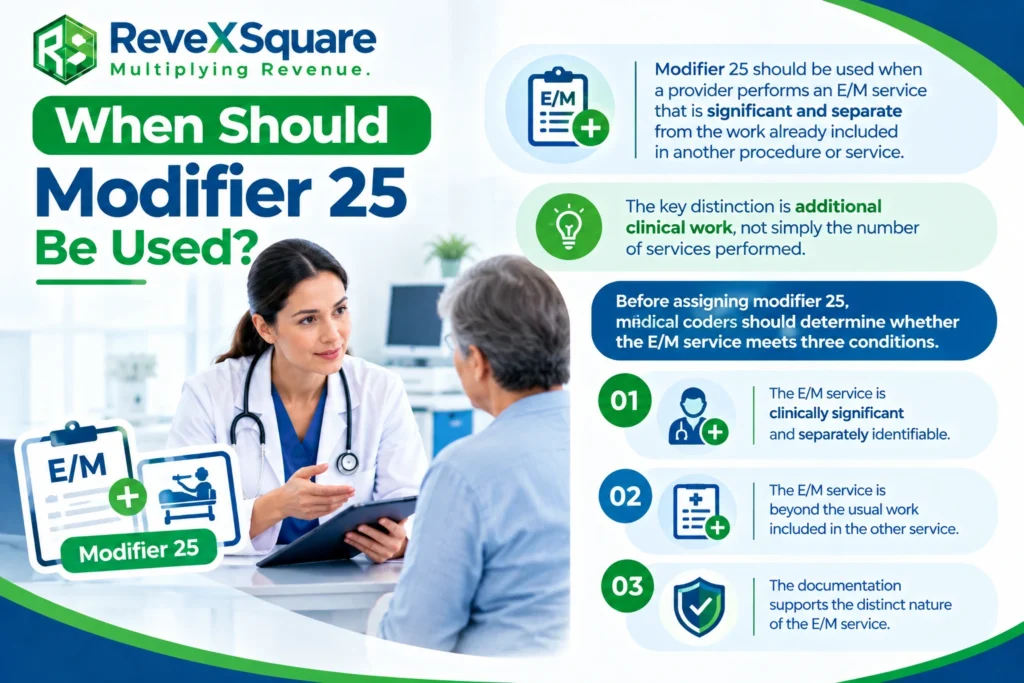
Modifier 25 should be used when a provider performs an E/M service that is significant and separate from the work already included in another procedure or service.
The key distinction is additional clinical work, not simply the number of services performed.
Before assigning modifier 25, medical coders should determine whether the E/M service meets three conditions.
1. The E/M Service Is Medically Necessary
The patient must have a clinical reason for receiving the additional evaluation.
For instance, a patient attending an orthopedic practice for a scheduled joint injection may also require assessment of worsening hypertension.
If the physician evaluates the hypertension, reviews the patient’s treatment, and changes medication based on clinical findings, that work may support a separate E/M service.
However, routine blood pressure checks performed as part of preparing the patient for the injection would not automatically qualify.
2. The Evaluation Goes Beyond Routine Procedure-Related Work
Minor procedures generally include normal pre-procedure and post-procedure care.
This may include reviewing the reason for the procedure, obtaining consent, examining the treatment site, providing immediate aftercare, and giving routine instructions.
Those activities are generally part of the procedure itself.
A separate E/M service must involve additional, identifiable work beyond those included activities.
3. The Medical Record Supports the Separate E/M Service
The documentation must show what the provider evaluated, why the additional service was necessary, and how the findings affected patient management.
The record should independently support the reported E/M code.
A practical test: If the procedure documentation were removed, would the remaining encounter note still justify a medically necessary E/M service?
If not, modifier 25 may be inappropriate.
The American Academy of Family Physicians recommends assessing whether the E/M service would stand alone as a billable encounter.
Modifier 25 Billing Examples: Correct and Incorrect Use
The following examples show how modifier 25 applies to common physician encounters.
These scenarios are illustrative. Actual code selection depends on the complete medical record, the service performed, and the applicable payer rules.
Example 1: Joint Injection and Management of Another Condition
Scenario: A patient arrives at an orthopedic clinic for a previously scheduled knee injection.
During the visit, the patient also reports persistently elevated blood glucose readings. The physician conducts an additional assessment, reviews the patient’s diabetes treatment, and makes a medically necessary change to the management plan.
Can modifier 25 be used?
Potentially, yes.
The knee injection and diabetes evaluation represent different clinical work. If the medical record supports an independently reportable E/M service, modifier 25 may be appended to the appropriate E/M code.
The E/M level must reflect the documented medical decision-making or qualifying time, excluding work already included in the procedure.
Example 2: Scheduled Minor Procedure Without Additional Evaluation
Scenario: A patient attends a dermatology practice for a scheduled removal of a benign skin lesion.
The provider confirms the treatment area, performs the procedure, and gives standard aftercare instructions. No additional condition is evaluated or managed.
Can modifier 25 be used?
No.
The documented work is part of the usual procedure-related service. There is no separately identifiable E/M service to support additional billing.
Even when the patient is new to the practice, new-patient status alone does not justify modifier 25.
Example 3: Preventive Visit With a Significant Medical Problem
Scenario: A patient arrives for an annual preventive examination.
During the appointment, the physician discovers uncontrolled hypertension, performs additional evaluation, reviews the medication regimen, and develops a treatment plan.
Can modifier 25 be used?
Yes, when the additional problem-oriented E/M service is separately supported.
For a qualifying commercially insured preventive visit, a practice may report the preventive medicine service and an appropriate problem-oriented E/M code with modifier 25.
For an eligible Medicare patient receiving an Annual Wellness Visit, a separate, medically necessary problem-oriented E/M service may also be reportable under Medicare rules.
The code selection and billing requirements differ between Medicare wellness services and conventional preventive medicine visits.
Patients may also have deductible or coinsurance responsibilities for the separately billed problem-oriented service.
For practices regularly managing preventive and chronic care encounters, accurate coding is particularly important. Revex Square offers family medicine billing services designed around these revenue cycle requirements.
Example 4: Diagnostic Nasal Endoscopy and a Separate E/M Service
Scenario: A patient visits an ENT specialist for persistent sinus symptoms.
The physician performs a clinically necessary evaluation that goes beyond the usual work associated with a diagnostic nasal endoscopy. During the same encounter, the endoscopy is performed.
Can modifier 25 be used?
Potentially, yes.
If the E/M service is significant, separately identifiable, and supported by documentation, it may qualify for separate reporting.
The American Academy of Otolaryngology–Head and Neck Surgery’s July 2026 guidance discusses this type of encounter.
However, merely performing a history and examination routinely required for the endoscopy does not establish a separate billable E/M service.
Example 5: Evaluation That Results in Major Surgery
Scenario: A physician evaluates a patient and decides to perform a major surgical procedure with a 90-day global period.
Should modifier 25 be used for the decision for surgery?
Generally, no.
When the E/M service results in the decision to perform a major surgery, modifier 57 is generally the appropriate modifier for the qualifying E/M service.
This distinction matters because using the wrong modifier can result in inaccurate claim reporting.
Modifier 25 Documentation Requirements
The strongest support for modifier 25 is a medical record that clearly separates the significant E/M work from the services normally included in the procedure.
Documentation should establish medical necessity and support the selected E/M level.
The following elements are important:
- Reason for evaluation: Identify the complaint or condition that required additional medical attention.
- Relevant clinical findings: Include the medically appropriate history, examination, and other findings relevant to the E/M service.
- Medical decision-making: Document the problems addressed, data reviewed or analyzed, and management risks when those elements apply to code selection.
- Assessment and plan: Explain the physician’s conclusions and the treatment or follow-up plan.
- Procedure documentation: Record the procedure separately enough to distinguish its normal work from the additional E/M service.
- Correct E/M level: Support the reported code through the applicable medical decision-making or total-time requirements.
A separate note may make the distinction clearer, but separate notes are not always required. What matters is whether the documentation establishes two separately reportable services.
Can E/M Time Be Counted Twice?
No.
When an office or outpatient E/M level is selected using time, the practice should not count time devoted to separately reported procedures toward the E/M total.
Likewise, work already included in the procedure should not be reused to justify the separate E/M service.
The AAPC E/M coding resource explains the applicable E/M selection framework, including medical decision-making and total time.
Documentation tip for physicians: Make the additional clinical work clear when completing the encounter note. Coders should report the work actually documented rather than relying on assumptions about what occurred.
Modifier 25 Medicare Guidelines for 2026
The Centers for Medicare & Medicaid Services (CMS) addresses modifier 25 in the National Correct Coding Initiative (NCCI) Policy Manual.
The 2026 Medicare NCCI Policy Manual, effective January 1, 2026, maintains important distinctions between minor procedures, major procedures, and separately identifiable E/M services.
Minor Procedures: 0-Day and 10-Day Global Periods
Medicare generally includes routine related E/M work in the payment for procedures with global periods of:
- 000: A procedure with a same-day global period.
- 010: A minor surgical procedure with a 10-day postoperative global period.
A significant, separately identifiable E/M service may be reported with modifier 25 when the applicable requirements are met.
However, the decision to perform a minor procedure is normally included in its payment.
A separate office visit should not be reported merely because the physician evaluated the patient and then decided to perform that minor procedure.
Major Procedures: 90-Day Global Period
A procedure with a 90-day global period is considered major surgery under Medicare’s global surgery rules.
When an eligible E/M service leads to the decision to perform major surgery, modifier 57 generally applies instead of modifier 25.
The correct modifier depends on the relationship between the E/M service, the surgical procedure, and the global period.
Do E/M Services Need Different Diagnosis Codes?
No. Medicare does not require different diagnoses for modifier 25.
The E/M service and procedure may relate to the same medical condition.
However, the medical record must still support clinically distinct E/M work beyond what is included in the procedure.
A separate diagnosis also does not automatically justify reporting an additional E/M code.
How Does Modifier 25 Affect HCPCS Code G2211?
HCPCS code G2211 describes office or outpatient E/M visit complexity associated with certain ongoing patient-care relationships.
The relationship between G2211 and modifier 25 requires special attention.
Since January 1, 2025, Medicare has allowed payment for G2211 with an eligible office or outpatient E/M code carrying modifier 25 in certain preventive-service circumstances.
These include qualifying same-day Annual Wellness Visits, vaccine administration, and specified Medicare Part B preventive services.
This exception does not mean G2211 is automatically payable whenever modifier 25 is reported.
CMS also expanded G2211 eligibility to specified home or residence E/M codes beginning January 1, 2026, subject to applicable requirements.
Practices should consult the CMS Medicare Preventive Services guidance, updated October 2026 before reporting G2211 with same-day services.
Modifier 25 vs. Modifier 59 vs. Modifier 57
Using the correct modifier is essential because each modifier communicates a different billing circumstance.
| Modifier | Main purpose | Generally appended to |
| 25 | Significant, separately identifiable E/M service on the same day as another service | E/M code |
| 59 | Distinct procedural service when the requirements for separate reporting are met | Appropriate non-E/M procedure code |
| 57 | E/M service resulting in the decision for major surgery | E/M code |
Modifier 25 and modifier 59 are not interchangeable.
Modifier 59 concerns the circumstances in which certain procedural services may be separately reported. Modifier 25 identifies qualifying separate E/M work.
Modifier 57 addresses the decision for surgery under the relevant surgical reporting rules.
For a broader explanation of procedural modifiers and Medicare edits, read Revex Square’s CPT modifiers guide.
Why Do Modifier 25 Claims Get Denied?
Modifier 25 denials can occur even when a healthcare professional provides both an E/M service and a procedure on the same date.
The problem may involve documentation, coding, payer policy, or claim processing.
1. Documentation Does Not Support a Separate E/M
The physician’s note may describe only the procedure and its routine associated work.
Without evidence of an additional, medically necessary E/M service, the payer may determine that separate reporting is not justified.
2. Modifier 25 Is Added Automatically
Some billing workflows attach modifier 25 whenever an E/M code and procedure appear on the same claim.
This approach is risky because same-day reporting alone is not enough.
Modifier 25 should follow a documentation review, not an automatic billing rule.
3. The Reported E/M Level Is Unsupported
Even if a separate E/M service occurred, the selected level must be justified.
A physician may perform a legitimate additional evaluation, but the documentation may not support the higher-level E/M code submitted.
The solution may require correcting the E/M level rather than defending an unsupported charge.
4. The Modifier Is Appended to the Wrong Code
Modifier 25 belongs on the qualifying E/M code.
Placing it on the procedure code can result in incorrect claims reporting or a processing issue.
5. Payer-Specific Rules Were Not Checked
Traditional Medicare follows applicable CMS policies, including NCCI requirements.
Medicare Advantage plans, state Medicaid programs, and commercial insurers may have different editing practices or additional payment conditions.
Billing teams should check the applicable payer policy rather than assume that every insurer processes modifier 25 identically.
6. NCCI Edits Are Misunderstood
NCCI Procedure-to-Procedure edits identify code combinations that are not ordinarily separately reportable.
Some edits allow an appropriate modifier when supported by the clinical circumstances. Others do not allow a modifier to bypass the edit.
A modifier should never be added solely to force a claim through an edit.
The CMS NCCI FAQ Library explains this distinction.
How to Resolve a Modifier 25 Claim Denial
When an insurer denies a claim involving modifier 25, the billing team should investigate the actual reason before correcting or appealing the claim.
Step 1: Review the remittance advice. Identify the denied claim line, payer explanation, Claim Adjustment Reason Code (CARC), and relevant remark codes. Do not assume the modifier caused the denial.
Step 2: Check the clinical documentation. Confirm that the medical record supports an independently reportable E/M service and the selected code level.
Step 3: Validate the code combination. Review the procedure code, global period, modifier placement, diagnosis linkage, and applicable coding edits.
Step 4: Check the payer’s billing policy. Determine whether the denial resulted from a coverage rule, claim-editing policy, missing information, or unsupported coding.
Step 5: Select the correct resolution. Submit a corrected claim when an eligible coding or claim-entry error can be corrected. When the original reporting was appropriate, prepare an appeal with relevant supporting documentation.
Step 6: Monitor the outcome. Track the claim through resolution and identify whether the same problem appears on other claims.
If the documentation does not support a separate E/M service, adding modifier 25 or appealing simply to obtain additional payment is not appropriate.
Practices managing recurring modifier-related denials may benefit from dedicated medical billing denial management services that focus on root-cause analysis, corrections, and payer appeals.
Modifier 25 Coding Audit Checklist for Medical Practices
Before submitting an E/M service with modifier 25, use this checklist:
| Audit question | Verification |
| Was an E/M service performed on the same date as another procedure or service? | Confirm service dates and billing circumstances |
| Is the E/M service independently medically necessary? | Review the clinical reason and assessment |
| Is the additional work beyond the usual procedure-related care? | Compare E/M documentation with included procedure work |
| Does the selected E/M level match the medical record? | Validate MDM or applicable total-time criteria |
| Is modifier 25 attached to the correct code? | Check the E/M claim line |
| Are applicable NCCI and payer rules satisfied? | Review current edits and payer requirements |
| Is the supporting documentation available? | Confirm record completeness before submission |
A consistent review process can help practices recognize unsupported modifier use before claims reach the payer.
It may also identify eligible encounters where separately reportable E/M services were overlooked.
How Medical Practices Can Reduce Modifier 25 Denials
Reducing recurring denials requires coordination between physicians, medical coders, and the billing team.
Start by identifying where mistakes enter the workflow.
If documentation is consistently incomplete, the practice may need clearer provider templates or focused training. If the claim line contains the wrong modifier, a coding validation step may be necessary.
If a particular insurer repeatedly denies appropriately documented services, the billing team should examine that payer’s editing rules and appeal process.
Practices should also track modifier-related performance over time.
Useful measures include:
- Modifier 25 denial rate by payer and specialty.
- Denials caused by insufficient documentation.
- Claim corrections involving E/M levels or modifier placement.
- Appeal outcomes and recovered reimbursement.
- Repeat denial patterns after coding workflow changes.
These findings can guide improvements in charge capture, clinical documentation, and claim submission.
Revex Square provides medical coding services and revenue cycle management support for healthcare practices seeking a more structured billing process.
How Revex Square Supports Modifier 25 Billing Accuracy

For a busy medical practice, the difficulty is not always understanding what modifier 25 means. It is applying the rule consistently across providers, specialties, and payers.
Revex Square helps healthcare providers manage the medical coding and billing processes that influence claim accuracy.
Its services include coding review, claim preparation, denial management, and accounts receivable follow-up.
For practices experiencing modifier 25 problems, these capabilities can support three important improvements.
More accurate medical coding: Review the medical record, E/M code selection, procedure reporting, and supporting documentation before claims are submitted.
Better denial follow-up: Investigate denied claim lines, identify coding or payer-related issues, and pursue appropriate corrections or appeals.
Improved revenue cycle visibility: Monitor claims, reimbursement issues, and recurring denial patterns so practice managers can address problems before they become widespread.
Revex Square is based in Texas and serves healthcare providers across the United States. Its medical billing services are designed for physician practices and healthcare organizations seeking outsourced revenue cycle support.
Need Help With Modifier 25 Denials?
If your practice regularly bills E/M services alongside procedures, recurring modifier 25 denials deserve closer review.
An examination of denied claims, provider documentation, payer edits, and coding workflows can help identify whether the issue involves unsupported reporting, missed billing opportunities, or insurer processing.
Contact Revex Square to discuss your medical coding, claim denials, and billing requirements.
Frequently Asked Questions About Modifier 25 Billing
1. Can modifier 25 be billed for the same diagnosis as the procedure?
Yes. A different diagnosis is not required under Medicare’s modifier 25 rules. The E/M service must still involve significant, separately identifiable work beyond the services included in the procedure. The medical record must support the additional E/M service.
2. What documentation does CPT 99213-25 require?
CPT 99213-25 requires documentation supporting an established-patient office or outpatient E/M service at the appropriate level, plus evidence that the E/M work was significant and separate from another same-day service. The record must support the applicable medical decision-making or time requirements without counting procedure work twice.
3. Why do insurers deny claims with modifier 25?
Common reasons include insufficient E/M documentation, an unsupported E/M level, incorrect modifier placement, bundled services, and payer-specific claim edits. The practice should review the actual denial codes and documentation before determining whether a corrected claim or appeal is appropriate.
4. Can a medical billing company help reduce modifier 25 denials?
Yes. A medical billing and coding company can review documentation, validate E/M coding, check applicable payer requirements, and identify recurring denial patterns. These steps can reduce preventable errors, although they cannot guarantee that every properly submitted claim will be paid.
5. Can Revex Square review previously denied modifier 25 claims?
Revex Square provides denial management and medical coding services that can help practices assess previously denied claims. Potential recovery depends on the documentation, payer rules, filing or appeal deadlines, and whether the original service is eligible for payment.
6. Do Medicare and commercial payers follow the same modifier 25 rules?
Not always. Medicare follows applicable CMS and NCCI guidance. Commercial insurers and Medicaid programs may apply different claims-processing rules or additional documentation requirements. Practices should verify the policies that apply to each payer and service.
7. How much does outsourcing medical billing cost at Revex Square?
Revex Square advertises medical billing services starting as low as 2.75% of collections. Actual pricing depends on the practice’s size, specialty, claim volume, and services required. Practices should request a customized quote to confirm pricing and service scope.
8. Does modifier 25 guarantee additional reimbursement?
No. Modifier 25 identifies a qualifying, separately reportable E/M service. Payment remains subject to medical necessity, documentation, correct coding, coverage, and payer rules. Adding the modifier without a valid clinical basis does not establish eligibility for reimbursement.
Final Takeaway
Modifier 25 should be used when a physician or qualified healthcare professional performs a significant, separately identifiable E/M service on the same date as another procedure or service.
The most important requirement is clear documentation of the additional clinical work.
Practices that apply modifier 25 based on the medical record, verify payer requirements, and review recurring denials are better positioned to submit accurate claims and protect eligible reimbursement.
For healthcare organizations facing frequent coding errors or unpaid claims, Revex Square’s billing team can help evaluate the revenue cycle processes affecting reimbursement