










Modifier 25 vs. modifier 59 is a problem every biller has lived through. The visit was documented, the procedure was documented, the claim went out looking perfect, and two weeks later the E/M line came back denied as “included in another service.” The care was fine. A tiny two-digit modifier was either missing or sitting on the wrong code. Modifier 25 vs. modifier 59 causes the most confusion because both quietly tell the payer, “These services are different; please pay for both.” But they operate in different places, and mixing them up is one of the fastest ways to lose revenue or, frankly, to get an audit letter in the mail.
So let’s clear it up: modifier 25 vs. modifier 59 once and for all.
What Modifier 25 Really Means
CPT describes modifier 25 as a significant, separately identifiable E/M service by the same provider on the same day as a procedure or other service. That means the doctor did more than the usual check-in.
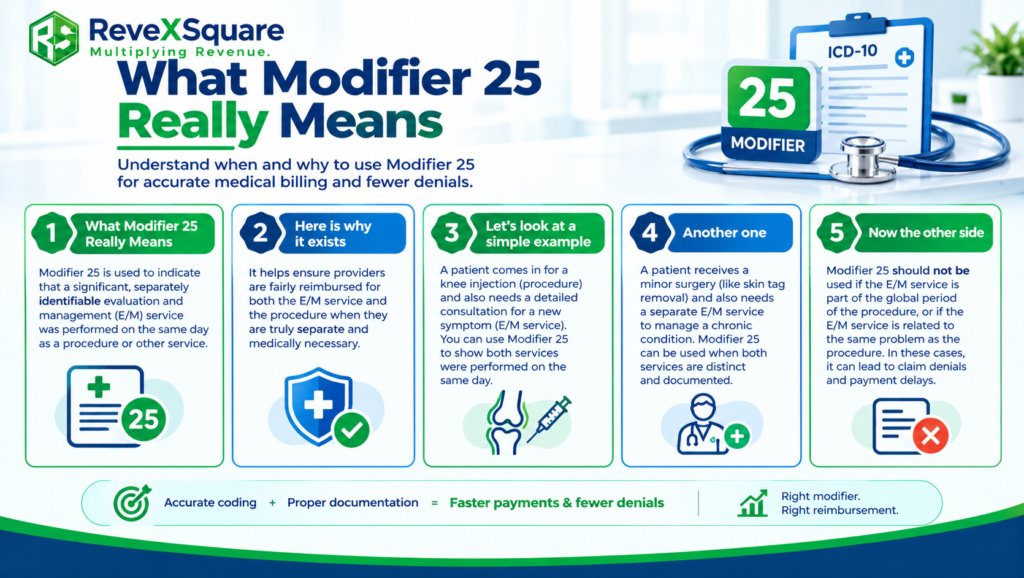
Here is why it exists.
When a provider performs a minor procedure, the payer assumes that the quick evaluation that comes with it (confirming the problem, explaining the plan, obtaining consent) is already included in the procedure fee. Modifier 25 says, “We went well beyond that. This patient needed a full visit on its own.”
Let’s look at a simple example.
A patient walks into a dermatology office with a new itchy rash and also asks about a mole that has changed color. The provider examines the rash, makes a diagnosis, and prescribes treatment. Then the provider biopsies the mole. The claim would show 99213-25 for the rash visit and 11102 for the biopsy. The rash needed its own work-up, so the visit stands alone.
Another one
A patient with worsening asthma is evaluated, the treatment plan is changed, and an injection is given before they leave. That is 99214-25 plus 96372 and the drug code.
Now the other side
If the patient came in only for a procedure that was already planned, there is no separate visit to bill. The usual pre-procedure talk and consent are part of the procedure payment. And if the visit led to a decision for major surgery (a 90-day global), the right modifier is 57, not 25.
What Modifier 59 Really Says
Modifier 59 means “distinct procedural service.” It exists because of the National Correct Coding Initiative (NCCI), a set of edits that bundles certain code pairs together because one service is normally part of the other. When both services were performed as separate and independent services, modifier 59 indicates to the payer that the edit should not apply.
It fits when the services happened in a different session, on a different body site or organ system, through a separate incision, for a separate lesion, or for a separate injury.
Common Example Comes from Physical Therapy
A therapist spends 15 minutes on therapeutic activities (97530) and then, in a separate timed block, 15 minutes on manual therapy (97140). NCCI has an edit between those two codes. If the note shows two distinct, non-overlapping blocks, modifier 59 (or the more specific XU) goes on 97140.
Same idea with two procedures on different sites, such as separate lesions on different parts of the body. If the note names each site clearly, 59 or XS can be supported. Always confirm the pair in the current NCCI tables first, because they change every quarter.
And when should you leave 59 off?
Never use it on an E/M code, never use it when the services were really one procedure, and never use it to push a claim through. If no NCCI edit exists between the two codes, there is nothing to bypass.
The Quick Difference: Modifier 25 vs Modifier 59
The easiest way to remember modifier 25 vs. modifier 59 is this:
| Comparison Criteria | Modifier 25 | Modifier 59 |
| Goes on | E/M codes (office and hospital visits) | Procedure and service codes |
| Tells the payer | The visit was a real, separate service. | The procedure was separate from the other one billed |
| Fixes | E/M bundled into a procedure | NCCI procedure-to-procedure bundling |
| Denied without it | The E/M line | The second procedure (often CO-97) |
Put 25 on a procedure code or 59 on an E/M code, and the claim is wrong from the start.
The X Modifiers: A Smarter Way to Say 59
Modifier 59 was used so often, and so loosely, that CMS created four more specific versions:
• XE: a separate encounter
• XS: a separate structure, such as an organ, site, or lesion
• XP: a separate practitioner
• XU: an unusual, non-overlapping service
CMS says modifier 59 should not be used when one of these describes the situation better. Some payers go further and reject 59 altogether, so check each payer’s rules before you submit.
Why the Chart Matters More Than the Modifier in Modifier 25 vs. 59 Billing
Interestingly, a recent federal audit shows just how often the paperwork falls short. The HHS Office of Inspector General looked at Medicare visits billed with modifier 25 on the same day as eye injections. Medicare had paid about $124 million for roughly 1.4 million of those visits. In the small sample OIG reviewed in detail, 22 out of 24 records did not support the modifier.
That is the Lesson
- A modifier only gets the claim past the edit. The documentation is what gets it paid and keeps it safe later.
- For modifier 25, the note should show a separate problem, with its own history, exam, and decision-making, and a visit level that still holds up after you set the procedure work aside.
- For modifier 59 or an X modifier, the note should name the different site, session, lesion, or provider and record times or locations when timing matters.
Common Modifier 25 vs 59 Examples That Get Denied
Seeing the wrong version helps as much as seeing the right one. These modifier 25 vs 59 examples show the mistakes that most often lead to a denial:
- Modifier 25 on the procedure line. The claim shows 99214 and 20610-25. The modifier belongs on the visit (99214-25), not on the injection. This usually comes back as CO-4.
- Modifier 59 on an E/M code. The claim shows 99214-59. Modifier 59 is for procedures, so the payer rejects it, and the visit still looks bundled.
- Modifier 25 on a planned procedure-only visit. The patient came in just for a scheduled injection, but the claim still bills a visit with modifier 25. With no separate problem in the note, the visit line gets denied or flagged for review.
Each of these looks like a small typo, but it can hold up payment for weeks.
Modifier 25 vs 59 Denials to Watch For
A missing or misplaced modifier usually shows up as one of two codes:
• CO-97: payment is included in the allowance for another service. This often means a missing 59 or X modifier or a missing 25 on the E/M.
• CO-4: the procedure code does not match the modifier, or a required modifier is missing.
Modifier 25 vs modifier 59 usage also gets extra attention in audits. If almost every visit with a procedure carries a 25, or one provider uses 59 far more than peers in the same specialty, someone will ask why. Using them when the record supports it is fine. Using them out of habit is where the trouble starts.
Some commercial payers also have their own rules for E/M services billed with modifier 25, such as reduced payment or prepayment review. Read your contracts and payer bulletins.
Best Practices for Modifier 25 vs 59 to Keep Claims Clean
• Run every claim through a scrubber that checks NCCI edits before it goes out.
• Don’t add modifiers by default. Have the coder confirm the documentation each time.
• Track how often each provider uses modifiers 25 and 59 and compare the rates across your group.
• Review denials by CARC code every month and share the patterns with your providers.
• Re-check payer policies each time the NCCI tables update, which happens quarterly.
Use modifier 25 on the visit when it truly stood alone. Use modifier 59 (or an X modifier) on the procedure when it truly was separate. Back both with a chart that tells the same story, and the claim has a much better chance of getting paid the first time.
Conclusion
In the modifier 25 vs. modifier 59 question, both tell the payer that two services billed together are not duplicates, but they are not interchangeable. Modifier 25 belongs on an E/M code when a significant, separate visit happens on the same day as a procedure. Modifier 59 belongs on a procedure code when an NCCI edit would bundle two really distinct services, and an X modifier is often the more specific choice. The chart decides whether either one holds up, so confirm the documentation before you append it, use it only when the record supports it, and keep an eye on payer policies and quarterly NCCI updates.
Frequently Asked Questions
Can modifier 25 and modifier 59 appear on the same claim?
Yes. Modifier 25 sits on the E/M line, and modifier 59 sits on a procedure line that has an NCCI edit with another procedure. Each one needs its own support in the chart.
Are modifier 25 and modifier 59 the same thing?
No. Modifier 25 is for an E/M visit on the same day as a procedure. Modifier 59 marks a distinct procedure so an NCCI edit does not bundle it.
Does Medicare still accept modifier 59?
Yes, but CMS prefers the more specific XE, XS, XP, or XU modifiers whenever one of them fits.
Can I bill a preventive visit and a problem visit on the same day?
Often, yes. If a significant, separate problem was evaluated during the preventive visit, the problem-oriented E/M can carry modifier 25, provided the note supports it. Payer rules vary.
What if I forgot the modifier?
Send a corrected claim or file an appeal with supporting notes, and do so within the payer’s timely filing window.
Need Help With Modifiers and Denials?
Modifier mistakes are quiet revenue leaks. A few dollars here and a denial there add up fast. Our certified coders check claims against current CPT, NCCI, and payer rules before they are submitted, and our denial management team works the claims that still come back.
Request a free billing audit, and we will show you where modifiers may be costing your practice money.