










Myths About Medical Billing Outsourcing Services in the United States
Medical billing outsourcing used to sound risky to many healthcare providers in the United States. Some practice owners worried about losing control over their finances, exposing sensitive patient information, or working with billing professionals who did not understand the U.S. healthcare system. Others believed that outsourcing was only suitable for large hospitals with complex billing operations and substantial administrative budgets.
Today, medical billing outsourcing has become a practical option for healthcare organizations of different sizes. From independent physicians and small private practices to specialty clinics and larger healthcare facilities, providers are exploring outsourcing to improve billing accuracy, manage claim denials, reduce administrative expenses, and maintain a more consistent revenue cycle.
Medical billing involves several interconnected tasks, including insurance eligibility verification, medical coding, claim submission, payment posting, denial management, and accounts receivable follow-up. When these activities are not handled efficiently, healthcare practices may experience delayed reimbursements, increasing outstanding balances, and unnecessary administrative pressure.
Outsourcing can help practices manage these challenges by providing access to experienced billing professionals, structured workflows, and performance reporting. However, the benefits depend on the billing company’s expertise, communication practices, technology, and understanding of payer requirements.
Despite these advantages, several misconceptions continue to prevent healthcare providers from considering outsourcing. Understanding the facts can help practice owners make informed decisions about their billing operations.
Myth #1 — Medical Billing Outsourcing Means Poor Control Over Finances
Fact: Outsourcing can improve financial visibility and operational control.
One of the most common concerns among healthcare providers is that outsourcing medical billing means giving up control over their revenue. Practice owners may worry that an external team will make financial decisions without their knowledge or provide limited information about submitted claims and outstanding payments.
In reality, a well-managed medical billing partnership should provide clear reporting, defined responsibilities, and regular communication. Practices can continue monitoring their financial performance while delegating routine billing activities to specialists.
Professional billing teams may provide access to claim status reports, accounts receivable summaries, denial analysis, collection reports, and reimbursement tracking. These tools help practice managers identify outstanding claims, understand payment delays, and monitor the progress of their revenue cycle.
For example, if a healthcare practice notices that several insurance claims remain unpaid beyond the expected payment period, its billing partner can investigate the outstanding accounts, identify possible causes, and follow up with the appropriate payer.
Healthcare providers should establish clear reporting schedules, performance indicators, approval procedures, and escalation processes before outsourcing. These arrangements help ensure that practice owners remain informed and retain appropriate oversight of their financial operations.
Myth #2 — Medical Billing Outsourcing Is Only for Big Hospitals
Fact: Small and mid-sized healthcare practices can benefit from outsourcing, too.
Another common misconception is that outsourcing is designed primarily for large hospitals with extensive billing departments. In reality, smaller healthcare practices often face significant administrative challenges because they have fewer employees and limited resources.
Independent physicians, family practices, behavioral health providers, and specialty clinics may depend on a small administrative team to handle patient registration, insurance verification, claim submission, payment posting, and follow-up activities. When one employee is unavailable or the claim volume increases, these responsibilities can quickly become difficult to manage.
Medical billing outsourcing allows smaller practices to access specialized support without necessarily hiring a full in-house billing department. Depending on the agreement, a practice may outsource its entire revenue cycle or select specific services that address its most pressing challenges.
For instance, a small clinic experiencing frequent claim denials might outsource denial management while continuing to manage patient registration internally. A growing medical practice may choose broader billing support as its patient volume increases.
This flexibility allows providers to align billing support with their operational needs and available budget.
However, outsourcing does not automatically guarantee better collections. Practices should evaluate the provider’s experience, service scope, reporting methods, and performance expectations before making a decision.
Read more: Why Small Healthcare Practices Need Medical Billing Services in 2026
Myth #3 — Medical Billing Outsourcing Is More Expensive Than Hiring Internally
Fact: Outsourcing may reduce overall operating costs, depending on the practice’s needs.
Some healthcare providers assume that paying an external billing company will cost more than employing their own billing staff. This assumption often overlooks the full cost of maintaining an in-house billing operation.
Hiring internal employees involves more than salaries. Practices may also need to cover employee benefits, recruitment, training, billing software, technology maintenance, continuing education, and the time required to supervise daily activities.
Staff turnover can create additional expenses when experienced billers leave and replacement employees require training. Smaller practices may also struggle to maintain sufficient staffing during busy periods, which can lead to backlogs and delayed claim follow-ups.
Medical billing outsourcing can combine several of these responsibilities into a service agreement. Depending on the provider’s pricing model, the practice may pay a percentage of collections, a fixed monthly fee, or another agreed-upon rate.
Before comparing costs, practice owners should examine both direct expenses and indirect costs, including:
- Employee salaries, benefits, and payroll-related expenses.
- Billing software, clearinghouse fees, and technology maintenance.
- Training, recruitment, and employee turnover.
- Lost revenue associated with preventable denials and delayed follow-ups.
- Management time spent monitoring billing performance.
For example, a practice with a low claim volume may find that a flexible outsourcing arrangement is more economical than maintaining a dedicated billing employee. A larger practice with established systems may reach a different conclusion.
The most appropriate option depends on claim volume, specialty requirements, staffing capacity, and the quality of the existing billing process. Providers should compare total operating costs alongside service quality and measurable results rather than focusing only on the monthly outsourcing fee.
Myth #4 — Medical Billing Outsourcing Leads to More Mistakes and Claim Denials
Fact: An experienced billing partner can help reduce preventable errors and improve claim quality.
Medical billing errors can occur when patient information is inaccurate, insurance coverage is not verified, procedure codes are incorrect, required documentation is missing, or payer-specific rules are overlooked.
Some healthcare providers believe that introducing an external billing team will create additional communication problems and increase the likelihood of errors. These concerns may be valid when a billing partner lacks appropriate training, quality controls, or knowledge of the practice’s specialty.
However, experienced billing professionals can establish systematic procedures for reviewing claims, identifying common errors, and addressing recurring denial patterns.
A structured billing process may include checking patient demographics, verifying insurance eligibility, reviewing coding and documentation requirements, confirming authorization when applicable, and validating claims before submission.
For example, if a practice repeatedly receives denials because prior authorization information is missing, a billing team can identify the recurring issue and recommend changes to the authorization workflow. Correcting the underlying process may help prevent similar denials in future submissions.
Outsourcing can also provide access to specialists who monitor payer requirements and applicable coding updates. Nevertheless, results depend on the billing company’s expertise, the accuracy of the information provided by the practice, and the effectiveness of its quality assurance procedures.
Healthcare practices should also understand their privacy responsibilities when working with external billing partners. The U.S. Department of Health and Human Services (HHS) guidance on HIPAA business associates explains the obligations that apply to business associates handling protected health information.
Myth #5 — Outsourcing Medical Billing Hurts the Patient Experience
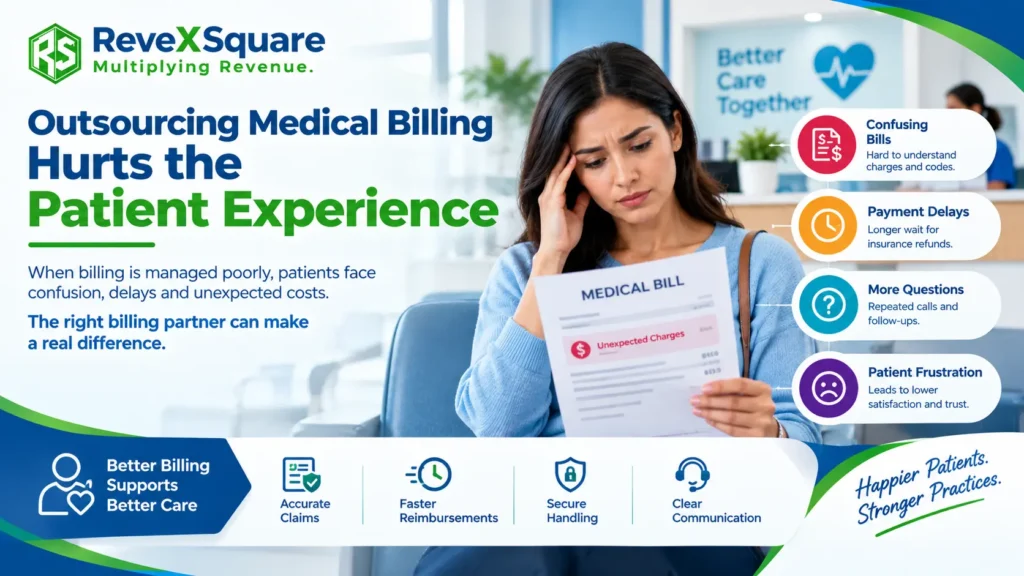
Fact: Efficient billing processes can support a smoother patient financial experience.
Patient satisfaction depends on more than the quality of clinical care. Billing confusion, unexpected balances, delayed statements, and difficulty understanding insurance responsibilities can also affect how patients perceive a healthcare practice.
When internal staff spend a large portion of their time correcting claims, contacting insurance companies, and investigating payment delays, they may have less time available to assist patients with appointments, billing questions, and other administrative needs.
A capable medical billing partner can help organize these processes and improve communication between billing operations and the practice’s front office.
For example, a billing team may help identify discrepancies between insurance payments and expected reimbursement, investigate unresolved balances, and prepare clearer account information for staff responding to patient questions.
Outsourcing may also support more timely claim processing and payment posting, helping practices identify patient responsibility after insurance adjudication.
However, a positive patient experience requires coordination between the external billing team and the healthcare practice. Patients should know whom to contact about billing questions, and sensitive financial concerns should be handled professionally.
Before outsourcing, providers should establish communication protocols, define responsibilities for patient inquiries, and agree on procedures for correcting billing issues. These steps can help maintain continuity and prevent patients from being transferred repeatedly between different departments.
Myth #6 — Medical Billing Outsourcing Is Too Risky for Data Security
Fact: Security risks can be managed through appropriate safeguards, contracts, and oversight.
Healthcare providers handle sensitive information, including patient demographics, insurance details, treatment-related information, and financial records. Sharing the information needed for billing with an external company naturally raises questions about privacy and security.
Some practice owners believe that keeping all billing activities in-house is the only way to protect patient information. However, internal operations can also face risks from unauthorized access, phishing attacks, weak passwords, improper data handling, and inadequate employee training.
The important consideration is not simply whether billing is performed internally or externally. It is whether appropriate safeguards are in place and consistently followed.
Healthcare organizations should evaluate a potential billing partner’s security policies, access controls, employee training, incident response procedures, data handling practices, and contractual commitments.
Depending on the services provided and the applicable legal requirements, these safeguards may include:
- A business associate agreement when required under HIPAA.
- Role-based access controls and appropriate authentication measures.
- Encryption and secure methods for transferring information.
- Employee confidentiality and security training.
- Audit procedures and incident reporting protocols.
- Documented policies for data retention, access, and disposal.
Healthcare providers should verify these safeguards rather than relying on general claims that a company is secure or compliant. HIPAA responsibilities depend on the parties’ roles and applicable requirements, and a contract alone does not guarantee compliance.
A careful vendor evaluation can help practices understand the risks involved and determine whether an outsourcing arrangement meets their privacy and security expectations.
Myth #7 — Medical Billing Outsourcing Means Working With Offshore Teams Only
Fact: Outsourcing arrangements can involve different staffing and service models.
The term outsourcing is sometimes associated exclusively with offshore billing teams. This misconception can discourage healthcare providers who prefer working with professionals familiar with U.S. payer systems, healthcare terminology, and domestic business practices.
In reality, medical billing outsourcing can involve U.S.-based teams, offshore teams, or hybrid arrangements that combine different locations and responsibilities.
Each model may offer different advantages and limitations. U.S.-based teams may appeal to practices that prioritize domestic staffing and convenient business-hour coordination. Offshore or hybrid arrangements may offer different cost structures or staffing capacity, depending on the provider.
Location alone, however, does not determine the quality of a billing service. Healthcare providers should evaluate the team’s experience with U.S. insurance requirements, specialty-specific billing, communication standards, quality assurance, and data security.
Practices should also ask how the company handles time-zone differences, urgent claim issues, staff supervision, and access to patient information.
When evaluating an outsourcing partner, the priority should be finding a service model that meets the practice’s operational, financial, communication, and compliance requirements.
Myth #8 — Outsourcing Means Losing Direct Communication With the Billing Team
Fact: Clear communication can be built into the outsourcing agreement.
Some practice managers worry that working with an external billing company will make it harder to resolve claim issues or obtain updates about outstanding payments. This concern is particularly important when a practice needs quick answers about denials, reimbursement delays, or payer requests.
Communication problems are possible when responsibilities are unclear or the service provider does not have a reliable escalation process. However, these problems are not an unavoidable part of outsourcing.
Before entering an agreement, healthcare providers should determine who will serve as the primary contact, how frequently performance reports will be shared, and how urgent issues will be escalated.
A structured communication process may include regular account reviews, outstanding claim reports, denial trend summaries, and scheduled meetings with the billing team.
For example, if a healthcare practice identifies an unexpected increase in unpaid claims, the billing partner should be able to explain which claims are affected, what steps have been taken, and whether additional information is required from the practice.
Clearly defined responsibilities also help prevent delays caused by uncertainty about who must provide documentation, respond to payer requests, or correct patient information.
A strong outsourcing relationship should function as a coordinated extension of the practice’s administrative operations, with both parties understanding their responsibilities.
Myth #9 — Medical Billing Outsourcing Guarantees Faster Payments
Fact: Outsourcing can improve billing efficiency, but reimbursement timelines still depend on several factors.
Healthcare providers often consider outsourcing because they want to receive insurance payments more consistently. Although an experienced billing company can help reduce administrative delays, no billing partner can guarantee that every claim will be paid quickly.
Reimbursement timelines depend on factors such as payer processing requirements, claim accuracy, medical documentation, authorization rules, eligibility information, and the need for additional review.
An effective billing team can help practices address avoidable delays by submitting clean claims, monitoring claim status, following up on unpaid accounts, and responding to payer requests promptly.
For example, a claim that remains unpaid because of missing documentation may require additional information before the payer can complete its review. A billing partner can identify the issue and coordinate with the practice to obtain the required records.
Providers should monitor meaningful performance indicators, including days in accounts receivable, denial rates, first-pass claim acceptance, collection performance, and the age of outstanding balances.
These measurements provide a more realistic picture of billing performance than relying on promises of immediate reimbursement.
The goal of outsourcing should be to create a more organized, measurable, and consistent revenue cycle rather than expecting every insurance payment to arrive without delays.
How to Choose the Right Medical Billing Outsourcing Partner
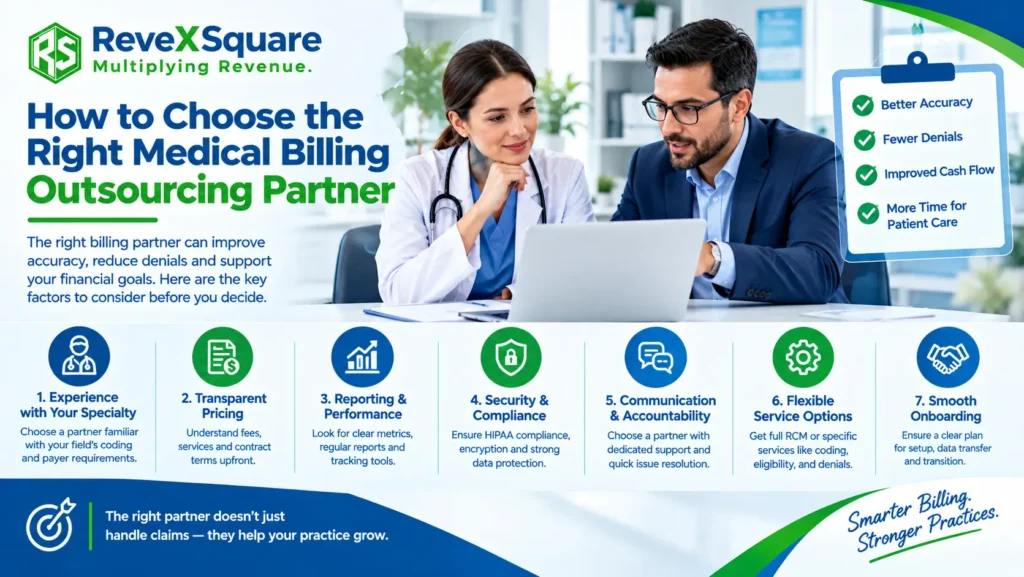
After understanding the common myths, healthcare providers should evaluate potential billing partners carefully. The quality of the service provider can significantly influence the outcome of an outsourcing arrangement.
Consider the following factors before making a decision:
1. Experience with your medical specialty
Different specialties may have different coding requirements, documentation standards, authorization rules, and payer workflows. Choose a provider with relevant experience handling your practice’s services and claim types.
2. Transparent pricing and service agreements
Understand how fees are calculated, which services are included, and whether additional charges apply. Review contract terms, reporting commitments, termination provisions, and responsibility for unresolved claims.
3. Reporting and performance monitoring
Ask which metrics the company tracks and how often it shares performance reports. Reporting should help you understand claim status, denials, outstanding balances, and collection trends.
4. Security and privacy safeguards
Review the provider’s security policies, access controls, relevant contractual obligations, and procedures for handling protected health information. Verify that the arrangement meets applicable legal and organizational requirements.
5. Communication and accountability
Confirm who will manage your account, how urgent issues will be handled, and how the company coordinates with your staff. Clear communication can reduce confusion and improve the resolution of billing problems.
6. Flexible service options
Determine whether the company offers complete revenue cycle management or individual services such as medical coding, eligibility verification, denial management, and accounts receivable follow-up.
7. A clear onboarding process
Ask how the provider will review existing workflows, transfer necessary information securely, establish responsibilities, and monitor performance during the transition.
Taking these steps can help healthcare practices compare providers based on their actual operational needs instead of relying exclusively on pricing or marketing promises.
Final Thoughts
Medical billing outsourcing is no longer simply an alternative for practices that cannot maintain an in-house billing department. It can be a strategic option for healthcare providers seeking specialized expertise, more organized billing workflows, and better visibility into their revenue cycle.
The myths surrounding outsourcing often arise from concerns about financial control, service quality, data security, communication, and cost. These concerns deserve careful consideration, but they do not mean that outsourcing is inherently risky or unsuitable for healthcare organizations.
The right approach is to evaluate the potential benefits alongside the responsibilities involved. Healthcare providers should assess a billing company’s experience, security practices, reporting capabilities, pricing structure, and ability to support their specialty.
When responsibilities are clearly defined and performance is monitored consistently, outsourcing can help practices address administrative bottlenecks, manage outstanding claims, and dedicate more internal resources to patient care.
For healthcare organizations considering this approach, medical billing services can provide a starting point for exploring billing support that aligns with their operational requirements.
Ultimately, the best decision depends on the practice’s goals, resources, and existing billing performance. A well-planned outsourcing arrangement can support financial stability while allowing healthcare teams to focus on delivering quality care.