




Point of care CNA refers to documenting the care Certified Nursing Assistants provide to residents, usually through an electronic charting system at or near the time of care. In nursing homes and skilled nursing facilities, CNAs record daily activities such as bathing, eating, transfers, mobility assistance, and changes in a resident’s condition.
These records help nurses monitor care, identify changes, and maintain accurate resident information. They may also support Minimum Data Set (MDS) assessments used in skilled nursing facilities.
Effective CNA charting is not simply about completing a checklist. It requires recording what happened, how much help the resident needed, and whether nursing staff should follow up.
What Is Point of Care CNA?
Point of care CNA is a documentation process that allows Certified Nursing Assistants to record daily resident care using an electronic system. Staff may enter information through tablets, computers, or workstations located near residents.
The purpose is to maintain timely, accurate records of services provided during a shift.
For example, when a CNA assists a resident with moving from bed to wheelchair, the charting system may ask whether the resident needed supervision, hands-on assistance, or help from more than one caregiver.
The CNA records the assistance actually provided, following facility instructions.
Point of care CNA is not a separate nursing certification. It describes how nursing assistants document care within their assigned responsibilities.
What Does POC Mean in Nursing Homes?
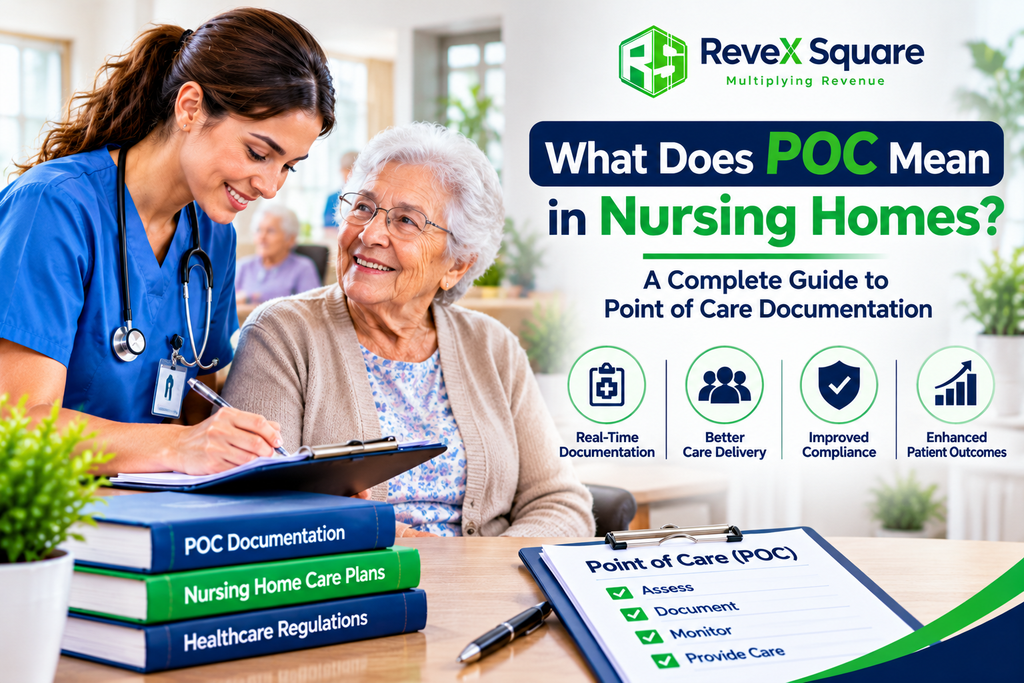
POC stands for point of care. It refers to the place where resident care is delivered.In nursing facilities, POC charting usually means entering care information electronically while working near the resident or shortly after completing the task.The term can also appear in other healthcare settings, so context matters. POC charting is different from point-of-care testing, which involves diagnostic testing near a patient.
How Does Point of Care CNA Charting Work?
A typical point-of-care charting process begins with the resident’s care plan and ends with an accurate electronic record.
1. Review the Resident’s Care Plan
The CNA checks assigned care instructions before beginning work.
These may include bathing schedules, mobility precautions, dietary assistance, repositioning, and other daily care requirements.
2. Provide the Assigned Care
The CNA performs the task within their training, responsibilities, and facility policies.
During care, they observe how the resident responds and how much assistance is required.
3. Record the Care Provided
The CNA enters the relevant information into the electronic chart.
The entry should reflect the care actually performed. A completed task should not be recorded if the resident refused it or the task was not carried out.
4. Report Changes to Nursing Staff
When a CNA notices a concerning change in a resident’s condition, documentation alone may not be enough.
The CNA should notify the responsible nurse according to the facility’s escalation procedures. Urgent conditions require immediate action under facility policy.
5. Complete and Review the Entry
Before saving, the CNA confirms that the correct resident, task, and response have been selected.
The completed entry becomes part of the information available to authorized members of the care team.
What Should CNAs Document at the Point of Care?
CNA charting commonly includes assistance with activities of daily living (ADLs) and observations made during resident care.
The specific tasks depend on the resident’s care plan, state requirements, facility policy, and the CNA’s authorized duties.
| Care activity | Documentation examples |
|---|---|
| Bathing | Assistance provided, completion, refusal |
| Dressing and grooming | Type and level of assistance |
| Eating | Meal intake and feeding assistance |
| Fluids | Intake measurements when assigned |
| Toileting | Assistance and relevant observations |
| Transfers | Assistance required and equipment used |
| Bed mobility | Repositioning and mobility support |
| Vital signs | Assigned measurements and observations |
| Skin condition | Visible changes reported to nursing staff |
| Behavior | Specific changes observed during care |
| Refused care | Task declined and required notification |
CNAs should document observable information without making diagnoses that fall outside their scope.
For example, a CNA may record that a resident appeared more confused than usual and that the nurse was notified. Determining the medical cause of that change belongs to an appropriately qualified clinician.
What Does Accurate CNA POC Documentation Look Like?
Good documentation describes what the CNA observed and the assistance actually provided.
Consider these examples.
Example 1: Bed-to-Wheelchair Transfer
Incomplete entry:
“Transfer completed.”
More useful entry:
“Assisted resident from bed to wheelchair using a gait belt and one-person physical assistance, as directed by the care plan. Resident required steadying during the transfer.”
The second entry makes the resident’s level of assistance clearer.
It also provides information that can be reviewed by nurses and assessment staff.
Example 2: Reduced Food Intake
Incomplete entry:
“Poor appetite.”
More useful entry:
“Resident consumed approximately 25% of lunch and declined additional food. Charge nurse notified.”
The entry reports an observable finding rather than an unsupported conclusion.
Example 3: Refused Care
Incomplete entry:
“Bath completed.”
More useful entry:
“Resident declined scheduled bathing assistance. Staff offered care again later, and the charge nurse was notified according to facility policy.”
A refused service must not be documented as completed.
These examples are for training purposes. Facilities should follow their approved charting terminology and procedures.
Why Is Point of Care CNA Documentation Important in Nursing Homes?
Accurate documentation helps the care team understand what happened during a shift and whether a resident’s needs have changed.
Continuity of Care
Residents may receive assistance from different caregivers throughout the day.
Consistent records help the next shift understand recent care, refused services, and observations requiring attention.
Monitoring Functional Changes
Changes in transfers, walking, eating, or toileting assistance may indicate that a resident needs further assessment.
Recording these changes gives licensed nursing staff more information to evaluate.
Supporting Care Plans
Care teams can use documented observations when reviewing whether a resident’s current care plan continues to meet their needs.
Maintaining Complete Records
Federal nursing facility requirements address the quality and organization of resident medical records.
Under 42 CFR § 483.70(h), facilities must maintain medical records that are complete, accurately documented, readily accessible, and systematically organized.
Electronic charting can help facilities maintain those records, but the system itself does not guarantee accuracy.
Staff training, supervision, and reliable documentation practices remain necessary.
How Does Point of Care CNA Charting Support MDS Assessments?
CNA documentation can provide valuable observations for the Minimum Data Set (MDS), a standardized assessment used in Medicare- and Medicaid-certified nursing facilities.
The MDS captures information about a resident’s functional abilities, health conditions, and care needs.
Because CNAs regularly help residents with daily activities, their records may contain useful information about how residents perform those tasks over time.
For example, a resident may begin needing more assistance with transfers than they required at admission.
Consistent CNA observations can help the assessment team investigate that change and determine the resident’s performance using the applicable MDS instructions.
However, CNA charting does not replace the MDS assessment.
Under 42 CFR § 483.20, a registered nurse must conduct or coordinate the resident assessment with appropriate participation from healthcare professionals.
The assessment must accurately reflect the resident’s status.
What Is Section GG in the MDS?
Section GG is the part of the MDS that records functional abilities, including self-care and mobility.
Examples include:
| Section GG item | Functional activity |
|---|---|
| GG0130A | Eating |
| GG0130B | Oral hygiene |
| GG0130C | Toileting hygiene |
| GG0170B | Sit to lying |
| GG0170C | Lying to sitting on the side of bed |
| GG0170D | Sit to stand |
| GG0170E | Chair/bed-to-chair transfer |
| GG0170F | Toilet transfer |
Section GG uses standardized assessment instructions. It should not be scored solely by copying a CNA’s daily charting selection into an MDS item.
The assessment team must consider the applicable assessment period, available evidence, and CMS coding definitions.
2026 update: CMS’s MDS 3.0 RAI Manual version 1.20.11 became effective on October 1, 2026. Facilities should use the current manual when completing applicable assessments.
The older MDS Section G functional status items were replaced by Section GG beginning October 1, 2023.
Facilities can find current instructions in the CMS MDS 3.0 RAI Manual.
Does CNA Point-of-Care Charting Affect Medicare Reimbursement?
CNA documentation can support information used in Medicare skilled nursing facility reimbursement, but an individual CNA entry does not determine payment.
Medicare Part A generally reimburses covered skilled nursing facility stays through the Skilled Nursing Facility Prospective Payment System (SNF PPS).
The Patient-Driven Payment Model (PDPM) classifies eligible residents using clinical and functional information reported through the applicable assessment process.
Section GG functional information contributes to the nursing, physical therapy, and occupational therapy components of PDPM classification.
For example, documentation describing how much help a resident needs with transfers may be relevant when assessment staff evaluate functional performance.
The documentation must be interpreted according to CMS rules. It cannot be adjusted simply to obtain a higher payment category.
The CMS Medicare Payment Systems guide explains how Section GG functional scores contribute to PDPM.
Does Every Nursing Home Use PDPM?
No. PDPM is used for covered Medicare Part A stays under the SNF PPS.
Other nursing facility stays may be paid through state Medicaid programs, managed care contracts, private insurance, or private-pay arrangements. Their reimbursement requirements may differ.
This distinction matters because an electronic CNA charting workflow can be used throughout a facility, even when residents have different payment sources.
Can CNAs Select Billing Codes?
No. Routine CNA care documentation does not authorize nursing assistants to independently assign billing codes or determine reimbursement classifications.
Clinical assessments, medical coding, and claims processing involve separate responsibilities.
Where a facility submits professional or facility claims, authorized billing teams may use medical coding services to review supported diagnoses, services, and coding requirements. Those reviews must rely on appropriate clinical documentation and cannot replace the MDS assessment process.
Common Point of Care CNA Charting Mistakes
Facilities should train staff to recognize documentation mistakes before they become repeated problems.
Delayed Charting
Recording several hours of work at the end of a shift can make it harder to remember specific care details.
CNAs should document promptly while maintaining resident safety and following facility procedures.
Incorrect Assistance Levels
A resident who needs hands-on assistance should not be recorded as independent.
Likewise, supervision is different from physical assistance.
Staff should understand the charting system’s terminology before selecting a response.
Recording Unfinished Care as Completed
If a resident refuses a task, the entry must reflect that refusal.
Marking an incomplete task as completed creates an inaccurate record.
Copying Previous Entries
Repeated entries may fail to capture real changes in a resident’s functional performance.
Charting should reflect the care provided during the relevant shift.
Missing Nursing Notifications
A change in resident condition may require direct communication, not just an electronic note.
Facilities should establish clear expectations for notifying nursing staff.
Using Shared Login Credentials
Shared accounts can prevent facilities from reliably identifying who made a documentation entry.
Individual access controls and accountability are important parts of protecting resident information.
How Can Nursing Homes Improve CNA Charting Accuracy?
Improving CNA documentation requires more than adding tablets or selecting a new software platform.
Facilities need clear instructions, practical training, and routine supervision.
Train Staff on Actual Care Scenarios
Training should include common situations such as transfers, partial feeding assistance, refused bathing, and changes in mobility.
Staff should practice selecting the correct charting response and describing relevant observations.
Standardize Documentation Expectations
Facilities should establish consistent definitions for assistance levels, refusals, incomplete tasks, and notification requirements.
A shared understanding reduces variation between shifts.
Review Records for Missing or Conflicting Information
Supervisors can review charting for incomplete tasks, unexplained changes, and entries that conflict with other clinical records.
Corrections should follow the facility’s documentation policies and preserve an accurate record of what occurred.
Improve Communication Between Care Teams
CNAs, licensed nurses, and MDS coordinators need clear ways to share observations.
When documentation suggests a change in functional status, the appropriate clinical team should evaluate it.
Monitor Documentation Quality
Facilities can track missing entries, late documentation, correction frequency, and staff training needs.
These measures help identify workflow problems without encouraging staff to alter records for reimbursement purposes.
Is Point of Care CNA Charting HIPAA-Compliant?
Electronic point-of-care charting can be used in a HIPAA-compliant environment when the facility implements appropriate privacy and security safeguards.
These may include authorized user access, secure devices, authentication controls, audit trails, workforce training, and procedures for handling lost or stolen devices.
According to the U.S. Department of Health and Human Services, mobile devices may access electronic protected health information when appropriate safeguards are in place. Relevant third-party service providers may also require business associate agreements.
Using an electronic charting platform does not automatically make a facility HIPAA-compliant.
The facility must evaluate how resident information is accessed, stored, transmitted, and protected.
Point of Care CNA vs. Traditional Paper Charting
Both electronic and paper records must accurately describe resident care. The main differences involve how staff record, access, and review information.
| Feature | Point-of-care electronic charting | Paper charting |
|---|---|---|
| Data entry | Electronic device or workstation | Paper forms |
| Access | Available to authorized users through the system | Depends on physical record availability |
| Record corrections | May provide system audit history | Requires compliant correction procedures |
| Reporting | May support automated summaries | Often requires manual review |
| Security | Depends on technical and administrative safeguards | Depends on physical and administrative controls |
| Staff training | Requires software and documentation training | Requires documentation and record-handling training |
Electronic systems may make some tasks easier, but they can also introduce problems when devices fail, connectivity is unreliable, or staff are not trained properly.
Facilities should maintain approved downtime procedures so resident care and documentation can continue during a system outage.
How Does CNA Documentation Connect With Medical Billing and RCM?
Point-of-care CNA charting and medical billing serve different purposes, but both depend on accurate information.
CNAs document resident care. Nurses and assessment professionals use clinical information to evaluate resident needs and complete applicable assessments. Billing personnel process claims according to the facility’s payment arrangements and payer requirements.
Problems can arise when records do not agree.
For example, an MDS review may identify differences between daily functional observations and an assessment entry. That discrepancy requires review by the responsible clinical and assessment staff.
A billing team should not independently change the clinical record or functional assessment.
If a claim is denied because required information is missing, incorrect, or inconsistent, the facility may need to coordinate clinical documentation review with its claims team. Structured denial management services can assist with reviewing payer denials and pursuing appropriate corrections or appeals.
Not every nursing facility denial is related to CNA documentation. Coverage, eligibility, authorization, coding, claim formatting, and payer-specific requirements can also affect payment.
For facility administrators, accurate CNA records are therefore one part of a larger clinical and administrative workflow.
Point of Care CNA Documentation Checklist
Before submitting a point-of-care entry, CNAs should confirm the following:
- The correct resident is selected.
- The date and relevant task are accurate.
- The care recorded was actually provided.
- The documented assistance reflects what happened.
- Refused or incomplete care is recorded correctly.
- Relevant observations are included.
- Concerning changes have been reported to the nurse.
- The entry is saved under the authorized user account.
Facilities can adapt this checklist to their care policies and documentation software.
Frequently Asked Questions About Point of Care CNA
What does point of care CNA mean?
Point of care CNA means documenting resident care at or near the time it is provided by a Certified Nursing Assistant. In nursing homes, this usually involves electronic charting of daily assistance, observations, and care tasks.
Is point of care CNA a separate certification?
No. Point of care CNA is not a separate professional certification. It generally refers to a charting workflow used by Certified Nursing Assistants who meet the applicable training and competency requirements for their roles.
What is CNA POC charting?
CNA POC charting is the process of electronically recording the assistance provided to residents. Common entries include bathing, eating, transfers, toileting, mobility, vital signs, and changes in resident condition within the CNA’s assigned duties.
How does point of care CNA work in nursing homes?
The CNA reviews the resident’s care plan, provides assigned care, documents what happened, and reports concerning changes to the nurse. Authorized staff can then review the electronic information for care coordination and assessment purposes.
Can CNA documentation be used for MDS Section GG?
Yes. CNA observations may provide supporting information when the assessment team evaluates resident function. However, Section GG must be completed according to CMS instructions. Daily CNA charting does not automatically establish the MDS response.
Does point of care CNA charting affect PDPM payments?
CNA documentation may support assessment information used in PDPM classification for covered Medicare Part A skilled nursing facility stays. CNAs do not independently determine PDPM scores, billing codes, or payment amounts.
What happens if a CNA forgets to chart care?
The CNA should follow the facility’s policy for late entries and corrections. Records must accurately reflect the care provided and should not falsely represent a late entry as documentation completed earlier.
Can CNAs use tablets for point-of-care charting?
Yes. Nursing homes may authorize CNAs to use tablets or other electronic devices for documentation. The facility must maintain appropriate security safeguards and provide training on the approved system.
Is point-of-care charting required in every nursing home?
Federal nursing facility rules require accurate resident records and applicable assessments, but they do not require every nursing home to use a particular CNA electronic charting product. Facilities may choose systems according to their operational and regulatory needs.
How can nursing facilities reduce CNA documentation errors?
Facilities can improve accuracy through practical staff training, consistent charting definitions, regular record reviews, clear escalation procedures, and coordination between CNAs, nurses, and assessment teams.
Conclusion
Point of care CNA documentation helps nursing homes record daily resident care more accurately and share useful observations with the care team.
Its value depends on the quality of the information entered. Accurate assistance levels, timely entries, clear reporting, and proper nursing follow-up help facilities maintain reliable records and identify changes in resident needs.
For skilled nursing facilities, these records may also contribute supporting information for MDS assessments. They do not replace professional assessments or independently determine Medicare reimbursement.
Nursing facilities should treat CNA charting as part of a broader effort to maintain safe resident care, accurate clinical records, and consistent administrative practices.