








Virginia healthcare facility licensing depends on the type of facility, the services offered, the location, and whether regulated equipment or procedures are involved. Hospitals, outpatient surgical hospitals, nursing facilities, home care organizations, and hospice programs may fall under Virginia Department of Health licensing. Some projects also require a Certificate of Public Need (COPN), which is separate from a facility license. After state approval, organizations may still need Medicare enrollment, Virginia Medicaid enrollment through PRSS, commercial payer credentialing, and contracting. Planning licensing, enrollment, credentialing, and revenue cycle management together can reduce launch delays, claim denials, and reimbursement problems after opening operations.
Key Takeaways
- Virginia healthcare facility does not use one licensing pathway for every organization; the facility type and services determine the regulatory path.
- A Certificate of Public Need (COPN) is a separate approval from facility licensure and may apply to certain facilities, services, projects, beds, or regulated equipment.
- State licensure does not automatically enroll a facility or provider with Medicare, Virginia Medicaid, or commercial health plans.
- Virginia Medicaid enrollment and revalidation are handled through the DMAS Provider Services Solution (PRSS); enrolled providers generally must revalidate at least every five years.
- Billing readiness should be planned before launch so provider data, payer enrollment, authorization, coding, claim submission, and denial workflows are aligned.
Opening or expanding a Virginia healthcare facility is a regulatory and operational project, not a single application. The safest starting point is to identify the facility category, map the services that will be offered, confirm whether COPN rules apply, and then build the payer-enrollment and billing plan around the approved structure.
What Does Virginia Healthcare Facility Licensing Mean?
Virginia healthcare facility licensing is the state authorization process that applies to certain regulated healthcare facilities. The exact license, agency, inspection requirements, and operating standards depend on the facility type and services. Licensure is different from a clinician’s professional license, COPN approval, Medicare or Medicaid enrollment, commercial payer credentialing, and billing setup.
The Virginia Department of Health (VDH), through its Office of Licensure and Certification, administers licensing programs for several facility categories, including hospitals, outpatient surgical hospitals, nursing facilities, home care organizations, and hospice programs. Other healthcare organizations and individual professionals may be regulated under different state or federal programs.
| Area | Primary Purpose | Typical Authority / Party |
| Facility licensure | Authorizes an applicable regulated facility to operate under state standards. | Virginia Department of Health or another applicable state regulator |
| Professional licensure | Authorizes an individual clinician to practice within a licensed scope. | Applicable Virginia professional licensing board |
| COPN | Reviews public need for certain covered facility projects, services, and equipment. | Virginia Department of Health |
| Medicare enrollment | Allows eligible providers or suppliers to participate and bill Medicare. | CMS / Medicare Administrative Contractor |
| Virginia Medicaid enrollment | Enrolls eligible providers for Virginia Medicaid participation. | DMAS / PRSS |
| Commercial credentialing | Verifies qualifications and network participation requirements. | Individual health plan / payer |
| RCM | Manages eligibility, coding, claims, denials, A/R, patient billing, and reporting. | Facility or outsourced RCM team |
Which Healthcare Facilities May Need Virginia Licensing?
Whether a Virginia healthcare facility needs a state license depends on its legal category and services. VDH licensing programs cover major categories such as general hospitals, outpatient surgical hospitals, nursing facilities, home care organizations, and hospice programs. A physician office or specialty practice should not assume that the same facility-license rules apply; the services, equipment, ownership, and professional licenses must be reviewed separately.
Before filing anything, answer these classification questions:
- What type of healthcare organization will operate?
- What clinical and non-clinical services will it provide?
- Where will services be furnished?
- Will surgery or other facility-based procedures be performed?
- Will the organization use regulated diagnostic or therapeutic equipment?
- Will the organization bill Medicare or Virginia Medicaid?
- Will it contract with commercial health plans?
- Could the project trigger Virginia COPN requirements?
This classification step matters because a Virginia healthcare facility license is not a blanket approval for every service. Facility scope, professional licenses, COPN requirements, payer enrollment, and other approvals can operate as separate layers.
What Is Virginia COPN and When Might It Apply?
Virginia COPN stands for Certificate of Public Need. It is separate from facility licensure and applies to identified medical care facility projects, services, and equipment. Depending on the project, COPN can be relevant to hospitals, nursing facilities, certain intermediate care facilities, specialized centers or clinics, and certain portions of physician offices developed for regulated services.
VDH lists COPN-covered areas that can include certain projects involving outpatient or ambulatory surgery, cardiac catheterization, CT, MRI, PET, radiation therapy, beds, operating rooms, and other regulated services or equipment. Exceptions and exclusions also exist, so the project should be reviewed before assuming that COPN is required.
VDH currently states that the COPN application review process can take approximately six to seven months. For projects involving major capital commitments, regulated equipment, or new service lines, COPN analysis should therefore happen early in planning.
| Question | Facility License | COPN |
| What does it address? | Whether an applicable regulated facility may operate. | Whether a covered project or service demonstrates public need under Virginia COPN rules. |
| Is it the same approval? | No. | No. COPN and licensure are separate. |
| Can both be required? | Yes, depending on facility type and project. | Yes, depending on the proposed project. |
| When should it be reviewed? | Before opening or making regulated changes. | Before initiating covered projects or major regulated investments. |
Virginia Medical Facility License Application: Step-by-Step
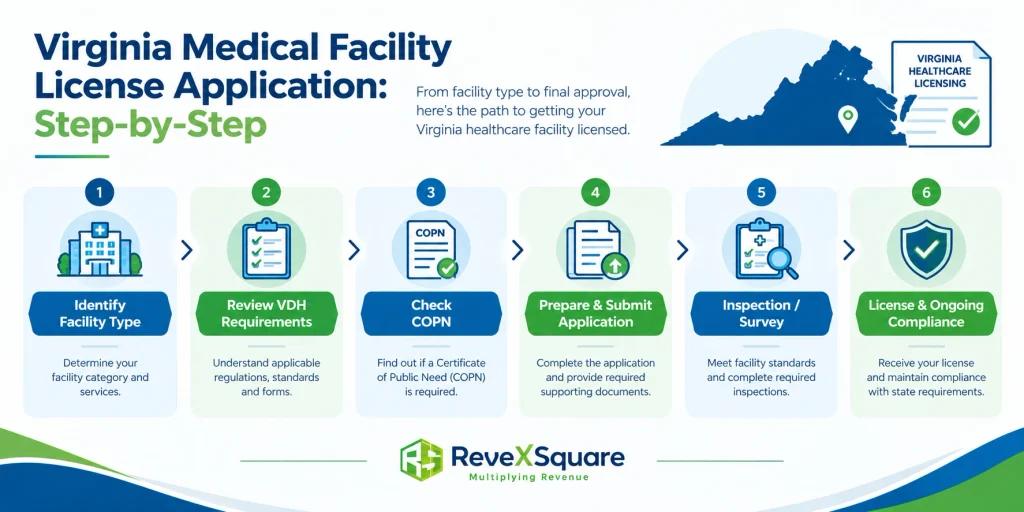
The Virginia healthcare facility license application process varies by facility type, but the planning sequence is consistent: classify the facility, review the applicable regulations, check COPN, prepare the application and supporting documents, complete required inspections, and maintain compliance after approval. The application should match the facility’s actual location, ownership, services, staffing model, and operating procedures.
Step 1: Identify the facility category
Start with the facility’s legal and operational classification. Examples can include a general hospital, outpatient surgical hospital, nursing facility, home care organization, or hospice program. The classification determines which regulations, forms, surveys, and approvals may apply.
Step 2: Review the applicable operating requirements
Before submission, review requirements that may address:
- staffing and clinical services
- medical records
- infection prevention
- patient safety
- physical environment and building standards
- emergency procedures
- quality management
- policies and procedures
Step 3: Check whether COPN applies
Compare the proposed services, equipment, beds, surgical capacity, and other project elements with current Virginia COPN rules. If COPN applies, it follows a separate process from the facility-license application.
Step 4: Submit the correct licensing application
VDH’s online licensing portal supports new licenses, renewals, exemptions for applicable programs, and changes to existing licenses. COPN applications continue to use the separate forms and procedures published by VDH.
Step 5: Prepare for inspection or survey
Where an inspection is required, the facility should be ready to demonstrate that written policies match actual operations. Review physical conditions, staffing, records, safety processes, infection-control practices, and clinical workflows before the survey.
Step 6: Maintain compliance after approval
Approval is not the end of the process. Facilities may need renewals, ongoing compliance, and reporting of changes involving ownership, location, name, services, or other regulated information. Major changes should be reviewed before implementation because they can also affect payer enrollment and contracting.
Virginia Hospital Licensing Requirements
Virginia law requires general hospitals and outpatient surgical hospitals to obtain a state license unless a specific exemption applies. VDH also conducts state inspections. Current VDH guidance states that hospitals are inspected every two years under state licensure, while Medicare and Medicaid certification and enrollment follow separate federal and payer processes.
A hospital launch or expansion can therefore involve several parallel workstreams: state facility licensure, applicable hospital regulations, COPN, Medicare certification and enrollment, Virginia Medicaid enrollment, medical-staff credentialing, commercial payer contracting, and revenue-cycle operations.
Treating these as one approval creates avoidable risk. A hospital can hold a state license and still be unable to bill a particular payer until the required enrollment, credentialing, or contracting is complete.
What Happens After Facility Licensing?
A Virginia healthcare facility license does not automatically activate Medicare, Medicaid, or commercial payer billing. After state approval, the organization may still need an NPI, Medicare enrollment, Virginia Medicaid enrollment, payer credentialing, contracts, service-location updates, and billing-system configuration before claims can be submitted correctly.
Medicare enrollment
CMS uses PECOS for online Medicare enrollment. For institutional providers, CMS describes a sequence that includes obtaining an NPI, completing the Medicare enrollment application, paying any applicable enrollment fee, and working with the Medicare Administrative Contractor and state agency.
When a paper application is used, CMS-855A is the enrollment application for institutional providers. Clinics, group practices, physicians, and other provider types may use different CMS enrollment applications.
Virginia Medicaid provider enrollment
Virginia Medicaid provider enrollment is managed by the Department of Medical Assistance Services (DMAS) through the Medicaid Enterprise System and the Provider Services Solution (PRSS). PRSS supports new enrollment, application status, provider-information management, and revalidation.
DMAS states that Medicaid fee-for-service providers and managed-care network providers must enroll in PRSS and revalidate at least every five years. Providers seeking managed-care participation must also satisfy the applicable managed care organization’s contracting and credentialing requirements.
Licensing vs. Enrollment vs. Credentialing: What Is the Difference?
Licensing, enrollment, credentialing, and contracting solve different problems. Licensing authorizes a facility or professional to operate or practice under applicable law. Enrollment registers the provider or organization with a payer program. Credentialing verifies qualifications. Contracting sets the network and reimbursement relationship. A billing team needs all relevant pieces aligned before claims are submitted.
| Process | Main Question | Common Output |
| Facility licensing | May this regulated facility operate? | State facility license / approval |
| Professional licensing | May this clinician practice in Virginia? | Active professional license |
| COPN | Does this covered project demonstrate public need? | COPN approval when required |
| Medicare / Medicaid enrollment | Is the provider or facility enrolled in the government program? | Active payer enrollment record |
| Commercial credentialing | Does the clinician or organization meet payer qualifications? | Credentialing approval |
| Contracting | What network and payment terms apply? | Executed payer agreement / participation status |
| Billing configuration | Can claims be submitted with correct identifiers and payer data? | Configured clearinghouse / payer / EDI setup |
A physician may be fully licensed in Virginia but still need payer enrollment and credentialing. Likewise, a facility can be licensed while a service location, rendering provider, or payer record remains incomplete.
Where Does Revenue Cycle Management Fit?
Revenue cycle management (RCM) is not a universal Virginia healthcare facility-licensing requirement. It is the financial and billing framework that turns documented healthcare services into accurate claims, payments, follow-up, and reporting. RCM should be designed before go-live because payer enrollment, authorization, coding, and location data directly affect reimbursement.
A complete RCM workflow can include:
- patient registration and insurance verification
- eligibility and benefits checks
- prior authorization
- charge capture and medical coding
- claim creation and submission
- payment and ERA posting
- denial management and appeals
- accounts receivable follow-up
- patient billing and collections
- financial and KPI reporting
The goal is not simply to send claims. A reliable revenue cycle identifies where reimbursement is being delayed, why claims are being rejected or denied, and what process changes can prevent the same problem from recurring.
RCM Priorities by Healthcare Facility Type
| Facility Type | Common Revenue-Cycle Priorities |
| Hospital | Inpatient and outpatient billing, coding, denials, payer configuration, A/R, reporting |
| Outpatient surgical hospital | Authorization, surgery coding, claim edits, implants/supplies where applicable, denials, A/R |
| Physician practice | Eligibility, coding, claims, patient balances, payer follow-up, A/R |
| Specialty clinic | Specialty coding, documentation, authorization, payer rules, denials |
| Nursing facility | Medicare, Medicaid, long-term-care billing, eligibility, A/R |
| Multi-location practice | Location enrollment, centralized billing, payer records, reporting |
| Imaging facility | Authorization, imaging coding, medical necessity, payer rules, claim follow-up |
How Should a Facility Measure RCM Performance?
| Collections alone do not show whether a revenue cycle is healthy. Facilities should monitor claim quality, denial patterns, accounts receivable, payment speed, authorization performance, and payer-enrollment issues. The purpose of KPI tracking is to identify the cause of revenue leakage early enough to correct it. |
| RCM KPI | What It Helps Measure |
| Clean claim / first-pass rate | How often claims are accepted without known front-end or billing errors |
| Denial rate | The share and causes of claims denied by payers |
| Days in A/R | How long collectible balances remain outstanding |
| Net collection rate | How much collectible revenue is ultimately collected |
| A/R aging | How much unpaid revenue sits in older aging buckets |
| Payment-posting time | How quickly payer and patient payments are posted |
| Authorization performance | Whether required approvals are obtained before services |
| Enrollment-related denials | Whether payer participation, service location, or provider data is blocking payment |
How Licensing, Enrollment, Credentialing, and RCM Connect
The four workstreams are separate, but reimbursement depends on their data being consistent. A facility may meet state requirements and still receive denials when the provider is not enrolled, the service location is missing, authorization was not obtained, the payer has outdated information, or the claim uses incorrect provider or coding data.
A practical sequence for a new or expanding facility is:
1. Confirm facility type and state regulatory path.
2. Determine whether COPN is required for the proposed project.
3. Complete applicable facility licensing and inspections.
4. Verify professional licenses and NPIs for clinicians and organizations.
5. Complete Medicare and Virginia Medicaid enrollment when applicable.
6. Complete commercial payer credentialing and contracting.
7. Configure payer, provider, service-location, coding, authorization, EDI, and billing data.
8. Run pre-billing checks before the first live claim.
9. Track denials and A/R by root cause after launch.
Common reimbursement failures include:
- provider not enrolled or not linked correctly to the group
- incorrect or inactive service location
- outdated payer demographic or ownership information
- missing prior authorization
- incorrect coding or modifier use
- wrong billing, rendering, ordering, or referring provider data
- missing documentation needed to support the billed service
Virginia Healthcare Facility Licensing Checklist
The exact requirements depend on the facility and services, but this checklist helps organize licensing, enrollment, credentialing, and billing work before opening or expanding a Virginia healthcare facility.
- Confirm the facility type and operating model.
- Review applicable VDH licensing requirements and Virginia regulations.
- Determine whether COPN applies.
- Prepare the correct license application and supporting documents.
- Prepare for required inspections or surveys.
- Confirm professional licenses for clinical staff.
- Obtain and validate required NPIs.
- Complete Medicare enrollment when applicable.
- Complete Virginia Medicaid enrollment through PRSS when applicable.
- Complete commercial payer credentialing and contracting.
- Verify payer records for every billing and service location.
- Establish coding, charge-capture, and authorization workflows.
- Set up claim submission, EDI, ERA/EFT, and payment-posting processes.
- Create denial-management and A/R follow-up workflows.
- Define RCM KPIs and reporting cadence.
- Review licensing and payer enrollment before major ownership, location, or service changes.
Frequently Asked Questions
What is Virginia healthcare facility licensing?
Virginia healthcare facility licensing is the state authorization process for applicable regulated healthcare facilities. The requirements depend on the facility type, services, location, and governing rules. It is separate from professional licensure, payer enrollment, credentialing, and COPN approval.
Who licenses hospitals in Virginia?
The Virginia Department of Health administers state licensing for general hospitals and outpatient surgical hospitals. VDH states that these hospitals must be licensed unless a specific exemption applies.
What is a Virginia medical facility license?
A Virginia healthcare facility license is state authorization for an applicable regulated healthcare facility to operate. It does not replace a physician or clinician’s professional license and does not automatically create Medicare, Medicaid, or commercial payer participation.
What is Virginia COPN?
Virginia COPN means Certificate of Public Need. It is a separate state review for certain healthcare facility projects, services, beds, and regulated equipment. A project may require a facility license, a COPN, both, or neither depending on its classification and scope.
Does every healthcare facility need a Virginia COPN?
No. COPN applies to defined facilities, services, projects, and equipment, and Virginia also recognizes exceptions and exclusions. The proposed project should be reviewed against current VDH COPN rules before major investment or construction decisions are made.
How long can the Virginia COPN process take?
VDH currently states that the COPN application review process can take approximately six to seven months. Actual project timing can vary, so COPN analysis should be done early when a planned service, facility, bed addition, or equipment purchase may be covered.
Does a Virginia facility license automatically provide Medicare enrollment?
No. Medicare enrollment is a separate CMS process. Institutional providers generally enroll through PECOS and may use CMS-855A when a paper application is required. The appropriate application depends on the provider or supplier type.
Does a facility license automatically provide Virginia Medicaid enrollment?
No. Virginia Medicaid enrollment is handled separately by DMAS through PRSS. Providers must meet the enrollment requirements that apply to their provider type, specialty, service locations, and participation model.
How often is Virginia Medicaid revalidation required?
DMAS states that Medicaid fee-for-service and managed-care network providers must revalidate enrollment at least every five years. Providers should complete revalidation before the deadline to avoid interruption or termination of participation.
Is revenue cycle management required by Virginia law?
RCM is not a universal facility-licensing requirement. It is an operational and financial process. A facility can manage billing in-house, outsource it, or use a hybrid model, but it still needs reliable payer, coding, claim, denial, A/R, and reporting workflows.
When should a new facility begin RCM planning?
RCM planning should begin before the first claim. Provider enrollment, credentialing, authorization, coding, charge capture, EDI, payment posting, denial handling, and A/R workflows should be tested before claim volume becomes significant.
Can licensing or enrollment problems cause claim denials?
Yes. A facility can be properly licensed and still experience reimbursement problems if payer enrollment, service-location data, provider records, authorization, or credentialing are incomplete or inaccurate. Billing data should be checked against current payer records before claims are released.
Where Revex Square Can Support the Revenue Cycle
Operational support after the regulatory pathway is definedRevex Square supports healthcare organizations with payer credentialing and enrollment, medical billing, medical coding, eligibility verification, denial management, accounts receivable follow-up, patient billing, and revenue-cycle reporting. Facility licensing and COPN determinations should be confirmed with the applicable Virginia agency and, when appropriate, qualified regulatory or legal counsel.
For a new or expanding Virginia healthcare organization, the most useful handoff point is often before payer enrollment and billing configuration begin. That allows provider, group, service-location, payer, and billing information to be aligned before claims start moving through the revenue cycle.
Learn more: Revex Square medical billing and credentialing services
Conclusion
Virginia healthcare facility licensing is only one part of opening or expanding a healthcare organization. The organization must first identify the correct facility type and understand the state requirements that apply to its services, location, staffing, and operations.
Some projects also require a Virginia COPN. After licensing, the organization may still need Medicare enrollment, Virginia Medicaid enrollment through PRSS, commercial payer credentialing, and contracting. Connecting those regulatory and payer workstreams with RCM before go-live can reduce avoidable claim delays, denial volume, and accounts-receivable problems.
Official Sources & Editorial Verification
This guide was reviewed against official Virginia and federal sources available in October 2026. Regulatory requirements can change, and the correct path depends on the facility type and proposed services. Always verify current requirements before filing or making a regulated change.
- Virginia Department of Health — Licensure and Certification
- VDH — Hospitals
- VDH — Certificate of Public Need Program
- VDH — Applications and Forms
- VDH — Statutes, Regulations & Guidance
- DMAS — Provider Enrollment & Revalidation
- Virginia Medicaid — PRSS
- CMS — Become an Institutional Provider
- CMS — Enrollment Applications