








Medical billing errors remain a major challenge in the healthcare industry. Studies suggest that nearly 80% of medical bills in the U.S. contain errors, many of which are linked to incorrect coding. These mistakes often result in claim denials, delayed reimbursements, and revenue loss for healthcare providers.
Accurate CPT coding is the backbone of a smooth revenue cycle, especially when supported by professional medical billing services. Even small documentation gaps or coding mismatches can disrupt cash flow and increase administrative workload. Whether you manage a clinic or a large healthcare facility, understanding high-risk CPT codes is essential.
In this guide, we’ll break down the most commonly denied CPT codes and how to fix them effectively.
What CPT Codes Are Most Commonly Denied?
The following CPT codes frequently lead to claim denials:
- CPT 99213 (Established patient office visit – low complexity)
- CPT 99214 (Established patient office visit – moderate complexity)
- CPT 93000 (Electrocardiogram – ECG)
- CPT 36415 (Venipuncture – blood draw)
Why CPT Coding Errors Cause Claim Denials
Common claim denial codes are associated with the following issues:
- Incomplete or missing documentation
- Incorrect Medical Decision Making (MDM) level
- Lack of medical necessity (ICD-10 mismatch)
- Duplicate billing or bundling issues
- Incorrect or missing modifiers
Fixing these issues starts with understanding how each CPT code is commonly misused.
CPT 99213 Common Issues and Fixes

CPT 99213 is used for established patient visits with low-complexity Medical Decision Making (MDM) or 20–29 minutes of total time spent on the encounter.
Common Denial Reasons
1. Insufficient Documentation
- MDM does not support low complexity
- Missing assessment or treatment plan
- No clear linkage between symptoms and diagnosis
Read More : 86% of Claim Denials Are Preventable
2. Time or MDM Mismatch
- Billing 99213 without documenting total time (if time-based)
- MDM documented is too minimal (should be 99212 instead)
3. Missing Clinical Details
- No chief complaint
- Incomplete history or exam (supporting only, not required for level selection)
- No follow-up plan
How to Fix It
- Use MDM or total time (2021+ E/M guidelines) to select the code
- Clearly document:
- Problem(s) addressed
- Data reviewed (labs, reports)
- Risk level
- Always include assessment and plan
CPT 99214 Denial Reasons and Solutions

CPT 99214 represents a moderate-complexity visit or 25–39 minutes of total time. It is one of the most audited E/M codes.
Common Issues
1. MDM Not Supporting Moderate Complexity
- Only one minor problem documented
- No risk or data complexity shown
2. Undocumented Data Review
- Labs or imaging reviewed but not mentioned
- No evidence of external records
3. Overcoding or Undercoding
- Billing 99214 for simple visits → denial risk
- Billing 99213 for complex visits → revenue loss
How to Fix It
Follow a structured SOAP format:
Subjective (S):
- Chief complaint
- Detailed HPI
- Relevant patient concerns
Objective (O):
- Vitals and physical findings
- Document reviewed data
Assessment (A):
- Diagnosis with severity
- Multiple conditions if applicable
Plan (P):
- Medications, tests, referrals
- Follow-up instructions
Ensure documentation clearly supports moderate MDM (problems + data + risk)
CPT 93000 ECG Billing Errors
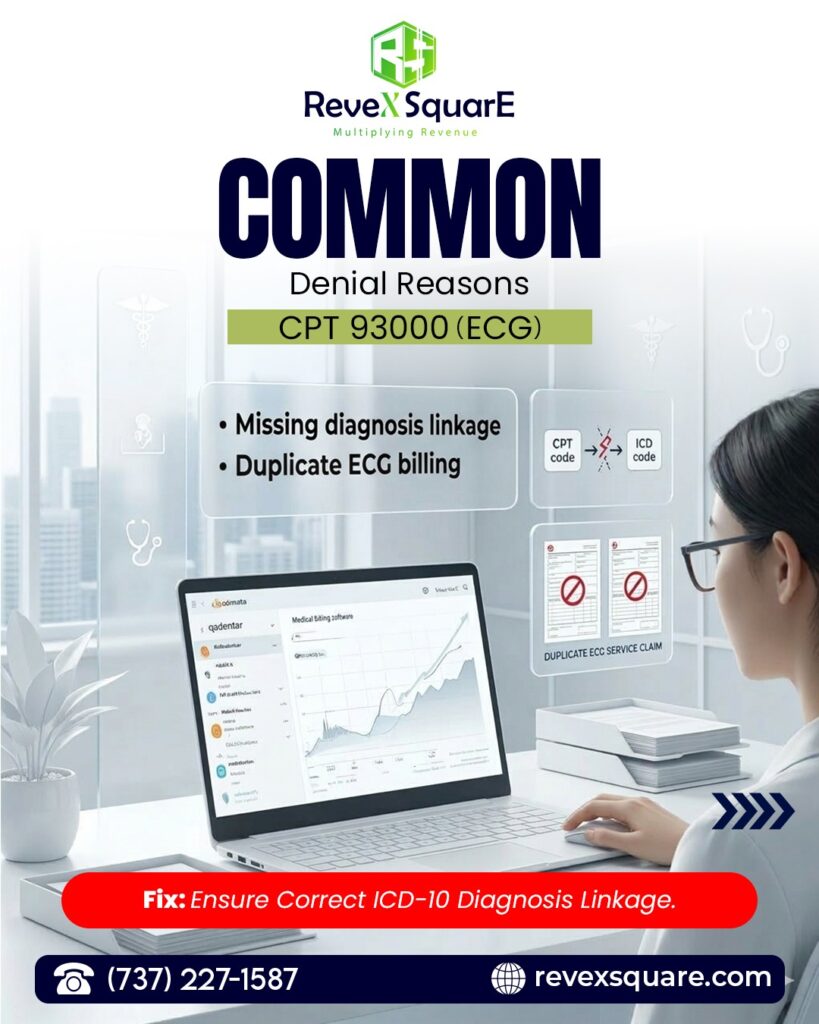
CPT 93000 covers a complete ECG service, including tracing, interpretation, and report.
Common Denial Reasons
1. Missing Diagnosis Linkage
- No ICD-10 code supporting medical necessity
Examples:
- Chest pain
- Arrhythmia
- Hypertension
2. Duplicate Billing
- Same ECG billed twice
- Multiple providers billing the same service
3. Lack of Documentation
- No interpretation report
- Missing physician signature
How to Fix It
- Always link CPT 93000 to a valid ICD-10 diagnosis
- Ensure:
- ECG report is documented
- Interpretation is included
- Use modifiers only when clearly justified
CPT 36415 Blood Draw Denials

CPT 36415 refers to venipuncture (blood draw) and is one of the most commonly misunderstood codes.
Common Issues
1. Bundling (Most Common)
- Often included in lab test reimbursement
- Not paid separately by many payers
2. Duplicate Billing
- Billed multiple times for the same visit
How to Fix It
- Bill only once per encounter
- Verify payer policy (many bundle this code)
- Do NOT bill separately if included in lab services
How to Prevent Claim Denials in Medical Billing
To reduce denials and improve revenue cycle efficiency:
1. Follow Updated E/M Guidelines (2021–2026)
- Base coding on MDM or total time
- History and exam are supportive, not mandatory
2. Improve Documentation Quality
- Avoid vague terms like “normal exam”
- Clearly justify medical necessity
3. Ensure Proper ICD-10 Linkage
- Every CPT code must match a diagnosis
4. Use Modifiers Correctly
- Apply only when medically necessary
- Avoid overuse
5. Conduct Regular Coding Audits
- Identify errors early
- Reduce compliance risks
How Revex Square Improves Billing Accuracy
Revex Square enhances medical billing by:
- Automatically reviewing CPT, ICD-10, and HCPCS codes
- Identifying missing documentation
- Suggesting correct modifiers
- Ensuring compliance with payer rules
This leads to:
- Fewer claim denials
- Faster reimbursements
- Improved cash flow
Conclusion
Accurate CPT coding is not just a technical requirement, it directly impacts the financial health of healthcare providers. Codes like 99213, 99214, 93000, and 36415 are widely used but highly prone to errors if not handled carefully.
The key to reducing claim denials lies in:
- Strong documentation
- Correct MDM-based coding
- Proper diagnosis linkage
- Compliance with payer guidelines
By adopting structured processes and leveraging expert solutions like Revex Square, healthcare providers can significantly reduce denials, accelerate reimbursements, and improve overall billing efficiency.