









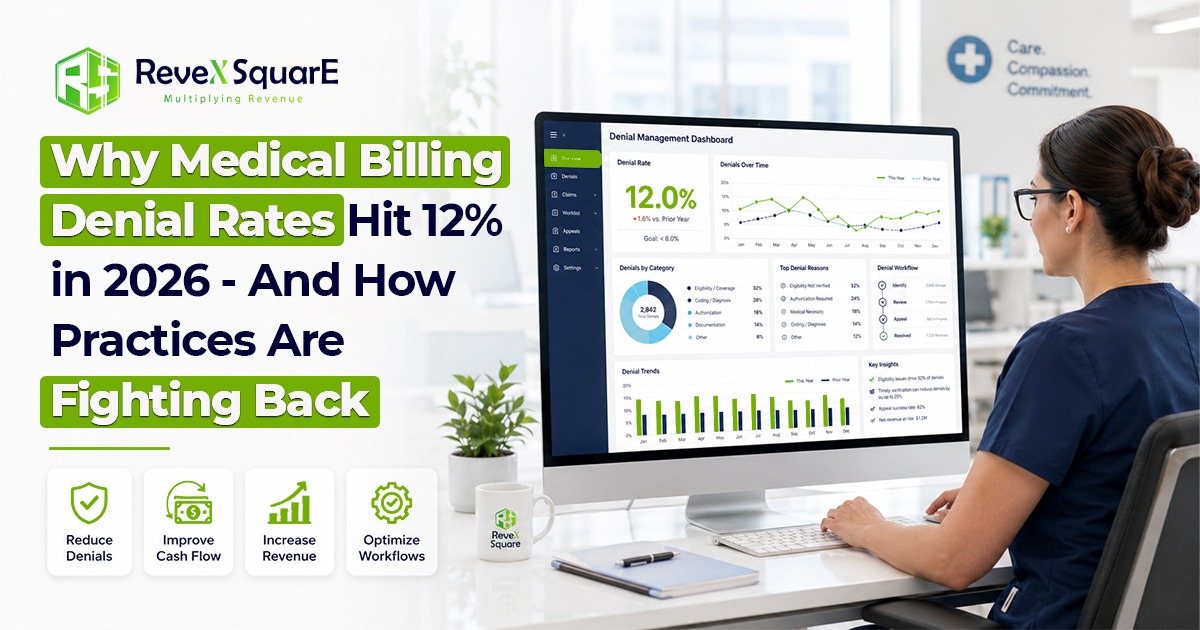
Medical billing denial management has become one of the biggest challenges for healthcare providers in 2026. According to industry reports, medical claim denial rates have reached nearly 12%, creating significant revenue loss, delayed reimbursements, and increased administrative workload. Effective denial management helps healthcare practices identify the root causes of denied claims, prevent recurring billing errors, and improve cash flow. In this guide, we’ll explain why denial rates are increasing, the most common causes of claim denials, and the proven strategies healthcare organizations use to reduce denials and maximize revenue.
At Revex Square, we help healthcare providers across the United States reduce claim denials through proactive denial management, accurate medical coding, real-time eligibility verification, and end-to-end revenue cycle management (RCM). Our healthcare billing specialists work closely with practices to identify denial patterns, improve first-pass claim acceptance rates, and maximize reimbursements while maintaining full compliance with payer and CMS guidelines.
Here’s what’s driving the increase, why it matters more than most practices realize, and what the providers holding their denial rates well below average are doing differently.
Denial rates don’t rise for one single reason — it’s usually a combination of shifting payer behavior, tighter documentation standards, and gaps that show up earlier in the revenue cycle than most practices expect. The four drivers below account for the majority of the increase this year.
Stricter payer documentation requirements
Payers are demanding more detailed clinical justification before approving claims, especially for higher-cost procedures and specialty care. A claim that would have been approved on standard documentation two years ago may now require additional notes, test results, or medical necessity language spelled out explicitly. Billing teams that haven’t updated their documentation checklists to match these tightened standards are seeing denials for claims that are clinically valid but administratively incomplete.

More automated payer-side audits
A majority of billing companies now believe payers are using AI to automate and increase claim denials. Whether that perception is fully accurate or not, the downstream effect is measurable: more appeals, more claims stuck in review, and longer resolution timelines. Payer systems are flagging inconsistencies and edge cases at a scale manual review never could, which means small, previously-overlooked errors are now far more likely to trigger a denial.
Eligibility and authorization gaps
A patient’s coverage details, deductible status, or prior authorization can change between the time an appointment is scheduled and the day they’re actually seen. If eligibility isn’t reverified close to the date of service, practices are submitting claims based on information that’s already out of date — a completely avoidable cause of denial that has nothing to do with coding accuracy.
Coding complexity in specialty care
Specialties with detailed documentation requirements — cardiology, orthopedics, oncology, and behavioral health among them — continue to see higher denial rates than primary care. These claims require more precise code selection, more supporting documentation, and closer alignment between what was clinically performed and what was billed. A generalist billing approach applied to a cardiology claim, for example, is far more likely to miss a payer-specific requirement than a workflow built specifically around that specialty.’
A New CMS Rule That Could Help — If Practices Actually Track It
As of January 1, 2026, a new CMS rule requires Medicare Advantage plans, Medicaid managed care organizations, and Federally-Facilitated Exchange plans to decide standard prior authorization requests within 7 calendar days, and expedited requests within 72 hours. Payers are also now required to provide a specific reason for every denial, rather than a generic rejection code.
This is a meaningful shift for practices that have historically waited weeks for authorization decisions, and it creates a genuine opportunity: since payers must now state exactly why a claim was denied, practices have a much clearer path to correcting and resubmitting it quickly. But this rule only helps if someone on your billing team is actively tracking these deadlines and flagging payers who miss them. Without a system in place to monitor authorization turnaround times, this regulatory improvement is easy to miss entirely — the deadline exists, but no one is watching whether it’s being met.
Some payers have also started offering “gold card” programs that exempt high-performing, high-approval-rate providers from certain prior authorization requirements altogether. Practices with consistently strong documentation and appropriate utilization patterns may be able to qualify for these expedited or waived processes, which reduces administrative friction significantly for the specialties that tend to need prior auth most often.
The Shift From Denial Management to Denial Prevention
The practices holding denial rates well below the 12% industry average almost all share one habit: they’ve moved away from a purely reactive approach — submit the claim, wait, and appeal if it comes back denied — toward catching problems before a claim is ever submitted. This shift typically includes four practical changes:
- Real-time eligibility verification before every visit, not just for new patients — coverage and authorization status should be reconfirmed close to the date of service, every time
- Predictive claim scrubbing that flags claims statistically likely to be denied, based on payer-specific history and known coding patterns, before they’re ever sent out
- Root-cause tracking of denial patterns by payer and procedure code, reviewed monthly rather than only after a denial rate spike triggers a scramble
- Clear documentation standards agreed on with clinical staff in advance, so medical necessity is unambiguous before coding even begins.
None of these steps eliminate denials completely — no billing process does. But they shift the majority of the work to the front end of the revenue cycle, where a problem is far cheaper and faster to fix than it is after a payer has already issued a formal denial and started a review clock.
Many healthcare providers choose to partner with experienced medical billing companies like Revex Square because preventing claim denials is far more cost-effective than correcting them after submission. By combining advanced claim scrubbing, specialty-specific coding expertise, payer compliance, and continuous denial analysis, Revex Square helps practices improve revenue cycle efficiency while reducing administrative workload.
What a Denied Claim Actually Costs Your Practice
Industry estimates put the average cost of reworking a single denied claim at roughly $57 once you account for staff time, resubmission, and follow-up — and that figure doesn’t include the cash flow impact of the delay itself. Collectively, providers spend an estimated $19.7 billion a year reworking denials that, in many cases, could have been prevented at the point of submission.
What makes this especially costly is that a meaningful share of denied claims are never reworked at all. Staff move on to newer claims, the appeal window passes, and the revenue is simply written off. For a practice submitting a few hundred claims a month, even a two-to-three percentage point improvement in denial rate can represent tens of thousands of dollars in recovered revenue annually — money that was always owed, just never collected.
Denial Prevention Looks Different by Specialty
A generic, one-size-fits-all approach to denial prevention tends to underperform, because the most common denial reasons vary significantly by specialty:
- Cardiology and orthopedics: denials often stem from insufficient documentation of medical necessity for diagnostic imaging and procedures — prior authorization tracking is critical here
- Behavioral and mental health: session limits, authorization renewals, and payer-specific coding for telehealth visits are common denial triggers
- Dermatology: cosmetic-versus-medical necessity distinctions frequently cause payer pushback if documentation doesn’t clearly establish the clinical reason for a procedure
- Internal medicine and primary care: high patient volume means eligibility and demographic errors — simple data-entry issues — are a disproportionately large share of denials
This is one of the strongest arguments for working with a billing partner that has specialty-specific experience, rather than a generalist provider applying the same checklist to every claim regardless of what was actually performed.
A Practical Checklist: Choosing a Denial Prevention Partner
If you’re evaluating whether to bring in outside help for denial management, these are the questions worth asking before you sign anything:
- What is your current first-pass clean claim rate, and how is it measured?
- Do you verify eligibility and authorization status close to the date of service, or only at intake?
- How do you track denial patterns — is it reviewed monthly, or only reactively when a problem is flagged?
- Do you have specific experience with my specialty’s most common denial triggers?
- What’s included in your denial management service versus billed as a separate add-on?
Frequently Asked Questions
What is considered a good medical coding claim denial rate?
Most industry benchmarks consider a denial rate under 5% to be strong, with anything above 10% signaling a need for process changes. The 2026 industry average of nearly 12% means a large share of practices are operating above the level considered healthy for consistent cash flow.
How long does it take to appeal a denied claim?
Timelines vary by payer, but most commercial payers allow 90 to 180 days to file an appeal, while Medicare typically allows 120 days. The challenge isn’t usually the deadline itself — it’s that many practices don’t have a system to flag denials quickly enough to act within that window, which is why a meaningful share of appealable claims are never appealed at all.
Is denial prevention more expensive than denial management?
Generally, no. Prevention work — eligibility checks, claim scrubbing, and documentation review — happens before a claim is submitted and is far less labor-intensive than reworking, appealing, and resubmitting a claim after the fact. Most practices find that investing in prevention reduces their total billing costs over time, even though it requires more attention at the front end of the process.
Can small practices realistically implement denial prevention on their own?
It’s possible, but it typically requires dedicated staff time, ongoing training on payer-specific rules, and software capable of real-time eligibility checks — resources that are harder to justify for a solo or small-group practice than for a larger health system. This is why many independent practices choose to work with a specialized billing partner rather than build this infrastructure internally.
A 12% industry denial rate doesn’t have to be your practice’s denial rate. The providers protecting their revenue most effectively in 2026 are the ones who’ve shifted from fighting denials after they happen to preventing them before a claim is ever submitted — through real-time eligibility checks, predictive claim scrubbing, specialty-specific documentation standards, and consistent, monthly denial-pattern tracking. The new CMS turnaround requirements add a layer of accountability on the payer side, but the practices seeing the biggest improvement in 2026 aren’t just waiting on regulation to fix the problem — they’re building prevention into their own workflow.Want to see where your practice’s denial rate stands? Revex Square’s denial management services combine proactive claim scrubbing, real-time eligibility verification, specialty-specific documentation support, and dedicated follow-up to help healthcare providers keep more of what they earn.nt diagnoses precisely. This supports accurate coding and faster insurance approvals.
A rising medical claim denial rate doesn’t have to become a financial burden for your practice. With the right denial management strategy, healthcare providers can reduce preventable denials, accelerate reimbursements, and improve overall revenue cycle performance. At Revex Square, we specialize in helping medical practices, specialty clinics, and healthcare organizations across the United States optimize their billing processes through proactive denial prevention, accurate medical coding, and comprehensive revenue cycle management services. If your practice is experiencing increasing claim denials or delayed reimbursements, contact Revex Square today to discover how our tailored medical billing solutions can help protect your revenue and support long-term growth.