








Medical claims can look straightforward on the surface: document the encounter select the diagnosis and procedure codes submit the claim and wait for reimbursement.
In practice it is rarely that simple.
A claim can contain the procedure code and still run into problems because the circumstances surrounding the service were not reported correctly. This is where CPT modifiers become important.
Modifiers add information to a CPT or HCPCS code to explain circumstances that are not fully captured by the procedure code itself. Used correctly they can help communicate services, professional or technical components, repeat procedures and other billing circumstances. Used incorrectly they can contribute to claim denials, delayed payments, rework and compliance concerns.
For physicians, medical practices, hospitals, ambulatory surgery centers (ASCs) urgent care organizations, medical coders, billers, practice managers and revenue cycle teams modifier accuracy is therefore more than a coding issue. It can affect the billing process.
This guide explains how modifiers work, the commonly encountered modifiers, why modifiers 25 and 59 receive so much attention and what healthcare organizations can do to reduce avoidable denials and underpayments.
Important: Coding rules can vary by payer and claim type. The guidance below is educational. Should be used alongside the current CPT code set, CMS guidance and applicable payer policies.
What Are CPT Modifiers?
CPT modifiers are two-character identifiers added to a CPT or HCPCS code to provide information about a service or procedure.
The CPT code tells the payer what service was performed. The modifier can provide context about how, where or under what circumstances that service was performed.
The American Medical Association (AMA) describes CPT as the language used to report medical services and procedures performed by physicians and other qualified healthcare professionals. The 2026 CPT code set contains than 11,520 codes and is updated regularly to reflect changes in healthcare services and technology.
A modifier does not replace the underlying procedure code. It supplements it.
For example two services may normally be considered related or bundled. However if the clinical circumstances demonstrate that the services were distinct and the applicable rules permit reporting, an appropriate modifier may communicate that distinction to the payer.
That does not mean a modifier should be added simply to make a claim payable.
CMS specifically states that a modifier should only be appended when the clinical circumstances justify its use. It should not be used solely to bypass an NCCI Procedure-to-Procedure edit.
Why Are CPT Modifiers Important in Medical Billing?
A modifier can be a part of a claim but its effect can extend much further.
When a modifier accurately represents the documented circumstances it can help a payer understand why a service was separately reported or why a particular billing treatment applies.
For healthcare organizations appropriate modifier usage can support:
- Accurate claim submission
- Appropriate reimbursement
- Cleaner claims
- Fewer avoidable denials
- Better coding consistency
- More efficient denial management
- Stronger documentation practices
- More reliable revenue-cycle reporting
There is also an important compliance consideration.
A billing team should never approach modifiers with the mindset of finding a code combination that “gets the claim paid.” The correct question is:
Does the medical record support the service and the modifier being reported?
That distinction separates coding from aggressive or unsupported billing.

Who Should Understand CPT Modifiers?
Modifier knowledge is not limited to coders.
Physicians and Healthcare Providers
Physicians and other clinicians create the documentation that ultimately supports coding. Clear documentation makes it easier for coding professionals to determine whether an identifiable service or other modifier-supported circumstance exists.
Medical Coders
Coders need to understand CPT guidelines, NCCI edits, payer policies, documentation requirements and the circumstances in which a modifier is appropriate.
Medical Billers
Billers work with the claims after coding. When a payer rejects or denies a claim because of coding or modifier issues the billing team may need to correct, resubmit or appeal it.
Practice Managers
Practice managers need to understand how recurring coding errors affect collections, staff productivity accounts receivable and overall financial performance.
Hospitals and Health Systems
A small coding problem becomes more significant when it is repeated across hundreds or thousands of claims.
Ambulatory Surgery Centers
ASCs often handle procedure- billing making accurate reporting of procedure combinations particularly important.
Revenue Cycle Management Teams
RCM leaders can use denial and payment data to identify patterns determine where errors originate and improve the billing workflow.
Common CPT Modifiers Healthcare Organizations Should Know
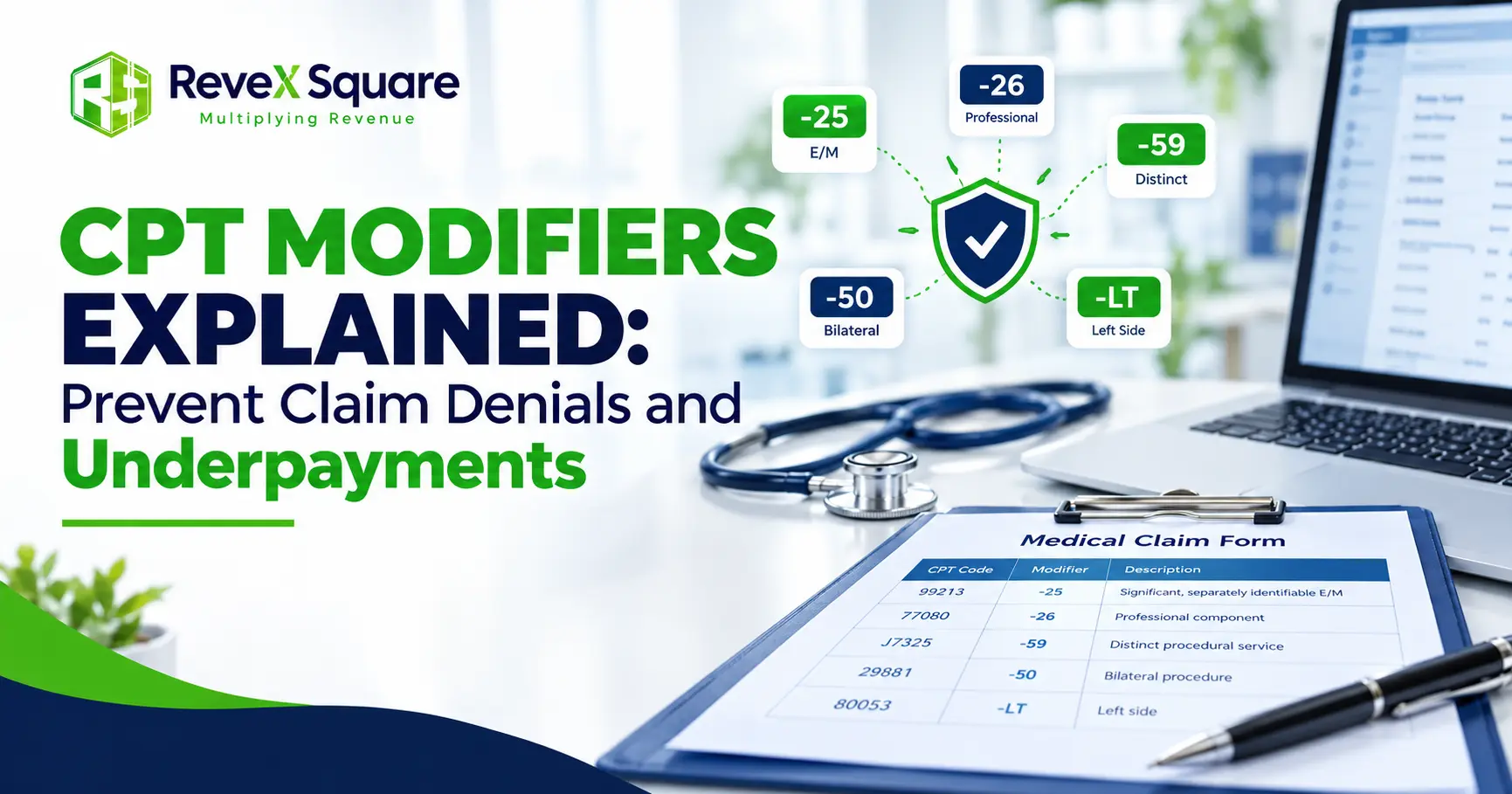
Common CPT Modifiers Healthcare Organizations Should Know. There are modifiers in professional and facility billing. The appropriate choice depends on the service, documentation, payer and circumstances
| Modifier | General purpose | Common situation |
| 25 | Significant, separately identifiable E/M service | E/M service performed with another procedure |
| 59 | Distinct procedural service | Separately reportable procedure under qualifying circumstances |
| 24 | Unrelated E/M service during postoperative period | Unrelated visit during a global period |
| 26 | Professional component | Professional portion of certain services |
| TC | Technical component | Technical portion of certain services |
| 50 | Bilateral procedure | Appropriate bilateral procedures |
| 51 | Multiple procedures | Multiple procedures during one session when applicable |
| 76 | Repeat procedure by same physician/QHP | Repeat service by same provider |
| 77 | Repeat procedure by another physician/QHP | Repeat service by another provider |
This is a general overview rather than a substitute for the current CPT codebook or payer-specific instructions.
Modifier 25 Explained
Modifier 25 is one of the modifiers that frequently comes up when an E/M service and another procedure occur during the encounter.
CMS explains that modifier 25 may be appended to an E/M code when the service is significant and separately identifiable from another procedure or service performed on the day when the circumstances support its use.
The important point is that same-day services do not automatically justify modifier 25.
A Simple Example
Consider a patient who visits a physician with a complaint.
During the encounter the physician evaluates the patients condition. Also performs a procedure.
If the documentation demonstrates that the E/M service was significant and separately identifiable from the work associated with the procedure modifier 25 may be appropriate when all other applicable requirements are satisfied.
If the E/M work was simply part of the normal work required to perform the procedure adding modifier 25 may not be justified.
Common Modifier 25 Problems
Healthcare organizations may encounter issues when:
- Modifier 25 is added automatically
- Documentation does not support a separate E/M service
- Staff use the modifier as a routine billing habit
- The E/M service is not actually separately identifiable
- Payer-specific requirements are overlooked
The solution is not to avoid modifier 25 altogether. The solution is to make sure its use is supported by the clinical record and applicable coding rules.
Modifier 59 Explained
Modifier 59 identifies a distinct procedural service when the circumstances meet the applicable requirements.
It is especially important in relation to NCCI edits.
CMS explains that modifier 59 and the more specific X{EPSU} modifiers may be appropriate in certain circumstances, including situations involving separate encounters, anatomic sites, or specimens. CMS also emphasizes that modifier 59 should be used only when another, more specific modifier does not better describe the circumstances.
Why Modifier 59 Is Frequently Misunderstood
Suppose two procedures are normally considered bundled.
A coder should not automatically add modifier 59 just because the provider performed both services.
Instead, the coder should ask:
- Were the services genuinely distinct?
- Does the documentation support that distinction?
- Does the relevant NCCI edit allow a modifier?
- Is another modifier more appropriate?
- Does the payer have additional requirements?
CMS’s 2026 NCCI guidance makes this distinction particularly clear: an NCCI-associated modifier should not be used merely to bypass an edit when the clinical circumstances do not justify it.
Modifier 25 vs. Modifier 59: What Is the Difference?
This is one of the most common questions in medical coding.
The simplest way to remember the distinction is:
Modifier 25 is associated with a separately identifiable E/M service.
Modifier 59 is associated with a distinct procedural service.
They are not interchangeable.
For example, modifier 25 may be relevant when an E/M service is reported on the same day as another procedure. Modifier 59 may be relevant when two procedures that would otherwise be subject to a coding edit were genuinely distinct and the reporting requirements are satisfied.
Using one in place of the other can create claim problems.
When in doubt, the coding team should return to the documentation and applicable coding guidance rather than choosing the modifier based solely on expected reimbursement.
How NCCI Edits Affect Modifier Reporting
The National Correct Coding Initiative (NCCI) is an important part of Medicare coding and claims processing.
CMS explains that NCCI Procedure-to-Procedure edits are designed to prevent inappropriate payment for services that generally should not be reported together. When a code pair has an applicable edit, the second code may be denied unless the circumstances support an appropriate modifier and the edit allows it.
CMS updates NCCI information periodically, and the 2026 Medicare NCCI Policy Manual took effect January 1, 2026.
This matters because a coding team should not rely on an old modifier cheat sheet and assume the rules have remained unchanged.
The Correct Workflow
A better process is:
Review documentation → Select codes → Check applicable edits → Determine whether a modifier is justified → Verify payer requirements → Submit claim
That approach is much safer than:
See denial → Add modifier → Resubmit
How Incorrect CPT Modifiers Can Cause Claim Denials
Modifier errors can appear in several forms.
1. Missing Modifier
A service may require additional information, but the appropriate modifier is not reported.
2. Incorrect Modifier
A modifier is present, but it does not accurately describe the circumstances.
3. Unsupported Modifier
The modifier might technically appear plausible, but the medical record does not support its use.
4. Modifier Overuse
A modifier is repeatedly attached to claims without reviewing the circumstances of each encounter.
5. Incorrect Modifier Placement
Even when a modifier is appropriate, placing it on the wrong code can create a claim-processing problem.
6. Ignoring Payer Rules
Medicare, Medicaid, and commercial insurers may have different billing requirements.
For Medicaid, CMS notes that states may implement their own edits concerning modifier usage in addition to the national NCCI framework.
That is why a “one rule fits every payer” approach is risky.
CPT Modifiers and Underpayments
Denials get plenty of attention, but underpayments deserve just as much.
A claim does not have to be completely rejected to create a revenue problem.
A payer may process a claim but reimburse less than the amount expected under the applicable contract, fee schedule, coding rules, or payment methodology.
Modifier-related problems can contribute to payment discrepancies when services are not reported or interpreted correctly.
This makes modifier review relevant to both claims submission and payment integrity.
For RCM teams, it is worth monitoring:
- Denial trends
- Underpayment trends
- Repeated modifier issues
- Coding-related adjustments
- Corrected claims
- Appeal volume
- Accounts receivable
- Days in A/R
If the same modifier-related issue keeps appearing, correcting individual claims may not be enough.
The organization needs to find the underlying process problem.
7 Ways to Prevent Modifier-Related Denials
1. Make Documentation the Starting Point
The coding decision should begin with the medical record.
Providers should document what they actually did, why they did it, and any circumstances that distinguish separately reportable services.
2. Train Providers and Coding Teams Together
Coding accuracy is not solely a coder’s responsibility.
Providers need to understand how documentation supports coding, while coders need to understand how clinical documentation translates into reportable services.
That shared understanding can prevent unnecessary back-and-forth.
3. Review NCCI Edits
For Medicare claims, review applicable NCCI Procedure-to-Procedure edits and modifier guidance before assuming two services can be reported separately.
CMS provides current NCCI edit files and educational resources for this purpose.
4. Check Payer-Specific Policies
Commercial insurance policies can differ from Medicare requirements.
The fact that a modifier is accepted in one billing environment does not automatically mean another payer will process it the same way.
5. Audit Modifier Usage
Regular audits can reveal patterns such as unusually frequent use of modifier 25 or modifier 59, missing modifiers, or unsupported reporting.
The goal of an audit should be improvement—not simply finding someone to blame.
6. Analyze Denial Patterns
If a practice sees repeated denials involving the same CPT code, modifier, payer, or specialty, investigate the pattern.
A single denial may be an isolated mistake.
A repeated denial is often a process signal.
7. Keep Coding Resources Current
The CPT code set changes over time. The AMA’s 2026 release included 288 new codes, 84 deletions, and 46 revisions, illustrating why healthcare organizations need current coding resources rather than relying on outdated references.
CPT Modifiers Across Different Healthcare Settings
The financial and operational impact of modifier accuracy can look different depending on the organization.
Physician Practices
Independent practices often have smaller billing teams, so repeated coding errors can consume a significant amount of staff time.
Hospitals and Health Systems
Large organizations process high claim volumes. Even a relatively small error rate can create substantial rework.
Ambulatory Surgery Centers
ASCs frequently submit claims involving multiple procedures, making accurate reporting and documentation particularly important.
Urgent Care Centers
Urgent care encounters can involve both evaluation and treatment procedures, creating situations where modifier knowledge matters.
Specialty Practices
Cardiology, orthopedics, gastroenterology, dermatology, pain management, behavioral health, and other specialties encounter different coding scenarios.
The rules should therefore be applied to the actual service and documentation rather than copied from another specialty.
Medical Billing Companies
Billing companies have an additional challenge: they may manage claims for many specialties and payer mixes.
Standardized processes, regular audits, and denial analytics can help identify recurring issues across client accounts.
How CPT Modifiers Fit Into Revenue Cycle Management
A modifier is only one part of a much larger process.
Think about the journey of a claim:
Clinical documentation → Medical coding → Claim creation → Claim submission → Payer adjudication → Payment or denial → Follow-up → Resolution
An error early in that process can create work later.
For example:
Incorrect documentation → Unsupported coding decision → Claim submission → Denial → Correction → Resubmission → Delayed payment
That means modifier accuracy should not be treated as an isolated coding metric.
RCM leaders can connect coding quality with broader performance indicators such as:
- Clean claim rate
- Denial rate
- First-pass resolution
- Days in accounts receivable
- Underpayment volume
- Corrected claim volume
- Appeal volume
- Net collections
Looking at the entire process helps healthcare organizations move from reactive denial management to preventive revenue-cycle management.
How Revex Square Can Help
For healthcare organizations, keeping up with coding requirements, payer policies, claim edits, denials, and payment issues can become difficult particularly as claim volumes increase.
Revex Square provides medical billing, medical coding, denial management, and revenue cycle services designed to help healthcare organizations improve the financial side of their operations.
A professional billing and coding review can help identify recurring issues such as:
- Coding inconsistencies
- Modifier-related denials
- Documentation gaps
- Claim submission errors
- Unresolved denials
- Payment discrepancies
- Revenue-cycle bottlenecks
The objective should not simply be to submit more claims.
It should be to create a process in which claims are accurate, supported by documentation, compliant with applicable requirements, and submitted correctly the first time.
That approach can help providers spend less time dealing with avoidable billing problems and more time focusing on patient care and running their organizations.
CPT Modifier Accuracy Checklist
Before submitting a claim, ask:
- Does the documentation support the reported service?
- Is the CPT or HCPCS code accurate?
- Is a modifier actually necessary?
- Does the documentation support the modifier?
- Is the modifier attached to the correct code?
- Have applicable NCCI edits been reviewed?
- Is another modifier more specific?
- Have payer-specific requirements been checked?
- Are the diagnosis and procedure codes consistent?
- Are units and place of service correct?
- Are recurring denials being monitored?
This simple review can make modifier accuracy part of a repeatable billing process instead of something addressed only after a denial arrives.
Conclusion
CPT modifiers may consist of only two characters, but they can have a meaningful impact on how a healthcare claim is interpreted and processed.
The key is not to memorize every modifier and attach one whenever a claim encounters an edit. Accurate coding starts with the medical record. From there, coders and billing professionals need to consider the CPT code, applicable coding guidelines, NCCI edits, payer requirements, and the actual circumstances of the encounter.
Modifier 25 and modifier 59 deserve particular attention because they are frequently encountered and can be misused when the documentation does not support separate reporting. CMS’s current NCCI guidance makes one principle especially important: a modifier should reflect the clinical circumstances, not simply be used to bypass an edit.
For physicians, hospitals, ASCs, urgent care centers, medical practices, coders, billers, and RCM leaders, the bigger objective is straightforward: submit accurate claims, prevent avoidable rework, and protect appropriate reimbursement.
When modifier accuracy becomes part of a broader coding and revenue-cycle strategy, healthcare organizations are in a much stronger position to identify problems before they turn into denials, underpayments, and unnecessary administrative costs.
Frequently Asked Questions About CPT Modifiers
1. What are CPT modifiers?
CPT modifiers are two-character identifiers added to CPT or HCPCS codes to provide additional information about a reported service. They help explain circumstances that are not fully represented by the procedure code itself.
2. Why are CPT modifiers important in medical billing?
They provide payers with additional information about how a service was performed or reported. When appropriately supported, modifiers can help claims accurately reflect the services documented by the provider.
3. What is the difference between modifier 25 and modifier 59?
Modifier 25 is generally used with an E/M code when a significant, separately identifiable E/M service is performed on the same day as another procedure or service. Modifier 59 identifies a distinct procedural service when the applicable requirements are met.
4. Can incorrect modifiers cause claim denials?
Yes. Missing, incorrect, or unsupported modifiers can contribute to claim denials or rejections, particularly when they conflict with coding guidelines, documentation, NCCI edits, or payer requirements.
5. Does using a modifier guarantee additional payment?
No. A modifier does not guarantee reimbursement. The underlying service must be appropriately reported, supported by documentation, covered when applicable, and processed according to the payer’s rules.
6. When should modifier 59 be used?
Modifier 59 should be reported only when the clinical circumstances support a distinct procedural service and another, more specific modifier is not more appropriate. CMS specifically cautions against using modifier 59 simply to bypass an NCCI edit.
7. When should modifier 25 be used?
Modifier 25 may be appropriate when a significant, separately identifiable E/M service is performed on the same day as another procedure or service and the documentation supports reporting it separately.
8. Do Medicare and commercial insurers have the same modifier rules?
Not necessarily. Medicare has its own NCCI policies, while commercial insurers and state Medicaid programs may have additional or different requirements. Billing teams should verify the rules applicable to the specific payer and claim.
9. How can a medical practice reduce modifier-related denials?
Start with strong clinical documentation, accurate coding, staff education, current coding resources, NCCI review when applicable, payer-policy checks, and regular analysis of denial patterns.
10. Should healthcare organizations outsource medical coding and billing?
It depends on the organization’s size, specialty, claim volume, internal expertise, payer mix, and revenue-cycle needs. Outsourcing can be useful when an organization needs additional coding expertise, denial-management support, or a more structured billing process.
Contact us for furthur Details