








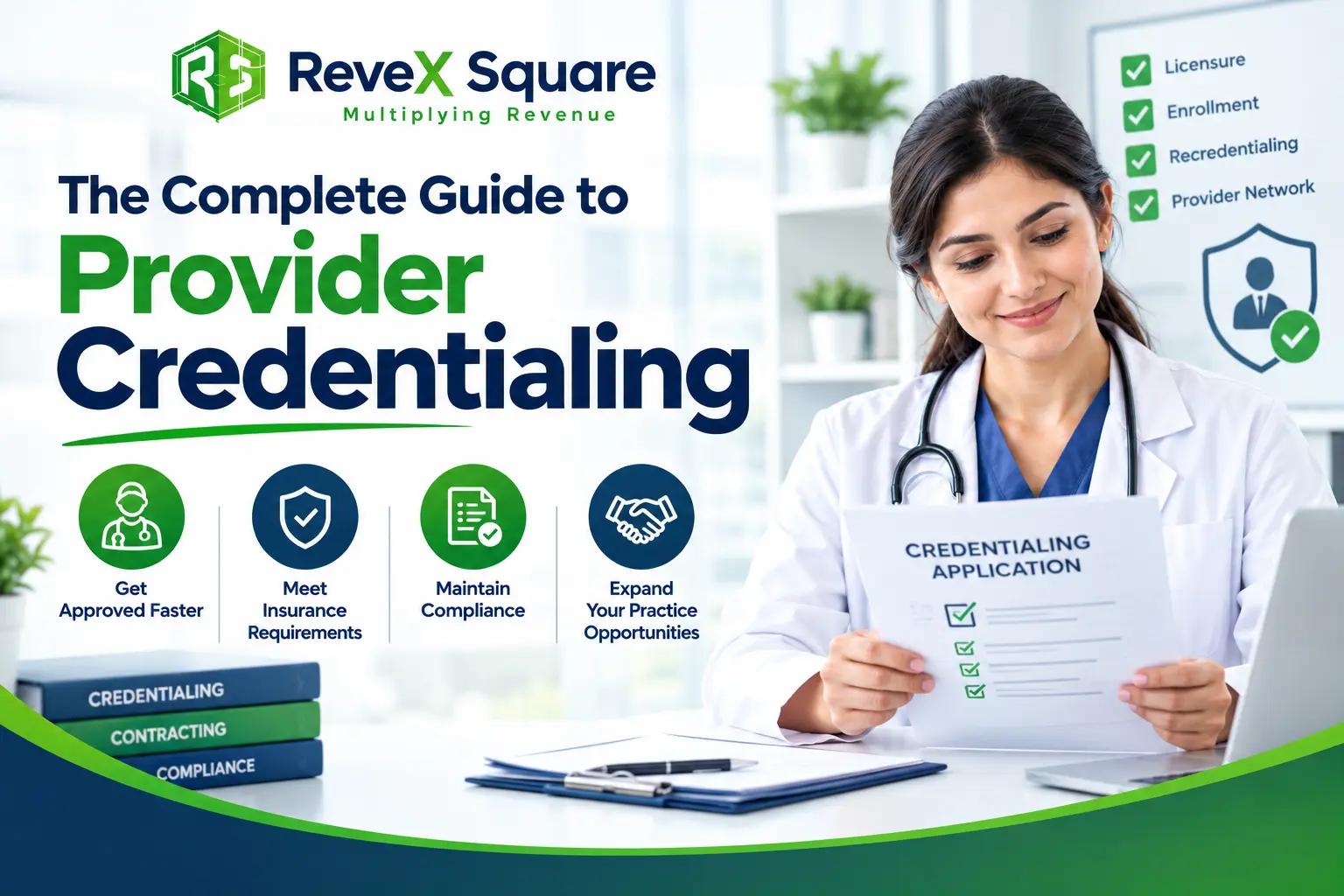
Provider credentialing is a process for any healthcare provider who wants to be paid by insurance companies. It’s not about paperwork. It’s about proving that you are qualified, licensed and trustworthy enough to care for patients under an insurance plan. At its core provider credentialing means verifying your education, training, licenses, work history and malpractice coverage. Payers do this before they allow you to join their network. Without this step you cannot bill insurance companies. That means no reimbursement. If you can’t get reimbursed your practice can’t survive.
For clinics or growing practices understanding credentialing isn’t optional. It’s the big hurdle between opening your doors and actually getting paid for each patient visit. So many new clinics think they’ll handle billing. Without credentialing those visits may never be billed at all. Have you ever seen a brand- clinic open with patients but still struggle to collect insurance payments? The reason is usually credentialing. It’s often the missing piece holding everything up.
So what is provider credentialing?
It’s like a background check. For healthcare providers Insurance companies want proof that the doctors, nurse practitioners, therapists and other clinicians in their network meet standards. They need to make sure:
- You have a state medical license
- Your malpractice insurance is current
- You have no disciplinary actions against your name
- Your education and board certifications are verified
- Your work history is accurate and complete
Think of it this way: when a payer lets a provider into their network they are putting their members health and trust in that persons hands. Credentialing is how they protect both patients and themselves. It’s diligence. And it matters.
Why does it matter much to providers?
Because without it there is no reimbursement. Most commercial insurers along with Medicare and Medicaid will not pay claims from -credentialed providers. If you’re out-of-network you’re likely going to face patient volumes or high patient responsibility costs. Neither of which supports a sustainable clinic. It also affects access. Many people choose doctors based on which insurance plans they accept. An uncredentialed provider is invisible to a group of potential patients. That limits your reach.
Another big concern: delayed or missed credentialing leads to lost revenue. Practices that wait long to start the process often find out months later that they submitted claims for services that were never billable. This creates a backlog of unpaid claims. A major financial setback. Finally credentialing is tied to compliance. Regulatory agencies and accreditation groups expect documentation and accurate records. If your credentialing file is incomplete or outdated you risk audits, penalties or even being removed from networks.
In short credentialing is not just paperwork. It is the gateway to your revenue cycle.
Credentialing vs. Enrollment vs. Contracting: Clearing Up the Confusion
Now let’s clear up some confusion around three mixed-up terms: credentialing, enrollment and contracting.
Credentialing is the verification step. It’s checking your information. Your license, your degrees, your malpractice history. To confirm it’s real and up-to-date. Enrollment is the application process. Once your credentials are verified you apply to join a payer’s network using that verified data. Contracting is where you negotiate payment rates and terms with the payer. This usually happens after enrollment is approved.
In reality credentialing and enrollment happen together. Most people use the word “credentialing” to describe the whole bundle. Including enrollment and sometimes even contracting. For simplicity we’ll keep using “credentialing” that way in this guide.
The Provider Credentialing Process: Step-by-Step
Let’s walk through the full process step-by-step.
Step 1: Gather Your Documentation
Before you fill out any form you need a set of documents. Payers reject applications all the time because something is missing. One wrong document can delay the thing by weeks.
The basic items include:
- Your state license (and copies of renewals)
- DEA registration (if you prescribe controlled substances)
- Board certification(s) or specialty credentials
- Malpractice insurance certificate and claims history
- Diplomas from medical school and residency/fellowship programs
- Work history for the last 5 to 10 years (with no unexplained gaps)
- National Provider Identifier (NPI) number
- Government ID and Social Security number
- Tax ID and W-9 form for your practice
Organize these files early. Keep them in a folder. Digital or physical. Make sure every copy is legible and matches across all sources.
Step 2: Register and Maintain Your CAQH Profile
CAQH Pro-View is the online hub that most private insurers use to pull provider data of filling out a separate form for every single payer you create one profile. Then payers access it directly.
Setting up CAQH takes time: You need to enter your education work history, references, malpractice info and more upload supporting documents. Check every field carefully one typo can cause problems.
Here’s the catch: CAQH is not a one-time setup. You must re-attest your profile every 90 days. That means logging back in and confirming your info is correct. Even if nothing has changed. If your profile expires payers won’t use it. That’s a reason for delays.
So make sure your team sets calendar reminders. Better yet assign someone responsible for tracking it.
Step 3: Submit Applications to Individual Payers
Once your CAQH profile is fresh and complete you authorize each payer to access it. Then you officially submit applications to each insurance company you want to join.
Some payers use CAQH only. Others require forms. For example Medicare uses PECOS and Medicaid programs in states have their own systems. These need to be handled
Each insurer has its portal, deadlines and rules. That’s why this stage often becomes the tedious. If you’re applying to ten or more insurers managing all those portals and deadlines can quickly become overwhelming.
This is especially hard for -provider clinics. Every doctor needs their application. Everything must be consistent. Any mismatch causes delays.
Step 4: Primary Source Verification
After submission the payer (or a third-party verifier acting for them) starts checking your data. They call schools, licensing boards past employers and insurance companies to confirm your details.
They don’t just trust the documents you send. They verify independently. That’s why dates, correct spellings and consistent information matter so much.
Any inconsistency. Such as an employment date on two documents. Triggers a manual review. That adds weeks to the timeline.
No amount of effort on your part can speed up this step. It’s controlled entirely by the payer.
Step 5: Committee Review and Approval
Once all verification is done your application goes to the payer’s credentialing committee. These groups meet on a schedule often monthly.
Even if your application is perfect it might miss a meeting deadline. If you submit late it could sit for another month before approval.
So timing is crucial submit early. Aim to finish all steps ahead of your expected patient start date.
Step 6: Contracting and Effective Date
After approval the payer sends a contract outlining payment rates, billing procedures and network terms. You sign it. Then comes the effective date. The day your practice becomes eligible to bill that payer.
Important: Services provided before the date cannot be billed. Even if you saw a patient months earlier and thought you were ready to bill you can’t submit those claims.
That’s why starting early is so essential. A delay of a few weeks can mean losing months of income
Average Timeline for Provider Credentialing
| Stage | Typical Timeframe | Notes |
|---|---|---|
| Document collection & CAQH setup | 1–2 weeks | Faster with an organized checklist |
| CAQH profile completion & attestation | Ongoing (re-attest every 90 days) | Must stay current throughout the process |
| Payer application submission | 1–2 weeks per payer | Can run in parallel across payers |
| Primary source verification | 30–60 days | Largely payer-controlled |
| Committee review & approval | 2–4 weeks | Depends on meeting schedules |
| Contracting & effective date | 1–3 weeks | Final step before billing can begin |
| Total average timeline | 90–150 days | Can extend to 6 months with errors or missing info |
Total average time: 90 to 150 days. Longer. Up to six months. If something goes wrong. If you’ve already started seeing patients and haven’t been credentialed yet you’re behind. That means those visits may never be reimbursed.
Common Challenges for New and Growing Practices
Even experienced teams struggle with credentialing. Here are the biggest issues:
Incomplete CAQH profiles: A single missing form can stop your application dead in its tracks.
Expired attestation: Forgetting to re-attest your CAQH every 90 days is one of the reasons for delays.
Inconsistent data: Small differences. Like a year off between job dates. Trigger scrutiny and slow things down.
Tracking payers: When you’re applying to 10 or more insurers keeping track of which ones are pending becomes nearly impossible without a system.
Recredentialing deadlines: Credentialing isn’t a one-off task. Most payers require re-verification every 2 to 3 years. Missing a deadline can kick you out of the network.
New provider onboarding: Every time a new clinician joins the process starts over.. Patient demand doesn’t pause while you go through it.
How to Navigate Provider Credentialing as a New Practice
Starting a clinic comes with tons of tasks. Hiring staff setting up EHR systems finding office space, marketing. All compete for attention. Credentialing tends to fall behind. The practices that move fastest on credentialing do a few key things right:
Start early: Begin the CAQH process and payer applications soon as your license is secured. Aim to start 90 to 120 days before your patient visit.
Use a master tracking sheet: List every payer, application status, submission date and follow-up notes. This small habit prevents applications from slipping through the cracks.
Respond immediately:Payers often request info. If you ignore the request your application stalls. Set up an inbox and assign someone to monitor it daily.
Keep documents current: Renewal dates for licenses, malpractice policies and certifications should be tracked. Nothing should lapse during the process.
Don’t assume “submitted” means “approved.”: Just because you sent an application doesn’t mean you can bill. Always ask for written confirmation of the date before submitting claims.
For solo providers this process is tough. Manageable for growing clinics with clinicians it becomes a full-time administrative job. That’s where a reliable billing and revenue cycle management partner can help.
Companies, like Revex Square focus on handling the credentialing life-cycle. They manage CAQH profiles, submit applications, track statuses respond to payer requests negotiate contracts and ensure timely re-credentialing of having your front desk staff chase attestations or lose track of applications you let experts handle it all. That way your doctors can see patients and bill confidently. Starting from day one not after months of waiting.
Tips to Speed Up Your Credentialing Timeline
To get the process done faster consider these strategies:
- Build a checklist: Create a list of required documents and steps. Use it for every provider and every payer.
- Stay organized: Keep all files in one place. Use cloud storage or a shared drive.
- Double-check consistency: Ensure names, addresses, dates and numbers match across all documents and forms.
- Use CAQH correctly: Complete your profile fully. Re-attest every 90 days. Don’t skip this step.
- Submit applications early: Apply to payers before your first patient visit. Give yourself buffer time.
- Assign responsibility: Choose one person or team to own the credentialing process. Avoid letting it fall between departments.
- Follow up regularly: Check the status of each application weekly. Call payers if updates stall.
- Consider outsourcing: If credentialing is slowing you down hire a trusted partner to manage it.
Remember: You are a provider. You save lives. You treat patients. You shouldn’t waste time on administrative tasks.
Frequently Asked Questions About Provider Credentialing
1. What is provider credentialing in simple terms?
It’s the process insurance companies use to verify a provider’s qualifications before allowing them to join their network and bill for services.
2. How long does provider credentialing take?
On average, it takes 90 to 150 days, though it can extend to six months if documentation is incomplete or inconsistent.
3. What is CAQH and why is it required?
CAQH ProView is a centralized database most commercial payers use to pull provider credentialing data instead of requiring separate paper applications for each one.
4. How often do I need to update my CAQH profile?
CAQH profiles must be re-attested every 90 days, even if no information has changed.
5. Can a provider see patients before credentialing is complete?
Yes, but insurance claims for those visits typically cannot be billed until the payer assigns an official effective date.
6. What’s the difference between credentialing and payer enrollment?
Credentialing verifies a provider’s qualifications; enrollment is the actual process of joining a specific payer’s network using that verified data.
7. Is Medicare credentialing different from commercial payer credentialing?
Yes, Medicare credentialing runs through the PECOS system and has its own timeline and requirements separate from CAQH-based commercial payers.
8. What documents are needed for provider credentialing?
Common requirements include a state license, DEA registration, malpractice insurance, board certifications, diplomas, NPI number, and a detailed work history.
9. How often does re-credentialing need to happen?
Most payers require re-credentialing every two to three years to keep a provider active in their network.
10. What causes credentialing delays most often?
Incomplete applications, expired CAQH attestation, and inconsistent information across documents are the most common causes.
11. Can a new practice apply to multiple payers at the same time?
Yes, and it’s recommended submitting applications to several payers in parallel significantly shortens the overall time to being fully in-network.
12. Should a practice handle credentialing in-house or outsource it?
Solo providers can often manage it manually, but growing practices frequently outsource to an RCM partner to avoid delays and free up staff time for patient care.
Conclusion:
Provider credentialing isn’t fun. It matters a lot for an growing practice getting it done right sets the stage for a strong revenue cycle from day one. Get it wrong Miss deadlines, let CAQH profiles expire or lose track of applications. And you risk losing months of income that you may never recover.
Whether you’re credentialing your provider or your fifteenth starting early keeping records clean and following up consistently pays off.. For practices that would rather focus on patient care than dealing with payer portals working with a team that specializes in credentialing and revenue cycle management can make the whole process easier, smoother and faster. That means providers get in-network get paid and get back, to doing what they do best.
Contact us for furthur Details