







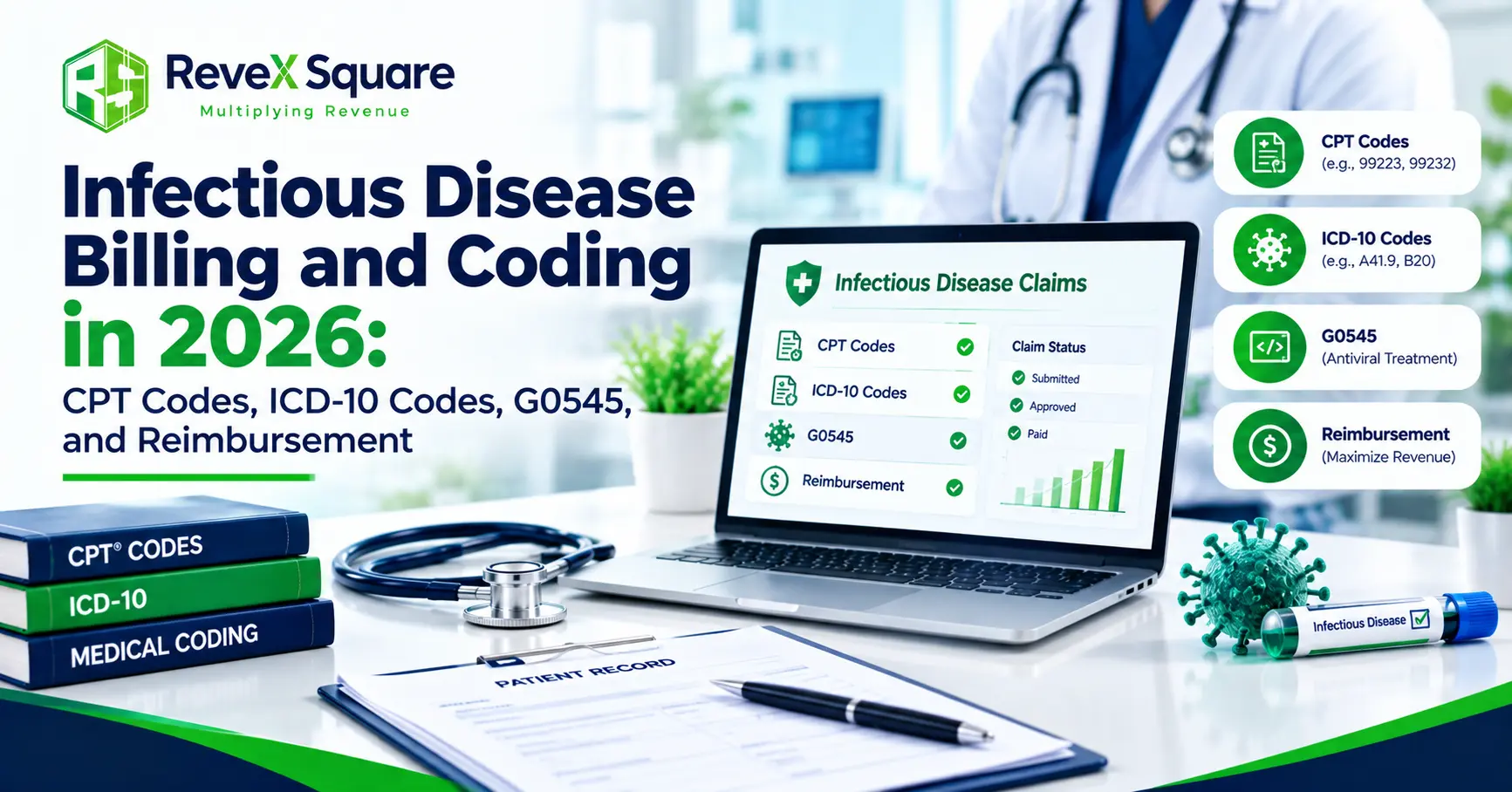
Infectious disease billing pays through hospital and office E/M codes, critical care codes, and two Medicare add-ons: G0545 for inpatient infectious disease care and G2211 for ongoing office care. Every claim needs an ICD-10 code that names the organism and any drug resistance, plus documented decision-making or time. Medicare does not accept consultation codes, so bill 99221–99223 for a new inpatient consult.
Key takeaways
- G0545 is the biggest ID-specific payment rule. Medicare has paid this inpatient add-on since January 1, 2025, and many billing guides still skip it.
- 41% of providers report denial rates of 10% or higher (Experian Health, 2025).
- Medicare telehealth flexibilities run through December 31, 2027, so virtual HIV and OPAT follow-ups stay billable.
- Pay is shifting. The 2026 Medicare conversion factor is $33.40. CMS proposes $32.84 for 2027.
In this guide
- What infectious disease billing is
- What changed in 2026 and 2027
- CPT codes for infectious disease billing
- How to bill an ID consult
- G0545 and G2211 explained
- ICD-10 codes that matter
- Documentation rules
- Telehealth and OPAT billing
- Why ID claims get denied, with research
- Two worked examples
- Pre-submission checklist, FAQs, and conclusion
What is infectious disease billing?
Infectious disease billing is the process of coding and billing the thinking-based care that infectious disease (ID) physicians provide. That care includes inpatient consults, hospital follow-ups, office visits, critical care, and long-term antibiotic management. Infectious disease billing differs from surgical billing because ID doctors seldom perform procedures. Their revenue comes from evaluation and management (E/M) codes, so payment depends on how well the chart supports the code.
Three terms drive every claim in infectious disease billing:
- CPT and HCPCS codes describe the service. CPT codes come from the AMA. HCPCS codes, such as G0545, come from CMS.
- ICD-10-CM codes describe the diagnosis. In infectious disease billing, they also name the organism and its resistance.
- Medical decision-making (MDM) or total time sets the E/M level. You choose one method per visit.
A strong ID claim links all three. The diagnosis code must justify the service, and the note must justify the level. If you want a broader view of how coders handle this, read Revex Square’s guide on how accurate medical coding improves reimbursements, and see the team’s medical coding services and internal medicine billing services, which share many ID workflows.
What changed in infectious disease billing for 2026 and 2027?
Five changes affect infectious disease billing right now: a higher 2026 conversion factor, G0545, extended telehealth, a proposed 2027 pay cut, and two proposed 2027 rule changes. The table below shows each change and what your team should do.
Table 1: Changes that affect infectious disease billing in 2026 and 2027
| Change | What it means | What to do |
| 2026 Medicare conversion factor | $33.40 for most clinicians and $33.57 for qualifying APM participants, up about 3.3% and 3.8% from 2025 (ASCRS summary). Congress added a one-year 2.5% boost. | Update your fee schedule model for 2026 and plan for the boost to end. |
| 2026 efficiency adjustment | CMS cut work RVUs by 2.5% for non-time-based services (CMS summary) but exempted time-based codes and codes on the telehealth list. | Check your top codes against the CMS exemption list. |
| G0545 inpatient ID add-on | Medicare pays this add-on with hospital inpatient and observation E/M visits when an ID specialist treats a confirmed or suspected infection (IDSA fact sheet). | Add G0545 to your charge capture for every eligible Medicare visit. |
| Telehealth through Dec. 31, 2027 | The Consolidated Appropriations Act, 2026 keeps the patient’s home as an eligible site and allows audio-only visits (HHS telehealth policy). | Keep billing virtual follow-ups, and track each payer’s modifier rules. |
| Proposed 2027 conversion factor | CMS proposes $32.84 for most clinicians, down 1.68%, and $33.17 for qualifying APM participants (CMS fact sheet). | Model a 2027 revenue dip. The rule is not final. |
| Proposed 2027 E/M and procedure rule | CMS proposes paying 50% for the lower-paid service when an office E/M visit and a procedure with a 0-, 10-, or 90-day global period occur on the same day. | Review how often your ID physicians bill procedures such as abscess drainage with a visit. |
| Proposed G2211 change | CMS proposes turning G2211 into a modifier that raises the E/M payment by 16%. | Watch the final rule before you change claim edits. |
| ICD-10-CM annual update | The FY2027 code set took effect October 1, 2026 (CMS ICD-10 page). We checked every diagnosis code in this guide against it. | Re-validate your code lists every October. |
The 2027 items are proposals. Comments closed September 14, 2026. Check the final rule before you change your billing process.
Which CPT codes matter most in infectious disease billing?
Infectious disease physicians bill hospital E/M codes most often, followed by office visits and critical care. The right code set depends on the setting and the payer. Use this table as a quick reference, and always confirm each payer’s policy.
Table 2: CPT and HCPCS codes used in infectious disease billing
| Setting | Codes | Notes |
| New inpatient or observation consult (Medicare) | 99221–99223 | Medicare does not recognize consultation codes, so the consultant bills initial hospital care. |
| Inpatient consult (payers that accept consult codes) | 99252–99255 | Confirm the payer pays consult codes and that the chart shows the request and the reply. |
| Hospital follow-up and discharge | 99231–99233, 99238–99239 | Pick the level by MDM or total time on the date of service. |
| Office or outpatient visit | 99202–99205 (new), 99212–99215 (established) | Add G2211 for eligible Medicare visits. |
| Critical care | 99291, 99292 | 99291 covers the first 30–74 minutes. Medicare pays the first 99292 only at 104 total minutes (CMS MLN guide). |
| Prolonged service (commercial payers) | 99417 (office), 99418 (inpatient) | Use only for payers that follow CPT. |
| Prolonged service (Medicare) | G2212 (office), G0316 (hospital) | G0316 attaches to 99223, 99233, and 99236. Medicare does not allow prolonged codes with critical care (CMS MLN guide). |
| ID complexity add-on (Medicare) | G0545 | Hospital inpatient and observation visits only. |
| Abscess drainage with a visit | 10160 plus modifier 25 on the E/M | Use modifier 25 only when the visit is truly separate. See Revex Square’s CPT modifiers guide. |
CPT is a registered trademark of the American Medical Association. Descriptions here are summaries, not official code descriptors.
The IDSA publishes a free E/M services reference guide for ID clinicians, and it is worth keeping beside your coders. Revex Square also explains CPT code categories and recent changes and the CPT codes that lose practices the most revenue.
How do you bill an infectious disease consult correctly?
Pick the code set by payer, then document the request, the findings, and your recommendations. Most infectious disease billing revenue starts with a consult, so errors here repeat on every claim.
- Check the payer. Medicare, and many Medicare Advantage plans, do not pay consult codes. Commercial plans vary.
- Choose the code. For Medicare, bill 99221–99223 for the first visit. For a payer that accepts consults, bill 99252–99255.
- Pick the level. Use MDM or total time on the date of service. Count only your own time.
- Document the request. Record who asked for the consult and why.
- Send the recommendations. Communicate them to the requesting clinician and note it.
- Add G0545 when eligible. For Medicare, add it to the hospital or observation visit.
Append modifier AI only when you are the admitting physician. A consultant should not use it.
How do G0545 and G2211 work in infectious disease billing?
In infectious disease billing, G0545 adds payment for the complexity of inpatient care, and G2211 adds payment for ongoing office care. Both are Medicare add-on codes, so you bill them with a base E/M code.
G0545: the inpatient ID add-on
- What it covers. The code describes visit complexity in hospital inpatient or observation care for a confirmed or suspected infectious disease. It includes transmission risk assessment, public health investigation and testing, and complex antimicrobial counseling and treatment (IDSA fact sheet).
- Who can bill it. An infectious disease specialist, which includes a physician or a non-physician practitioner with ID specialization.
- What it needs. CMS did not add documentation rules. The chart must still show the infection and your ID-specific work.
- What it is not. It is not time-based, it does not apply to outpatient visits, and it is a Medicare code. CMS valued it at 0.89 work RVU for 30 minutes. See the IDSA G0545 FAQs.
G2211: the office visit add-on
Bill G2211 when you serve as the continuing focal point for a patient’s serious or complex condition. An ID physician who manages a patient’s HIV over time fits that description (AAFP guidance). Medicare does not pay G2211 when the E/M visit carries modifier 25, with limited exceptions for certain preventive services. CMS proposes to convert G2211 to a modifier in 2027.
Which ICD-10 codes matter most in infectious disease billing?
Infectious disease billing rewards the most specific code the documentation supports, so always name the organism when you know it. Specific codes support medical necessity. Vague codes invite denials. The table lists common ID scenarios. We validated each code against the FY2027 ICD-10-CM set.
Table 3: ICD-10-CM codes for infectious disease billing, checked against the FY2027 set
| Scenario | ICD-10-CM code | Tip |
| Sepsis due to MSSA | A41.01 | A41.01 is methicillin-susceptible Staph aureus, not E. coli. |
| Sepsis due to MRSA | A41.02 | Use B95.62 for MRSA as the cause of a condition coded elsewhere. |
| Sepsis due to E. coli | A41.51 | This is the correct E. coli sepsis code. |
| Sepsis due to Klebsiella or other gram-negative organism | A41.59 | Use A41.52 for Pseudomonas and A41.54 for Acinetobacter. |
| Sepsis with septic shock | R65.21 | Code the sepsis first, then R65.21. |
| Carbapenem resistance | Z16.13 | Z16.24 means resistance to multiple antibiotics, not carbapenem. |
| ESBL resistance / vancomycin resistance | Z16.12 / Z16.21 | Add the resistance code after the infection code. |
| HIV disease / asymptomatic HIV status | B20 / Z21 | Use B20 when the patient has or ever had an HIV-related illness. Use Z21 if never. |
| HIV pre-exposure prophylaxis visit | Z29.81 | Added in FY2024. |
| Long-term antibiotic therapy (OPAT) | Z79.2 | Pair with the infection code. Add Z51.81 for drug level monitoring. |
| Diabetic foot ulcer | E11.621 + L97.- | E11.621 is the foot ulcer code. Add an L97 code for the ulcer site. |
| Immunodeficiency due to drugs | D84.821 | Supports complexity in patients on chemotherapy or biologics. |
| COVID-19 / exposure only | U07.1 / Z20.828 | An exposure code does not support an ICU-level service. |
Check codes in your encoder every October, and confirm the date of service matches the code set in effect. Revex Square’s common CPT codes that lead to claim denials and internal medicine CPT code denials guides explain the diagnosis-to-service match payers check.
What documentation does infectious disease billing require?
Document the infection, the organism, the resistance pattern, and either your decision-making or your total time. Payers read the note, not the code. These details protect your claim:
- Infection site. Name it: bloodstream, lung, bone, skin, urinary tract, or device.
- Organism. Record the culture result and the date. Do not write “sepsis” when you know the organism.
- Resistance. State MRSA, VRE, ESBL, or carbapenem resistance in words.
- Patient status. Mark new or established, and inpatient, observation, or outpatient.
- MDM. List data you reviewed (cultures, imaging, labs), your assessment, and your risk (for example, drug toxicity monitoring).
- Time. Write total minutes and the tasks, such as “65 minutes: chart review, bedside exam, counseling, care coordination.” For critical care, exclude time for separately billed procedures.
- The reason for the consult and the plan. Note who asked and what you recommended.
Revex Square covers the front-end checks in insurance verification in healthcare and the eligibility verification services that keep claims from failing before coding starts.
How do telehealth and OPAT affect infectious disease billing?
For infectious disease billing, Medicare covers telehealth follow-ups through December 31, 2027, and long-term IV antibiotic care needs strong prior authorization work. HHS states that Medicare patients can receive non-behavioral telehealth at home with no geographic limit through that date (HHS telehealth policy). Commercial payers set their own modifier and place-of-service rules, so check each contract before you submit.
Outpatient parenteral antimicrobial therapy (OPAT) brings extra steps: drug and pump authorization, weekly labs, and line care. Code Z79.2 with the infection, add Z51.81 for drug level checks, and review the supporting workflows in home healthcare billing services and lab billing services. For patients with HIV or other chronic infections, RPM and CCM billing services describe care management programs you can add.
Why do infectious disease claims get denied?
Infectious disease claims get denied mostly for data errors, weak documentation, and the wrong code set for the payer. National research backs this up.
Table 4: Research on denials that applies to infectious disease billing
| Study | Finding | Why it matters for ID |
| Experian Health, State of Claims 2025 | 41% of providers report denial rates of 10% or higher. 54% say claim errors are rising. 43% say they are understaffed. | ID teams juggle hospital and clinic claims with thin staff. Errors multiply. |
| Same Experian survey, causes | Top causes: missing or inaccurate data (50%), authorizations (35%), registration errors (32%). | Organism, resistance, and OPAT authorization data fail in exactly these ways. |
| AMA 2025 Prior Authorization Survey (1,000 physicians) | 95% say prior authorization delays care. Practices spend about 13 hours a week on it. | IV antibiotic therapy and specialty drugs often need approval before day one. |
| KFF, ACA Marketplace claims, 2024 | HealthCare.gov insurers denied 19% of in-network claims and 37% of out-of-network claims. | Marketplace patients appear in ID clinics. Track denials by payer. |
Table 5: Common infectious disease billing denials and fixes
| Denial reason | Example | Fix |
| Consult code sent to Medicare | Billed 99254 to a Medicare plan | Bill 99221–99223 for Medicare patients. |
| Vague diagnosis | Billed A41.9 when a culture named the organism | Update the claim to the organism-specific A41 code. |
| Wrong or missing resistance code | Used Z16.24 for carbapenem resistance | Use Z16.13 for carbapenem resistance. |
| Critical care time not met | Billed 99292 at 95 minutes to Medicare | Bill 99291 only until 104 minutes. |
| Modifier 25 missing | Billed 10160 and a visit with no modifier | Append 25 to a separate, documented E/M. |
| G0545 on the wrong visit | Billed G0545 with an office visit | Attach G0545 only to inpatient or observation E/M visits. |
| No prior authorization | Started home IV antibiotics without approval | Verify authorization before the first dose. |
Revex Square explains the root causes in healthcare claim denial causes and why 86% of claim denials are preventable. Teams that want help appealing can review denial management services, and practices with old unpaid claims can read how to collect old medical claims.
Two worked examples in infectious disease billing
These teaching examples show how infectious disease billing rules fit together. They are illustrations, not payment promises.
Example 1: ICU sepsis consult
| Scenario: An ID physician consults on a patient in septic shock from carbapenem-resistant Klebsiella pneumoniae and documents 95 minutes of critical care time.Diagnoses: A41.59 (sepsis due to other gram-negative organisms), R65.21 (severe sepsis with septic shock), Z16.13 (carbapenem resistance).Medicare claim: 99291 once. Medicare does not pay the first 99292 until 104 total minutes, and it does not allow G0545 or prolonged codes with critical care.Commercial payer that follows CPT: 99291 once and 99292 once, because CPT allows the first 99292 at 75 minutes. Confirm with the payer.Chart must show: start and stop times or total minutes, the cultures reviewed, antibiotic changes, and the discussion with the ICU team. |
Example 2: Stable HIV follow-up
| Scenario: An established patient on antiretroviral therapy sees the ID physician by video for a routine follow-up. The doctor has managed the patient’s HIV for years.Codes: A level 99214 office visit, plus G2211 for Medicare because the physician provides ongoing care for a serious condition. Do not add modifier 25.Diagnoses: B20 if the patient has ever had an HIV-related illness, or Z21 if never. Add Z79.899 for long-term drug therapy.Chart must show: viral load review, adherence discussion, side-effect check, and the plan. Confirm the payer’s telehealth modifier and place-of-service rules. |
What should you check before you submit an infectious disease claim?
Run this ten-point infectious disease billing check on every claim. It catches most errors before the payer does.
- Is coverage active, and is prior authorization on file?
- Does the payer accept consult codes?
- Did the note name the infection site and organism?
- Does the diagnosis code match the organism?
- Did you add the resistance code (for example, Z16.13)?
- Does the E/M level match MDM or documented time?
- Is critical care time documented and over the payer’s threshold?
- Did you add G0545 or G2211 where Medicare allows?
- Is modifier 25 on the visit only when a separate procedure occurred?
- Does the claim use the right telehealth modifier and place of service?
Should you outsource infectious disease billing?
Outsource infectious disease billing when your team cannot keep up with payer rules, critical care time audits, or denial follow-up. ID billing mixes hospital, clinic, and home infusion claims, and each one follows different rules. A billing partner that tracks Medicare changes, such as G0545 and the 2027 proposals, protects revenue you would otherwise lose. Read how to outsource medical billing services and how to choose a medical billing company before you decide.
Revex Square offers revenue cycle management services, accounts receivable services, and inpatient hospital billing services. Browse all specialties or view pricing plans. To review your own ID claims, book a consultation.
Frequently asked questions about infectious disease billing
What CPT codes do infectious disease specialists bill most?
Hospital E/M codes (99221–99223, 99231–99233, 99238–99239), office visits (99202–99215), consults (99252–99255) where accepted, and critical care (99291–99292).
What is HCPCS code G0545?
A Medicare add-on for inpatient and observation care by an infectious disease specialist. It pays for added visit complexity and needs no extra documentation.
Does Medicare pay for consultation codes?
No. Medicare stopped recognizing them in 2010, so bill 99221–99223 or the correct office E/M code instead.
When does Medicare pay 99292?
After 104 total minutes of critical care, according to the CMS MLN guide. CPT itself allows it at 75 minutes, so other payers may differ.
What is the ICD-10 code for carbapenem resistance?
Z16.13. Do not use Z16.24, which means resistance to multiple antibiotics.
What is the difference between B20 and Z21?
B20 is HIV disease, used when the patient has or ever had an HIV-related illness. Z21 is asymptomatic HIV infection status.
Is telehealth covered for infectious disease billing in 2026?
Yes for Medicare, through December 31, 2027. Check each commercial payer’s modifier and place-of-service rules.
Can I bill G2211 for HIV care?
Yes, when you provide ongoing care for a serious condition in an office visit. Medicare does not pay it with modifier 25 (AAFP guidance).
How much does Medicare pay for ID visits in 2026?
Payment equals total RVUs, adjusted for your location, times the conversion factor, which is $33.40 for most clinicians in 2026. Look up your locality’s fee schedule.
Will infectious disease billing payments change in 2027?
CMS proposed a lower conversion factor of $32.84 and new rules for same-day visits with procedures. These are proposals until CMS finalizes them.
How do I reduce infectious disease billing denials?
Verify coverage and authorization first, name the organism and resistance, document time, and match the code set to each payer.
Do commercial payers pay more than Medicare?
Often, but it depends on your contract. Compare your actual contracted rates with the Medicare fee schedule.
Is infectious disease billing different from internal medicine billing?
Yes. Infectious disease billing is hospital-heavy and adds organism and resistance coding, critical care time rules, and the G0545 add-on.
Conclusion: get infectious disease billing right in 2026
Accurate infectious disease billing comes down to three habits: choose the right code set for each payer, name the organism and resistance in both the note and the claim, and capture every Medicare add-on you earn. The 2026 rules reward ID physicians who bill G0545 and G2211 correctly, and the 2027 proposals make clean claims even more important.
Audit your last 90 days of ID claims against the checklist above, fix the top three denial causes, and update your charge capture for G0545. If you want expert help, contact Revex Square or read about the team on the About Us page.