









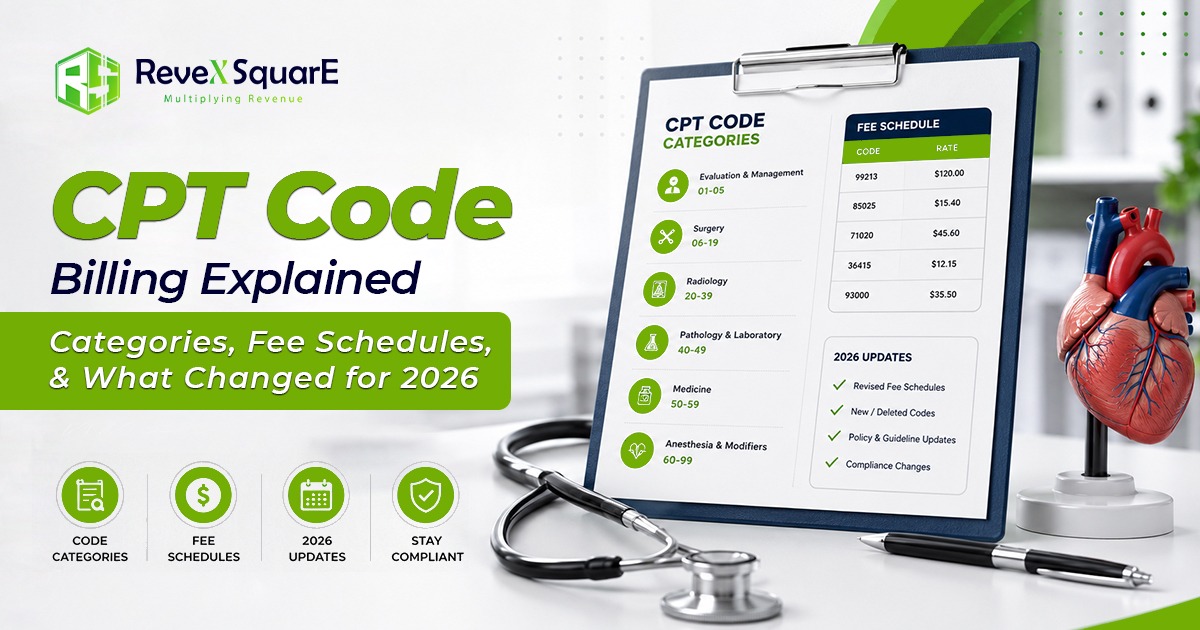
If you’ve ever looked at a denied claim and wondered whether the problem started with a single five-digit number, there’s a good chance it did. CPT code billing sits at the center of nearly every healthcare claim submitted in the United States, and even small errors in how these codes are selected or reported can be the difference between a clean payment and a frustrating denial. This guide walks through what CPT codes actually are, how they’re organized, how they connect to fee schedules and HCPCS, and what’s new for 2026.
What Is the CPT Code Set?
Current Procedural Terminology, or CPT, is the standardized system used to describe medical coding services and procedures performed by a physician or other qualified health care professional. Every procedural terminology CPT code is a five-digit number that tells a payer exactly what was done during a visit, test, or procedure — everything from a routine office visit to a complex surgical procedure has its own corresponding code.
The CPT code set is owned, published, and updated by the American Medical billing Association (AMA). It isn’t a static list — existing codes are revised, new codes are added, and outdated codes are retired every single year to keep pace with how medicine is actually practiced. For 2026, the update was one of the largest in recent years, adding roughly 288 new codes, deleting 84, and revising 46 across specialties including remote patient monitoring, hearing devices, and vascular procedures.
The Types of CPT Codes: Category I, II, and III
Understanding the types of CPT codes is the foundation of accurate cpt coding. There are three distinct categories, and mixing them up is one of the most common sources of billing confusion:
- Category I CPT codes: the codes most practices use daily. These represent widely performed medical services and procedures that are FDA-approved, supported by peer-reviewed literature, and eligible for reimbursement under standard fee schedules.
- Category II CPT codes: supplemental tracking codes used for performance measurement and quality reporting. They don’t carry a monetary value on their own but help reduce the need for manual chart review during audits.
- Category III: temporary codes assigned to emerging technologies, services, and procedures that haven’t yet met the bar for a permanent Category I code. Because they’re new and often experimental, payment for Category III codes is determined by individual payer policy rather than a standard fee schedule.
A code can move between categories over time. In the 2026 update, for example, CT cerebral perfusion imaging moved from a long-standing Category III code to new Category I codes — a reminder that a code your practice used successfully last year may need to be re-verified before you bill it again this year.
CPT Codes vs. HCPCS Codes
CPT codes and HCPCS codes are closely related, but they’re not identical, and mixing them up causes real billing problems. CPT codes are technically referred to as HCPCS Level I — the same five-digit numeric code, like 99213 for an established patient office visit, functions as both. The common procedure coding system HCPCS also includes a second tier, HCPCS Level II, which is maintained separately by the Centers for Medicare Medicaid Services (CMS) and covers items CPT doesn’t — durable medical equipment, ambulance services, prosthetics, orthotics, internal medicine and supplies used outside a physician’s office.
One detail that trips up newer billing staff: CPT is copyrighted by the AMA, and commercial use requires a valid license, while HCPCS Level II codes sit in the public domain and require no license at all. If your practice bills for both physician services and durable medical equipment, your team needs to be fluent in both systems, not just one.
Who Creates and Updates CPT Codes
New and revised codes don’t appear at random. They go through a structured review process managed by the AMA‘s CPT Editorial Panel, a group made up of physicians nominated by medical specialty societies, along with representatives from CMS, the insurance industry, and allied health professions. Proposals for new codes — often submitted by medical specialty societies advocating for a procedure their members perform — are reviewed, debated, and either approved, rejected, or sent back for revision.
Here’s a detail many billing guides skip: the CPT Editorial Panel meets three times a year to review Category I and Category III proposals, and Category II codes specifically are released three times yearly, in March, July, and November, while Category III updates are issued twice a year. This is why practices sometimes see mid-year code additions rather than waiting for the annual January release — it’s easy to miss a Category III update if your team only checks the coding manual once a year.
CPT Codes, Fee Schedules, and Billing Rates
A CPT code alone doesn’t determine what a provider gets paid — that’s where fee schedules come in. The Centers for Medicare Medicaid Services (CMS) publishes the Medicare Physician Fee Schedule annually, assigning relative value units (RVUs) to each Category I code based on physician work, practice expense, and malpractice risk. Commercial payers typically build their own fee schedules using the Medicare Medicaid services CMS structure as a reference point, then apply their own percentage adjustments.
This is why CPT code billing rates can vary significantly from one payer to the next for the exact same code. Category III codes complicate this further, since they aren’t assigned RVUs at all — payment depends entirely on individual payer policy rather than a predictable, published rate. Practices that bill Category III codes without confirming payer-specific coverage in advance are far more likely to see those claims denied or paid inconsistently.
CPT Code Billing Guidelines Practices Should Follow
Accurate cpt code billing depends on more than picking the code that sounds closest to what happened during the visit. A few guidelines make the biggest difference in reducing denials:
- Match documentation to the code — the medical record should clearly support the specific service or procedure billed, not just a general description of the visit
- Verify category before billing — confirm whether a code is still Category I, or whether it has shifted categories in the most recent annual update
- Check payer-specific rules for Category III codes before submission, since there’s no standard fee schedule to fall back on
- Update charge masters and encoder software every January to reflect deleted, revised, and newly added codes
- Use modifiers correctly, since an otherwise-correct CPT code with the wrong (or missing) modifier is a common, avoidable cause of denial
Specialty Considerations: Clinical Laboratory and Beyond
Certain areas of billing carry their own CPT quirks. Clinical laboratory services, for example, often use codes structured differently from standard evaluation and management codes, including designations for Multianalyte Assays with Algorithmic Analysis and proprietary laboratory analyses codes that follow their own numbering conventions. Specialties like cardiology, orthopedics, and behavioral health have also seen significant code restructuring in recent years, driven largely by proposals from their respective medical specialty societies as technology and treatment approaches evolve.
Why This Matters for Your Practice’s Revenue
None of this is abstract for a practice trying to get paid on time. A claim billed with an outdated code, a miscategorized Category III procedure, or a mismatch between documentation and the CPT code selected is one of the most common — and most preventable — reasons claims come back denied. Getting cpt coding right the first time protects both revenue and staff time that would otherwise go toward rework and appeals.
This is exactly where Revex Square’s medical billing and coding services support healthcare providers — keeping up with each year’s CPT changes, verifying category status before a claim goes out, and making sure documentation and coding stay aligned so practices get paid accurately and on time.
Frequently Asked Questions
What is the difference between Category I, II, and III CPT codes?
Category I CPT codes cover standard, widely performed medical services and procedures eligible for reimbursement under normal fee schedules. Category II CPT codes are supplemental codes used for quality and performance tracking, with no direct payment attached. Category III codes are temporary codes for emerging technologies and procedures, paid according to individual payer policy rather than a set fee schedule.
How often are CPT codes updated?
The AMA releases a full CPT code set update every year, effective January 1. However, updates don’t happen only once annually — Category II codes are released three times a year, and Category III codes are updated twice a year, which means practices need to check for changes more often than just the January release.
Who decides which new CPT codes get approved?
The CPT Editorial Panel, working with the AMA, reviews all code proposals. The panel includes physicians nominated by medical specialty societies along with representatives from CMS and the health insurance industry. The CPT Editorial Panel meets three times a year to evaluate new code proposals, revisions, and Category III additions.
What’s the difference between CPT codes and HCPCS codes?
CPT codes are the same thing as HCPCS Level I — both refer to the identical five-digit numeric codes maintained by the AMA. HCPCS Level II is a separate, alphanumeric code set maintained by CMS covering durable medical equipment, supplies, and services that CPT doesn’t include.
Why do CPT code billing rates vary between insurance companies?
CMS publishes the Medicare Physician Fee Schedule as a baseline, but commercial payers set their own rates, often using the CMS fee schedule as a reference point before applying their own adjustments. Category III codes have no standard fee schedule at all, so payment depends entirely on each payer’s individual policy.
Can a CPT code change category over time?
Yes. A temporary Category III code can be promoted to a permanent Category I code once it meets criteria such as FDA approval, widespread use, and supporting clinical evidence — as happened with CT cerebral perfusion imaging in the 2026 CPT update. This is why practices should periodically re-verify the category status of codes they bill regularly.
Need help keeping your practice’s coding accurate through every annual CPT update? Revex Square’s medical billing and coding services combine certified coders with proactive documentation review to help healthcare providers reduce denials and get paid faster.
Contact us for further details