






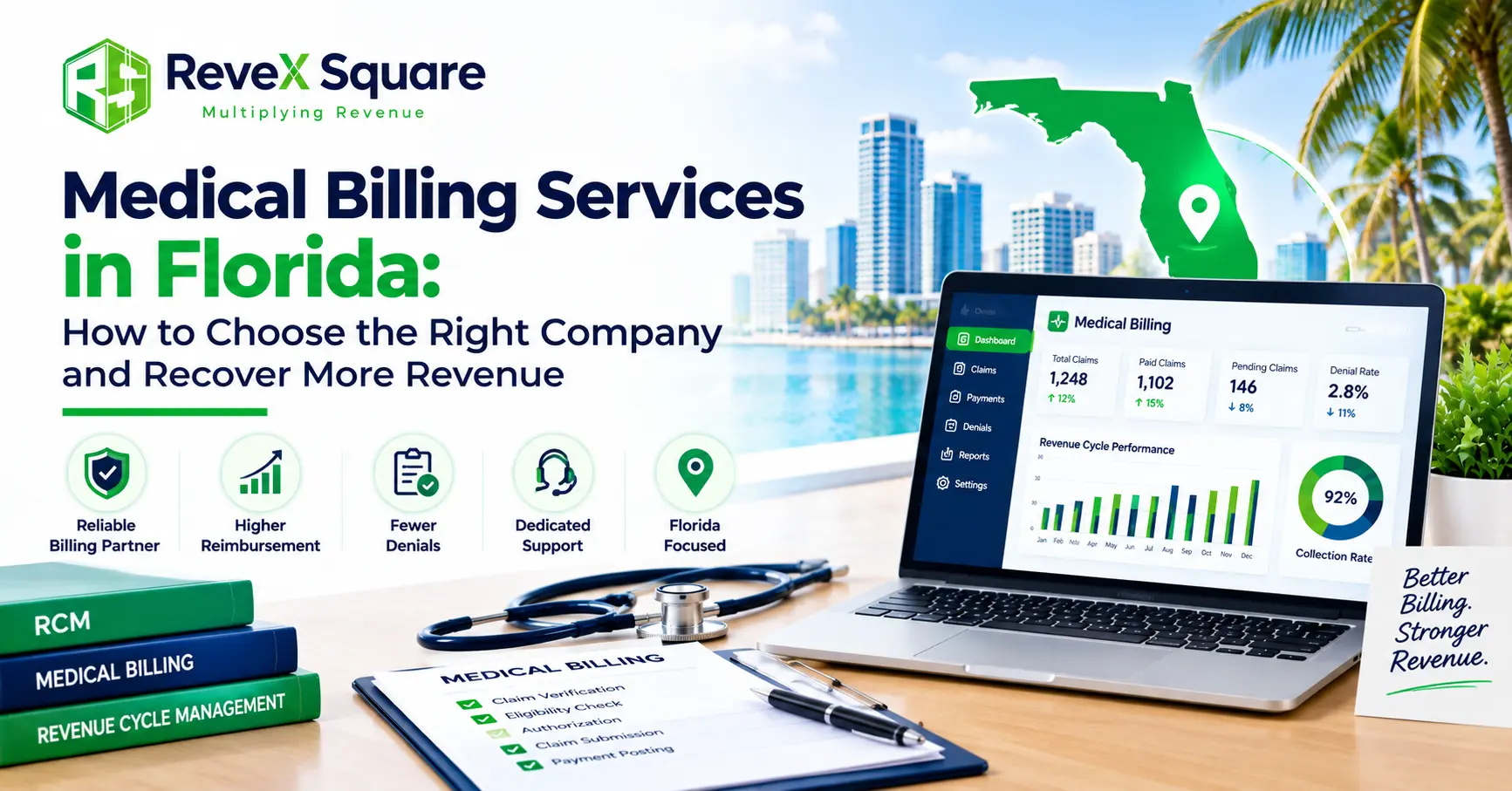
Medical billing services in Florida manage your claims from eligibility check to final payment. The team codes visits, submits claims, appeals denials, posts payments, and collects patient balances. Most companies charge a percentage of collections. Pick a company with Florida payer experience, certified coders, HIPAA compliance, and monthly reporting, and confirm it tracks Florida’s 20-day claim payment deadline.
Key takeaways
- 41% of providers report denial rates of 10% or higher, according to the Experian Health 2025 State of Claims survey.
- 19% of in-network claims were denied by HealthCare.gov insurers in 2024, according to KFF.
- 22.8% of Florida residents are 65 or older, so Medicare rules shape your cash flow more than they do in most states.
- Florida law sets clocks for insurer payments (20 days) and patient refunds (30 days), and good medical billing services in Florida track both.
What do medical billing services in Florida include?
Medical billing services in Florida turn patient visits into paid claims. A billing company verifies coverage, assigns codes, sends claims to payers, works denials, posts payments, and bills patients for their share. Each step feeds the next, so one early error shows up later as a denial.
A full-service Florida medical billing company covers these tasks:
- Eligibility and benefits verification. The team confirms active coverage before the visit. Revex Square runs insurance eligibility verification in Florida so front-desk errors do not become denials.
- Medical coding. Certified coders convert notes into CPT, ICD-10, and HCPCS codes. See the Florida medical coding services page for scope.
- Charge entry and claim submission. Billers scrub each claim for errors and send it electronically.
- Denial management. Specialists find the root cause, fix the claim, and appeal on time. Read how denial management services in Florida work.
- Accounts receivable follow-up. The team chases unpaid claims until payers pay. Start with accounts receivable services in Florida.
- Patient billing. Clear statements and payment options raise collections. Learn about patient billing services in Florida.
- Reporting. You receive monthly numbers on collections, denial rate, and days in accounts receivable.
If you want a plain-language overview before you compare vendors, read what medical billing services are. For the complete service list, visit the main medical billing services page and the revenue cycle management services page.
Why do denials cost money, and how do medical billing services in Florida reduce them?
Medical billing services in Florida reduce denials by fixing the errors that cause most of them: missing data, authorization gaps, and registration mistakes. National research from 2025 and 2026 shows the problem is growing, and it applies to Florida practices as much as to any other state. Revex Square covers the same trend in its guide to why denial rates hit 12% in 2026.
Table 1: Research on claim denials and what it means for medical billing services in Florida
| Study | What it found | What it means for a Florida practice |
| Experian Health, State of Claims 2025 (250 healthcare finance and billing professionals) | 41% of providers have denial rates of 10% or higher. 54% say claim errors are rising. 68% say clean claims are harder to submit than a year ago. | A 10% denial rate is the line to beat. If your rate sits above it, you are in the group that is growing. |
| Same Experian survey, causes of denials | Top causes: missing or inaccurate data (50%), authorizations (35%), incomplete registration data (32%). 90% of resubmissions get some human review. | Fix intake and eligibility first. These errors happen before coding starts. |
| KFF, ACA Marketplace claims in 2024 | HealthCare.gov insurers denied 19% of in-network claims and 37% of out-of-network claims. | Marketplace plans are one payer group, but they show how often payers say no. Track denials by payer. |
| CAQH Index 2025 (released February 2026) | U.S. healthcare avoided $258 billion in administrative costs in 2024 through electronic transactions. $21 billion in savings remains from manual and partly manual work. | Manual eligibility checks and paper follow-up still cost money. Electronic workflows cut it. |
| U.S. Census Bureau QuickFacts | 22.8% of Florida residents are 65 or older. | Medicare and Medicare Advantage claims make up a large share of Florida volume. Payer-specific rules matter. |
The takeaway is practical. Practices that fix data quality at intake, verify eligibility every visit, and appeal every winnable denial recover revenue that competitors write off. Revex Square explains the main triggers in healthcare claim denial causes and why 86% of claim denials are preventable.
Which Florida rules shape medical billing services in Florida?
Florida law gives insurers 20 days to act on an electronic claim and gives your practice 30 days to refund a patient overpayment, so medical billing services in Florida must track both clocks. Under the state’s prompt pay statute, an insurer must pay a claim or notify you that it is denied or contested within 20 days after receipt. If the insurer contests the claim, you have 35 days after the notice to send the information it requests.
The Florida Department of Financial Services reviews prompt pay complaints under sections 627.6131 and 641.3155. Its medical providers page explains what to submit when a plan misses a deadline. A newer rule works in the other direction. CS/CS/SB 1808 requires providers to refund patient overpayments within 30 days after determining the patient overpaid. The law took effect January 1, 2026. A practitioner who misses the deadline faces discipline, and an AHCA-licensed facility can face a fine of up to $500.
Table 2: Florida deadlines that affect medical billing services in Florida
| Rule | Deadline | Action for your billing team |
| Insurer acknowledges an electronic claim (s. 627.6131) | Within 24 hours after the start of the next business day | Save the acknowledgment as proof of timely filing. |
| Insurer pays, denies, or contests a claim (s. 627.6131) | 20 days after receipt | Flag every claim older than 20 days and call the payer. |
| Your response to a contested claim | 35 days after the insurer’s notice | Send records fast. Late documents turn fixable claims into lost claims. |
| Refund of patient overpayment (SB 1808) | 30 days after you determine the overpayment | Review credit balances monthly and issue refunds on a set schedule. |
| Medicaid enrollment deficiencies (AHCA) | 21 days to correct | Submit complete applications. Incomplete files delay your Medicaid ID. |
| Medicaid enrollment processing (AHCA estimate) | 60 days or less once the clock starts | Start enrollment before a new provider’s first patient visit. |
Section 627.6131 covers major medical expense policies. HMOs fall under section 641.3155, and payer contracts can add terms. Confirm the rule for each plan type, and ask your attorney about edge cases.
Emergency providers face one more layer. Florida law bars out-of-network providers from balance billing PPO, EPO, HMO, and Medicaid managed care members for emergency services. The federal No Surprises Act adds a dispute process, and federal agencies finalized new operational rules for it on May 28, 2026. Revex Square tracks how these laws shape claims in healthcare laws and medical billing in the USA. Every billing team must also protect patient data under the HIPAA Privacy Rule.
How do medical billing services in Florida work, step by step?
Medical billing services in Florida follow eight steps, and a failure at any step delays payment. Use this sequence as a checklist when you audit your own workflow or a vendor’s.
- Register the patient. Collect full demographics, insurance IDs, and the subscriber’s details. Registration errors cause 32% of denials, according to Experian’s survey.
- Verify eligibility and authorization. Confirm active coverage and check whether the service needs prior approval. See insurance eligibility checks.
- Document the visit. The provider records the history, exam, decision-making, and time. Documentation supports every code.
- Code the encounter. Coders assign CPT and ICD-10 codes and add modifiers such as modifier 25 when needed. Revex Square explains CPT modifiers in a separate guide.
- Submit a clean claim. A scrubber checks the claim for missing fields, mismatched codes, and payer-specific edits before it goes out.
- Track and work denials. Billers sort denials by reason code, fix the cause, and appeal inside the payer’s window.
- Post payments and bill the patient. The team posts ERA and EFT data, checks each payment against the contract, and sends patient statements.
- Report and improve. Monthly reports show where revenue leaks. Read about collecting old medical claims if your accounts receivable has aged.
Which billing metrics should you track?
Track four numbers every month: first-pass acceptance rate, denial rate, days in accounts receivable, and net collection rate. Ask any billing company to report all four.
Table 3: Four metrics that measure medical billing services in Florida
| Metric | Formula | What it tells you |
| First-pass acceptance rate | Claims paid on first submission ÷ claims submitted | How clean your claims are before payers review them. |
| Denial rate | Claims denied ÷ claims submitted | How often payers reject your claims. Compare it with the 10% line from the Experian survey. |
| Days in accounts receivable | Total A/R ÷ average daily charges | How long you wait to get paid. |
| Net collection rate | Payments collected ÷ amount you are allowed to collect | How much of your earned revenue you actually keep. |
| Worked example (illustration, not a client result): A practice submits 800 claims a month with an average expected payment of $150. At a 10% denial rate, 80 claims come back denied, which puts $12,000 of monthly revenue on hold. If better eligibility checks and coding cut the denial rate to 6%, only 48 claims come back. That change frees $4,800 a month, and the practice still appeals the remaining 48. |
Should you outsource medical billing services in Florida or keep billing in-house?
Hire outside medical billing services in Florida when denials rise, staff turnover disrupts claims, or billing work pulls your team away from patients. Keep it in-house only when you can staff certified coders, a denial specialist, and a manager who tracks every payer change. Experian’s survey found 43% of providers report being understaffed, which explains why many practices move billing out.
Table 4: In-house, outsourced, and hybrid medical billing services in Florida compared
| Factor | In-house billing | Outsourced billing | Hybrid |
| Cost structure | Salaries, benefits, software, training | Percentage of collections or flat fee | Lower payroll plus a vendor fee for hard tasks |
| Coding updates | Your staff tracks CPT, ICD-10, and payer edits | The vendor trains its coders on every update | Vendor handles coding, you keep the front desk |
| Denial follow-up | Slips when the office is busy | Dedicated team works denials daily | Vendor works denials and aged A/R |
| Staff absence | Sick days stall claims | Team covers the gap | Partial coverage |
| Reporting | Manual, if anyone has time | Monthly dashboards and reviews | Shared reports |
| Best for | Large groups with a full billing department | Small and mid-size practices | Practices that want control of intake and payments |
Read how to outsource medical billing services before you sign a contract. Small offices can also compare options in best medical billing services for small practices, and a practice that wants to leave a weak vendor should read how to switch medical billing companies.
How do medical billing services in Florida differ by specialty?
Medical billing services in Florida must match your specialty, because each one codes, documents, and gets paid differently. A generalist that misses a modifier or a payer edit leaves money unpaid. Browse every specialty billing service Revex Square supports, and use the notes below as a starting point.
Emergency and freestanding ER billing
Emergency medicine billing depends on accurate E/M level selection, critical care time capture (CPT 99291 and 99292), and underpayment recovery. Florida emergency physician groups and freestanding emergency departments treat patients with no verified coverage at arrival. Billers must code acuity correctly, apply No Surprises Act rules, and compare payer payments with contracted or reference rates. Revex Square offers dedicated freestanding ER billing services.
Urgent care billing
Urgent care billing needs speed and accuracy because walk-in volume, mixed services, and many payer types create frequent errors. Teams must code procedures, in-house labs, and occupational medicine visits correctly. See urgent care billing services for details.
Behavioral and mental health billing
Behavioral health billing requires precise psychotherapy codes, time documentation, and correct modifiers for telehealth. For example, CPT 90832 covers 30 minutes of psychotherapy and needs a documented start and stop time. Read the CPT 90832 billing guide and the mental health billing services guide, and review behavioral health billing services for psychiatrists, therapists, and outpatient programs.
Cardiology, internal medicine, family practice, and therapy
Office-based specialties lose revenue to under-coded visits and missing modifiers. Cardiology groups bill echocardiograms and ECGs, and internal medicine and family practices rely on E/M levels. Review cardiology billing services, internal medicine billing, family medicine billing, and physical therapy billing. For skilled nursing, rural health clinics, and durable medical equipment, ask any vendor to show current experience with each payer method before you sign.
Do medical billing services in Florida need an office in Miami, Orlando, or Boca Raton?
No. Medical billing services in Florida work remotely, but the company must have Florida payer experience. Billing teams file claims electronically, so a vendor can serve practices in Miami, Orlando, Boca Raton, Eatonville, and across South Florida. Ask about the payers your patients use most: Medicare, Florida Medicaid managed care plans, and major commercial carriers. A team that already works those payers starts faster and makes fewer early mistakes. Compare coverage on the Florida medical billing services page and the full states we serve list.
How do credentialing and enrollment affect medical billing services in Florida?
A provider who is not credentialed with a payer cannot bill that payer. Credentialing delays cause denied claims and postponed revenue, so start the process before a new provider sees patients. Revex Square handles credentialing and enrollment in Florida, and the provider credentialing guide explains each step. For Medicaid, AHCA screens providers by risk level, and the agency’s provider enrollment page lists forms and revalidation rules. Its readiness page covers the 21-day and 60-day timelines.
What do medical billing services in Florida cost?
Most medical billing services in Florida charge a percentage of monthly collections, a flat monthly fee, or a per-claim fee. Percentage pricing ties the vendor’s income to yours, because the vendor earns more only when you collect more. Compare quotes by what each fee includes, not by the headline rate. Revex Square lists its plans on the pricing plans page.
Table 5: Common pricing models for medical billing services in Florida
| Pricing model | How it works | Best for | Watch for |
| Percentage of collections | Vendor takes a set percent of what you collect | Most practices | Extra fees for coding, credentialing, or patient statements |
| Flat monthly fee | Fixed amount per month | Stable, high-volume practices | Fee does not drop when collections fall, and does not reward results |
| Per-claim fee | Set price for each claim submitted | Low-volume or seasonal practices | Costs rise fast with volume; denials may cost extra |
| Hybrid | Base fee plus a smaller percentage | Practices that want a service-level guarantee | Complex contracts; read every line |
How do you choose the best medical billing services in Florida?
Choose medical billing services in Florida that prove specialty experience, report numbers openly, and follow compliance rules. Use these questions in every sales call. Revex Square covers the topic in more depth in how to choose a medical billing company.
Table 6: Checklist for choosing medical billing services in Florida
| Ask this | Strong answer | Red flag |
| How many clients do you have in my specialty? | A number, plus references you can call | General claims about “all specialties” |
| Are your coders certified? | Yes, through AAPC or AHIMA, and they follow current ICD-10 guidelines | No credentials or vague training claims |
| What is your first-pass acceptance rate? | A reported figure with a clear definition | No data, or a number with no source |
| How do you handle HIPAA? | Written policies, staff training, and a signed business associate agreement | No agreement offered |
| What do I see every month? | Dashboards for denials, A/R, and collections | Reports only on request |
| How do you find underpayments? | Payment checks against contracted rates, with appeals | No process |
| What are the contract terms? | Clear notice period, you own your data, no hidden setup fees | Long lock-in and fees to export data |
Not sure where your own numbers stand? Book a consultation and ask for a billing audit.
What should you do in 90 days to improve your medical billing services in Florida?
Start with a denial audit. Pull the last 90 days of denied claims, group them by reason code, and fix the top three causes. Then apply these Florida-specific habits:
- Log every claim clock. Flag any claim past 20 days and any contested claim approaching the 35-day response deadline.
- Run eligibility at every visit. Medicaid managed care and Medicare Advantage enrollment can change between visits.
- Review credit balances monthly. Issue patient refunds inside the 30-day window under SB 1808.
- Code to full specificity. Vague diagnosis codes and missing modifiers trigger denials.
- Appeal with records. Attach notes, test results, and the payer’s own policy language.
- Audit quarterly. Compare payments with contracted rates and look for short pays.
Frequently asked questions about medical billing in Florida
Which medical billing company is the best in Florida?
No single company fits every practice. Compare at least three medical billing services in Florida on specialty experience, certified coders, HIPAA compliance, and monthly reports.
How much do medical billers make in Florida?
Florida medical records specialists earn a median of about $45,760 a year (BLS, May 2025). Glassdoor lists an average of $51,731 for billing and coding specialists, so this also answers how much medical billing pays in Florida.
What are the top 10 medical billing companies?
No official top 10 list exists, and rankings change by source and specialty. Build a shortlist of three to five medical billing services in Florida and score them on specialty experience, denial rates, reporting, and fees.
What are the key medical billing laws in Florida?
Florida’s prompt pay statutes (s. 627.6131 and s. 641.3155) set claim payment deadlines, and SB 1808 sets a 30-day patient refund rule. The federal No Surprises Act and HIPAA cover balance billing and patient data.
What is the golden rule of medical billing?
If it is not documented, it was not done. Bill only for services that the medical record clearly supports.
What are the new legal guidelines in Florida for 2026?
SB 1808 took effect January 1, 2026 and requires providers to refund patient overpayments within 30 days. Federal agencies also finalized a No Surprises Act dispute resolution rule on May 28, 2026. Confirm details with your attorney.
Is AI replacing medical billers?
No. AI speeds up claim checks and coding suggestions, but people still resolve denials and appeals. Experian found that 90% of denials get at least some human review before resubmission.
Which medical billing company is the best in the USA?
There is no single best company nationwide. Choose a company that proves specialty experience, reports first-pass acceptance, and follows HIPAA.
Where do medical billers get paid the most?
Pay is highest in large health systems and varies by state. AAPC’s 2026 report puts Delaware at the top at $77,708 and Mississippi lowest at $50,393.
Who gets paid more, a medical biller or coder?
Coders generally earn more. Payscale data shows $23.54 an hour for coders versus $20.16 for billers, because coding needs more technical training.
Where can I learn medical billing and coding skills in Florida?
Florida state colleges, career schools, and online programs teach both skills. Earn a certification such as the CPC through AAPC or the CCS through AHIMA.
Is there a demand for medical billers?
Yes. Florida ranks third nationally in employment of medical records specialists, and job growth is projected near 8% over the next decade.
Is there a shortage of medical billers?
Hiring is tight. Experian found that 43% of providers report being understaffed, which is one reason practices outsource billing.
What billing systems do hospitals use?
Large hospitals commonly run Epic, Oracle Health (Cerner), or MEDITECH. Smaller practices often use athenahealth, NextGen, or similar cloud systems.
Conclusion: choose medical billing services in Florida that protect your revenue
The right medical billing services in Florida cut denials, speed up payments, and keep your practice inside Florida’s legal deadlines. The research is consistent: denials are rising, most start with data errors, and manual work still costs the industry billions. A billing partner that fixes intake, tracks the 20-day and 30-day clocks, and reports clear numbers pays for itself.
Before you sign with any vendor, check specialty experience, certified coders, HIPAA compliance, and monthly reporting. To see how your current billing compares, visit Revex Square’s medical billing services in Florida page or contact the team for a free consultation. You can also read the team’s story and expertise first.